ZF Marine Debuts 4600 POD Propulsion System
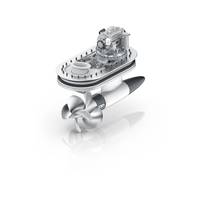
Marine driveline specialist ZF announced it will premier its new 4600 POD Propulsion System for large vessels for the first time in North American markets during this week’s Fort Lauderdale Boat Show (FLIBS).Engineered for large recreational and commercial vessels with planing and semi-displacement hulls measuring from 80 up to 130 feet, the 4600 POD Propulsion system first set sail in the Grande 26M motor yacht by Azimut last fall, but has been unavailable outside of European markets until now.
New Deere Marine Engine Ships
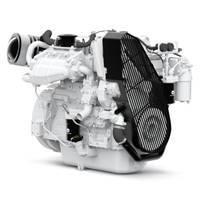
John Deere Power Systems is shipping the new PowerTech 4045SFM85 marine engine to boat owners and builders. The manufacturer touts the PowerTech 4045SFM85's power-to-weight, torque and compact size, saying it is suited for planing and semi-displacement hulls.The PowerTech 4045SFM85 engine has two ratings:-- M4 rating with 205 kW (275 hp) at 2600 rpm and-- M5 rating with 235 kW (315 hp) at 2800 rpm. These ratings are ideal for light-duty commercial vessels, high-speed governmental applications and high-speed pleasure crafts.
John Deere Rolls Out Trio of Marine Engines
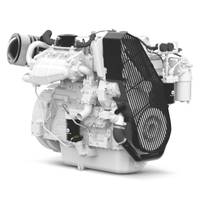
John Deere Power Systems has expanded its lineup with three new marine engines available for order from early 2018. The new 4.5L PowerTech 4045SFM85 offers high power to weight ratio for repowering and new vessel construction, and is ideal for planing and semi-displacement hulls, the manufacturer said. It has two ratings for light-duty commercial vessels, high-speed governmental applications and high-speed pleasure craft, which includes an M4 rating with 205 kW (275 hp) at 2,600 rpm and M5 rating with 235 kW (315 hp) at 2,800 rpm. The 4045SFM85 propulsion engine ratings will meet U.S.
Torqeedo to Showcase Cruise Engine at Seawork
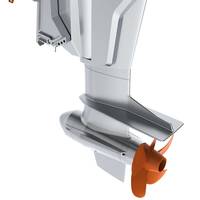
Torqeedo will debut its innovative new electric motor at this year’s Seawork International. The new generation, the Cruise 10.0R, is equivalent to a 20HP combustion engine. It boasts 12kW peak power, 10kW continuous power and a voltage level of 48V to deliver impressive, emission-free performance at speeds of up to 17.2knots (31.9km/h). The Cruise 10.0R weighs 47.2kg in its smallest variation and features a powered tilt function, alongside a maximum RPM standing at 1,400RPM, and 315lbs of static thrust.
AAM to Construct USACE Survey Catamaran
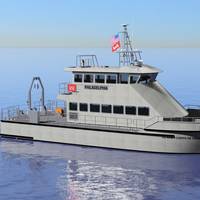
All American Marine, Inc. (AAM) was recently awarded a contract by the U.S. Army Corps of Engineers (USACE) for the design and construction of a new hydrofoil supported aluminum catamaran survey vessel. The vessel will primarily perform survey missions and some dive operations in support of dredging work planned within the Corps’ Philadelphia District. USACE has designated that the new catamaran will replace the aging survey boat, Shuman, which currently fills the mission critical role. The 68’ x 26’ custom aluminum catamaran will be designed by Teknicraft Design, Ltd.
USACE Orders Foil-assisted Survey Catamaran
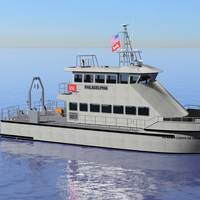
The U.S. Army Corps of Engineers (USACE) has awarded a contract to All American Marine, Inc. (AAM) for the design and construction of a new hydrofoil supported aluminum catamaran survey vessel. The new vessel will replace the aging survey boat, Shuman, to primarily perform survey missions and some dive operations in support of dredging work planned within the Corps’ Philadelphia District. The 68- by 26-foot custom aluminum catamaran will be designed by Auckland, New Zealand firm Teknicraft Design, Ltd., for whom AAM is the exclusive in North America builder.
HydroComp NavCad Released
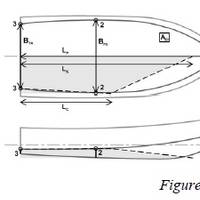
HydroComp NavCad is software for resistance and propulsion that can be found in the toolbox of naval architects and marine professions from around the world. First introduced in 1988, NavCad has undergone numerous upgrades in its 25-year history, but HydroComp says none of the previous upgrades are more significant than those found in this newly released version of NavCad. More than just an upgrade for current users, the new NavCad establishes a framework for ongoing feature development and improvements in the user experience. The design for this framework was first sketched out in early 2010.
Fuel Efficiency, Reduced Emissions for Maritime
Ferries and ocean going vessels can now sail more efficiently, save fuel, and reduce their CO2 emissions by using the Automated Draft Indicator System (ADIS). Weir-Jones Engineering Ltd. has recently released the third generation of this innovative marine technology. ADIS defines the position of the static water plane relative to the vessel. In this way, the position of any part of the ship relative to the water plane can be accurately determined. Based on these measurements, the position and orientation of the vessel including the draught, freeboard, heel and trim are precisely established. The calculations are carried out in real-time and these parameters are continuously updated and displayed.
First Self-Sufficient Zero Carbon Life Support Vessel (LSV)
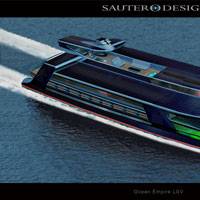
The Ocean Empire LSV (life support vessel) is a 144.3-ftSolar Hybrid Superyacht with two Hydroponic farms and fishing facilities to harvest the sea. Her solar powered propulsion systems and all the hotel amenities of a luxury global voyager are supplied by harnessing 3 major sources of sustainable of energy. The first and foremost source of energy is from the Sun which powers Solar Cells (covering the entire surface of the vessel) while at the same time illuminating 2 Hydroponic farms.
Transonic Hull Technology for Offshore Vessels
Hydrodynamics theory establishes that wave making resistance of displacement hulls originate from their body shape, especially from shoulders, midbody, and rear quarter curvatures of their waterplane at the water-air interface. These curvatures create bow waves, midbody troughs, and stern waves, which set the “hull speed” limit when the distance between bow and stern wave equal the boat’s length (speed/length ratio 1.34). Above hull speed, resistance grows at a high exponential rate. Transonic Hull (TH) technology eliminates this problem by using a slender triangular waterplane with apex at the bow, and rectilinear sides, free of curvatures, extending from bow to a maximum beam at the stern. This shape also generates the sharpest possible entry angle at the bow.
U.S., Spain Team To Develop New Warship
Proving the depth of efforts to internationalize business, the Advanced Frigate Consortium (AFCON) announced its intention to design, develop and market a new class of corvette-size ships to meet the emerging needs of international navies. The main players in the consortium include IZAR of Spain, Lockheed Martin Naval Electronics & Surveillance Systems and General Dynamics Bath Iron Works of the U.S. The corvette ship class will be designed with advanced platform, propulsion and combat systems including superior anti-air, anti-surface, and anti-submarine warfare capabilities. The AFCON team will work with international navies to design and develop an affordable, high-performance warship tailored for use in a nation's anti-air, anti-submarine, and anti-surface warfare operations.
Navy to Christen New Guided Missile Destroyer Bainbridge
The newest Arleigh Burke class guided-missile destroyer, Bainbridge (DDG 96) was christened on Nov. 13 at Bath Iron Works, Bath, Maine. John Young will deliver the ceremony's principal address. grandfather. of champagne across the bow to formally christen Bainbridge. Bainbridge who served in the Navy from 1789-1833. powered cruiser USS Bainbridge (DLGN-25, later CGN-25), 1962-1997. authorized by Congress. Strategy. subsurface battles simultaneously. 21st century. Cmdr. John M. accommodations for 380 officers and enlisted personnel. Bainbridge is being built by Bath Iron Works. 511 feet, a waterline beam of 59 feet and a navigational draft of 33 feet. knots. Power Plant: Four General Electric LM 2500-30 gas turbines; two shafts, 100,000 total shaft horsepower. Aircraft: None.