
Great Ship - SK Supreme
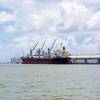
Samsung Heavy Industries Co. is scheduled to deliver by year's end, the largest size LNG carrier of GTT Mark-III membrane type and is scheduled to deliver two more vessels within 2000. Supreme, a 138,000 cu. m. LNG Carrier has been designed and constructed with the regulation of ABS and KR classification societies and the membrane cargo containment system developed by GTT (Gaz Transport & Technigaz) in France.
The cargo tanks are protected by a complete double side/bottom, cofferdam between each tanks and trunk at topside. For the hull and cargo containment system of cargo tank, Dynamic Load Analysis and extended fatigue analysis have been carried out to ensure the vessel's high reliability and long lifetime.
Cargo will be carried at -163 degrees C in the near atmospheric pressure with an insulation of 250 mm and membrane of 1.2 mm thick corrugated stainless steel sheet.
The GazTransport & Technigaz Mark-III system offers a low boil-off rate, in this case 0.15 percent/day of total cargo volume. Each cargo tank is fitted with two 1,700 cu. m. /h submerged centrifugal pumps, which are capable of unloading cargo within 12 hours. Cargo loading is carried out by shore-based pumps, after the tanks have been pre-cooled by LNG spray. Vapor produced during this process is returned ashore through the ship's high-duty compressors. Boil-off gas generated on voyage is heated and delivered as fuel gas to the main boiler by a low-duty compressor and boil-off gas heater.
An elevated walkway over the tanks affords access from the Centralized Administration and Control Center (CACC), located at the fourth tier level of accommodation deckhouse the wheelhouse, to the compressor room and deck. The CACC provides a central command station for cargo and ballasting operations, as well as monitoring, remote control of the propulsion plant, integrated automation and shipboard management systems.
The propulsion machinery comprises a 39,500 SHP Kawasaki steam turbine set driving a fixed propeller through a double reduction gearbox. The vessel's service speed stands at 20.8 knots with a 21 percent sea margin. Steam is generated by two Kawasaki boilers, capable of burning fuel oil, boil-off gas or a combination of both. Electrical power is derived from two turbo-alternators, each producing 3,450 kW, and a 'stand-by' 3,450 kW diesel-driven set.
Fire safety measures include dry powder and water spray for the cargo tank areas, and a water spray for the deckhouse front. Accommodation is provided for 48 persons.
Mooring arrangement and hull parallel body have been especially designed to suit the cargo loading/unloading at worldwide LNG terminals. Cargo cooling, also loading and unloading operations will be done, utilizing two Atlas Copco high duty compressors (32,000 cu. m. /h), a main vaporizer (21,300kg/h) and two heaters (1,560 kW), while forced boil-off, and the handling of gas fed to the main propulsion boilers, is served by two ATLAS COPCO compressors (8,500 cu. m. /h), a forcing vaporizer (7,000 kg/h) and a combined heater (540 kW). Inerting of the insulated space and cargo tanks is by means of two Permea nitrogen generators (90 m3/h) and a MOSS inert gas generator (14,000 cu. m. /h). A particular feature of design is the adoption of a single control room for engine room and cargo spaces. The high degree of automation fitted includes an operating control conditions, optimization of ship and machinery control conditions, ship management and vibration monitoring. A distributed control system incorporates four twin and three single workstations, with electronically self-contained screens capable of controlling any ship function, provided the operator presents the correct badge. Also included are 30 main and 70 submimic boards. New insulation material such as reinforced polyurethane foam and triplex are applied, having excellent quality and reliability, and fabricated by well-established Korean subcontractors. Gas trials have been successfully fulfilled in Korean LNG terminal (Incheon) this past November. Samsung began to invest and develop LNG technology in 1986, and acquired the technologies of engineering and construction from GTT in 1990.