Houston Ship Channel Project Complete
HOUSTON -- The Port of Houston Authority
(PHA) last Thursday welcomed congressional leaders, the U.S. Army Corps
of Engineers (USACE), and more than 300 other invited guests to
celebrate the completion of the widening and deepening project expected
to further fuel the port's remarkable growth.
"This project has benefited from a great home-team," said PHA Chairman
Jim Edmonds. "The support of our partners in Congress and the
Legislature has been extraordinary to keep our port safe and our
economy growing," he said.
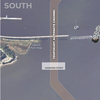
Aboard the pilot vessel Bayou City a small group of officials cut a
ribbon stretched 150 feet across the channel. Owned by the Houston
Pilots Association, the vessel sailed from the port's Barbours Cut
Terminal to the Fred Hartman Bridge (TX 146) and was overlooked by
guests onboard a paddlewheeler, The Colonel.
"From streamlining the control of the Port of Houston Authority to
providing funding for us to partner with the Corps of Engineers, local
officials have worked hard for decades to make the project a reality
today," said Tom Kornegay, Executive Director of the Port Authority.
Envisioned more than 30 years ago, the project reduces collision and
oil-spill risks in the Houston Ship Channel by widening it to 530 feet
(from 400 feet) and deepening the channel to 45 feet (from 40 feet).
Greater capacity was also provided by the addition of barge lanes
constructed on either side of the channel to a depth of 12 feet to
allow slower barge traffic to navigate the channel.
In addition to enhancing safety and increasing capacity, the deepening
and widening project also helps protect water and air quality. By
reusing materials from Galveston Bay in Galveston Bay, the Port of
Houston Authority and the U. S. Army Corps of Engineers have taken a
precedent-setting role in improving water and air quality.
"Projects like Redfish Island, Goat Island and Evia Island are all made
possible through the re-use of the dredged material," said Chairman
Edmonds. "The port authority takes seriously its stewardship of the
environment and its responsiveness to the community."
The creation of more than 4,250 acres of marshland using dredged
materials from the channel is managed under a plan created by the
Beneficial Uses Group (BUG), a coalition of local, state, and federal
government agencies formed in 1990. The largest wetland creation effort
of its kind in the nation, the BUG Plan is also one of the most
successful. Members of the BUG include Port of Houston Authority, U.S.
Army Corps of Engineers, National Marine Fisheries Service, Texas
General Land Office, Texas Parks and Wildlife Department, U.S.
Environmental Protection Agency, U.S. Fish and Wildlife Service, and
U.S. Natural Resources Conservation Service.
While on-going channel maintenance is financed entirely by the federal
government, channel deepening projects are cost-shared between local
sponsors and the federal government. The total federal and non-federal
cost of this project is $705.23 million. The Port of Houston Authority,
as the local sponsor, is contributing its share of the non-federal cost
from bonds approved by Harris County voters in 1989 by a margin of
nearly two to one.
The Port of Houston Authority owns and operates the public facilities
located along the Port of Houston, the 25-long complex of diversified
public and private facilities designed for handling general cargo,
containers, grain and other dry bulk materials, project and heavy lift
cargo, and other types of cargo. Each year, more than 6,600 vessels
call at the port, which ranks first in the U.S. in foreign waterborne
tonnage, second in overall total tonnage, and sixth largest in the
world. The Port Authority plays a vital role in ensuring navigational
safety along the Houston Ship Channel, which has been instrumental in
Houston's development as a center of international trade. The Barbours
Cut Container Terminal and Central Maintenance Facility are the first
of any U.S. port facilities to develop and implement an innovative
Environmental Management System that meets the rigorous standards of
ISO 14001. Additionally, the port is an approved delivery point for
Coffee "C" futures contracts traded on the New York Board of Trade's
Coffee, Sugar & Cocoa Exchange.