
Port of Tacoma Deepens Sitcum Waterway
Keeping an eye to its future, the Port of Tacoma has started a new waterway-deepening project that will assure that the Pacific Northwest's largest container port will continue to attract
the world's largest container ships.
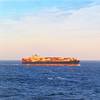
"We already serve Maersk Sealand's S-Type container vessels -- the world's largest," said Jack Fabulich, President of the Port of Tacoma
Commission, adding that these Maersk container ships, at 380 yards (347-meters)
long, are expected to be eclipsed by even larger ships in the near future.
"We feel it is critical that the Port of Tacoma remain a step ahead of our competitors and be able to accommodate these large vessels -- fully
loaded -- at both high and low tides."
The Port of Tacoma has a naturally deep harbor that does not require maintenance dredging. At low tides, however, some of these very large
ships cannot be fully laden; so Seattle-based Manson Construction is deepening the
Sitcum Waterway, already at 46-48 ft., to a depth of 51 ft.
The $1.024 million contract calls for approximately 170,000 cubic yards of
material to be removed over a five- to six-week period. Manson will operate 24 hours a day, seven days a week using a 24-cubic yard clamshell
bucket to remove material, which is barged to and deposited at a Department of Natural Resources-approved site in Commencement Bay (approximately 500 ft. in depth).
The Sitcum Waterway was dredged to its current depth during 1994 environmental remediation dredging. The sediments of this project
allowed a 25-acre expansion of the Maersk-Sealand Terminal (APM Terminal) in 1996.
Today, the Sitcum Waterway serves three significant terminal
operations:
Maersk Sealand Terminal (APM Terminal): Calling at this terminal is Denmark-based Maersk Sealand and vessels operated by CSX Lines, a domestic
container carrier serving Alaska, Hawaii and Guam. The facility boasts 132 acres (53 hectares) and two berths totaling 2,200 ft. (484 meters).
Four with 18-container-wide outreach and one crane with a 14-container outreach load and unload containers. This facility offers immediate access to the Port's South Intermodal Yard.
Husky Terminal (Terminal 7, Berth D): Three cranes with 14-container-wide outreach on this 1,000-foot (305-meter) berth serve container ships operated by Japan-based "K" Line. The terminal is directly adjacent the Port's
North Intermodal Yard; containers move between the terminal and the intermodal
yard without leaving Port property.
Terminal 7 (Berths A, B and C): With 2,700 ft. (823 meters) of berth space, this Port-operated terminal is used for breakbulk shipments, RoRo
cargoes and heavy lift/project cargoes. The facility features two cranes with 14-container wide outreach (Berth C) and a bulk materials crane (Berth B). With a rail spur on the dock, there is easy access to the Port's
North Intermodal Yard.