Report: Diesel Power Key to Maritime Industry
Diesel powers the American economy -- including almost the entire commercial maritime fleet. This is the conclusion of an extensive study conducted by Charles River Associates and released by the Washington based Diesel Technology Forum. In addition to cargo ships, tankers, tugs, and towboats, diesel powers 94% of all freight shipments, 85% of all public transit buses, two-thirds of all farm equipment, and all heavy construction equipment. Forum representatives are carrying this message to the "Conference on Marine Vessels and Air Quality" being held in San Francisco on February 1st and 2nd.
"Now, for the first time, we have a well documented and quantitative report, that defines diesel's critical role in the economic fabric of the nation and in the commercial marine industry in particular. The diesel impact is enormous, and in some cases irreplaceable," stated Allen Schaeffer, the Forum's executive director. "The current success of the maritime industry, whether it be on the Great Lakes, rivers or the high seas, is tied to the increased use of modern diesel power. Diesel engines of all sizes are used for prime propulsion power, container cranes and lifts, loaders, pumps and other related machinery, both on vessels and land based support facilities."
"It is essential, as maritime leaders meet to discuss the impact of ship emissions on air quality that we understand the importance of the diesel engine to the maritime industry," stated Schaeffer. "Because diesel engines are essential to cost-effective worldwide shipping, it is a technology worth investing in," he added.
The Diesel Technology Forum members are among the leaders in the movement to reduce emissions from all types of diesel engines. Representatives of the international shipping industry are currently attending a conference in San Francisco, sponsored by the EPA and more than 20 governmental and maritime agencies and associations, to discuss the key issues of marine vessels and air quality."
"Modern diesel technology is poised to meet the clean air challenge and cooperation among all the stakeholders can bring about positive results," said Schaeffer. "Retrofitting marine engines with the latest pollution control devices is part of the U.S. Environmental Protection Agency retrofit demonstration project. Tremendous advances are occurring in clean diesel technology each day that will provide an increasing number of solutions for marine operators."
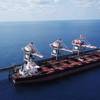
In 1997, 1,921 establishments were engaged primarily in maritime transportation. These entities employed 73,000 individuals and had a payroll of $2.8 billion. Water carriers moved 563 million tons of cargo worth $76 billion in single-mode movements and 113 million tons of intermodal freight worth $10 billion. Nearly all of the bulk carriers that transport oil, ore, wheat and other goods are diesel powered. So are the containerships that transport the majority of all manufactured imports and exports. These ships utilize the largest diesel engines made.
The dominance of the diesel engine in powering ocean-going ships reflects improvements in the engines over the last few decades. In the 1970's a significant number of ships were powered by steam turbines. But during the 1980's and 1990's, diesel engines swept the field, because they permitted substantial savings in fuel costs. American President Lines next generation of containerships, the C-10s, are powered by diesels, and achieved a 60% savings in fuel use over the steam turbine-powered C-8s. The last edition of Containerisation International Yearbook, which lists all container vessels in commercial service or under construction, reveals that only several hundred of the over 7,000 containerships in service were powered by steam turbine engines.
Approximately, 8% of the country's total freight tonnage travels by barge through the 12,000 miles of inland waterways. A total of 650 million tons of freight including 60% of the nation's grain exports, 24% of its chemical and petroleum shipments, and 20% of its domestic coal are moved through this network -- all propelled by diesel power. The workhorse of the inland waterways is the diesel-powered towboat. These towboats are in essence a hull wrapped around one or more huge and extremely powerful diesel engines. The over 5,000 towboats in the towboat fleet generate a total of 9.4 million horsepower. For this application, there are no viable alternative power sources that provide the efficiency, fuel economy, and power as does the diesel engine.