Test Site Validates Navy’s New Power System
By Edward Lundquist, Senior Science Advisor, Alion Science and Technology
The surface combatant Integrated Power System (IPS) propulsion Engineering Development Model (EDM) for the U.S. Navy’s new Zumwalt-class DDG 1000 destroyer is being tested at the Land-Based Test Site (LBTS) at the Ships Systems Engineering Station, Philadelphia, PA.
The new destroyer will be an all-electric ship. Unlike conventional arrangements where the installed prime mover devotes power to main propulsion, the Zumwalt-class ships will have two large gas turbine generators and two smaller ones that provide power that can be used for propulsion, weapons or ship services. Efficient power management makes the ship’s installed power available to all of the electric loads throughout the ship.
The LBTS in Philadelphia is currently configured with one Main Turbine Generator Set (MTGS) powered by a Rolls Royce MT30 (based upon the Rolls Royce “Trent” engine that powers the Boeing 777 airliner) as well as a smaller Rolls Royce 4500. The ship will have two MT30s and two 4500s.
The marinized MT30 has 80% commonality with the Trent 800, but is shock-mounted and has different blade coatings for operation in a saltwater environment.
The Zumwalt’s motor-generators can provide either AC or DC power that can be adapted for propulsion, hotel services and combat systems. This provides a more efficient and flexible electrical propulsion and distribution system throughout the ship.
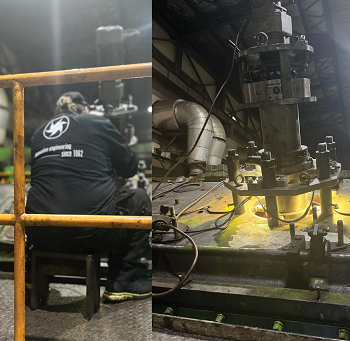
The Navy has already tested the 18-megawatt advanced induction motor (AIM), which will be the baseline for DDG 1000, produced by Alstom ConverTeam. This is essentially the same system being installed on the Royal Navy's new Type 45 destroyer. Now engineers at the LBTS are installing a 36-megawatt permanent magnet motor (PMM), developed by DRS Technologies, for testing. The PMM was originally envisioned for the DD(X) program (now DDG 1000), but technical issues caused delays. Those problems have been corrected and the PMM will be run at full power for several months to ensure that it meets expectations. The Navy remains very interested in using PMM technology later, perhaps as one of the spiral insertions in a future ship. PMM has greater “power density”—meaning it's smaller and lighter for the same amount of power. The test program validates key system metrics such as torque, speed and power output, and specific fuel consumption for the various configurations.
The IPS system is fully automated with little operator intrusion. The testing at the LBTS will validate that the DDG 1000 IPS will automatically take appropriate corrective action if there is a malfunction or casualty without an operator telling it what to do.
At full power, DDG 1000 will achieve speeds in excess of 30 knots. If one of the main turbines is lost, the plant can be isolated and still achieve 27 knots. Normal station-keeping can be accommodated with the two small turbines.
The IPS features Integrated Fight Through Power (IFTP), a fully automated DC Zonal Electric Distribution System (DC ZEDS) that provides flexible, reliable, high quality power to all shipboard loads.
The combat value of an electric ship goes well beyond efficiencies and signature reduction. Once on station, a warship cruises at a reduced power. When not needed, one or more engines can be taken offline to save fuel. At lower speeds, Zumwalt has a surplus of power that can be made available as needed. The Navy wants to harness this power availability for new weapons including directed energy weapons or rail guns that may eventually find their way aboard DDG 1000 or similar combatants. The power previously trapped in the propulsion train can now be directed to enhance combat capability and mission flexibility.
A new Arleigh Burke-class guided missile destroyer (DDG) joining the fleet today has four gas turbines for propulsion (two per shaft) and three smaller ship service gas turbine generators for the combat systems and hotel services. About 90% of its total installed power is used for propulsion and is unavailable for other requirements, such as sensors or weapons.
The emphasis today is to develop smaller, lighter and more efficient engines, generators and motors. The distributed nature of the DDG 1000 engineering plant offers flexible ship design. Pods and azimuthing thrusters were considered for Zumwalt, but ruled out because of their size.
Distributed power is desirable for a warship because of survivability. Engines can be placed in various locations, not just low in the ship in what are traditionally engineering spaces. If one of the engines gets knocked out in one part of the ship, that part of the distribution system can be isolated, and power can still be generated and distributed throughout the rest of the system. However, space, weight and exhaust considerations will result in a fairly conventional arrangement in DDG 1000.
Edward Lundquist is a retired U.S. Navy captain and a senior science advisor with Alion Science and Technology.