USS Boxer, Counterpiracy in Gulf of Aden
In a show of international sea power in the Gulf of Aden, seven nations representing three task forces coordinated efforts to pursue a skiff after the pirates on board opened fire on a German oiler, the Federal German Ship (FGS) Spessart, March 29.
At approximately 3 p.m. local, FGS Spessart, reported they were being attacked by pirates who may have mistaken the naval supply ship for a commercial merchant vessel. An embarked security team aboard the ship returned fire on the suspected pirates during the initial attack.
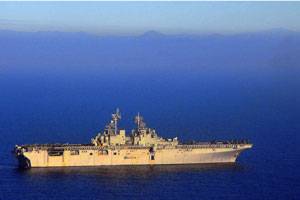
Subsequently, Spessart pursued the skiff while providing additional details of the attack to a variety of international naval vessels operating in the area. A number of naval ships and aircraft joined the pursuit, including the Dutch frigate HNLMS Zeven Provincien, an SH-60B helicopter assigned to the Spanish warship SPS Victoria, a Spanish P-3 maritime patrol aircraft, two Marine Corps helicopters from the Combined Task Force (CTF) 151 flagship USS Boxer (LHD 4) and the European Union's CTF 465 flagship, the Greek frigate HS Psara.
Supported by an AH-1 Cobra attack helicopter and a UH-1 Huey assigned to Marine Medium Helicopter Squadron 163 (Reinforced), "Evil Eyes," embarked aboard Boxer, the international naval forces contained the armed suspects until Psara arrived with a German boarding team. Upon boarding the skiff, the team found seven suspected pirates and their weapons.
The suspected pirates were disarmed and transferred to the German frigate Rheinland-Pfalz where they will remain until a final determination is made regarding potential prosecution.
While this event showcased the incredible international naval capabilities operating in the Gulf of Aden, it also highlighted the complexity of counterpiracy operations. The crew of Spessart and the embarked security team provided the critical first line of defense, utilizing defensive measures that are essential for all ships operating in the region.
Moreover, nearly five hours transpired between the time Spessart's armed security team thwarted the initial attack and when an armed boarding team was within range of the pirate skiff. In the interim, armed coalition aircraft kept the suspected pirates from getting away.
This incident in the Gulf of Aden happened at a time when other pirates have been operating well off the eastern Somali coast.
The area off the coast of Somalia and Kenya when combined with the waters of the Gulf of Aden equals more than 1.1 million square miles, roughly four times the size of Texas or the size of the Mediterranean and Red Seas combined. In a region this large, merchant mariners must often serve as the first line defenders against pirates because naval forces will likely not be close enough to respond.
(Source: Navy News Service)