
USS George Washington Investigation Complete
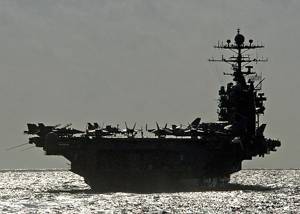
Commander, U.S. Pacific Fleet, Adm. Robert F. Willard, issued a final endorsement to the investigation of a fire that occurred aboard USS George Washington (CVN 73) on May 22. As directed by Adm. Willard, Commander, Naval Air Forces Pacific, Vice Adm. Thomas J. Kilcline, Jr., relieved the Commanding Officer of USS George Washington (CVN 73), Capt. David C. Dykhoff, today due to a loss of confidence in his ability to command and his failure to meet mission requirements and readiness standards.
As directed, Kilcline also relieved the George Washington Executive Officer, Capt. David M. Dober, for substandard performance.
Capt. J.R. Haley, previously assigned as Deputy Chief of Staff to Commander, U.S. Pacific Command, has taken command of . Haley commanded the nuclear powered aircraft carrier USS Theodore Roosevelt (CVN 71) from June 2005 to January 2008.
Capt. Karl O. Thomas, who has been serving as Executive Officer of USS Dwight D. Eisenhower (CVN 69) since July 2007, has been reassigned as George Washington's executive officer.
The Chief of Naval Operations directed the Manual of Judge Advocate General investigation headed by the Commander, U.S. Pacific Fleet. The investigation determined that the likely cause of the fire was unauthorized smoking that ignited flammable liquids and other combustible material improperly stored in an adjacent space. The fire and the subsequent magnitude of the fire were the result of a series of human acts that could have been prevented. Specifically, the storage of 90 gallons of refrigerant compressor oil in an unauthorized space contributed to the intensity of the fire.
The fire, which occurred in an unmanned Auxiliary Boiler Exhaust and Supply space, took approximately 12 hours to extinguish due to the location and geometry of adjacent spaces and ventilation systems that created a chimney effect. Thirty-seven Sailors were treated for minor injuries incurred during fire fighting efforts, with one Sailor requiring treatment for first and second degree burns. Approximately 80 out of over 3,800 total spaces aboard the carrier were damaged by the fire.
The estimated cost of repairs to George Washington as a direct result of the shipboard fire is approximately $70 million. This includes cost for material and labor cost from the public and private sector ship repair activities.
Repairs to George Washington are nearly complete and she will depart , , on Aug. 21, with an arrival in expected in late September. George Washington's turnover with the U.S. Navy's last conventionally-powered aircraft carrier, USS Kitty Hawk (CV 63), will begin upon Kitty Hawk's arrival in on Aug. 7.