
Navy Evaluates Eco-friendlier Warship Gun
Press Release
Thursday, October 11, 2012
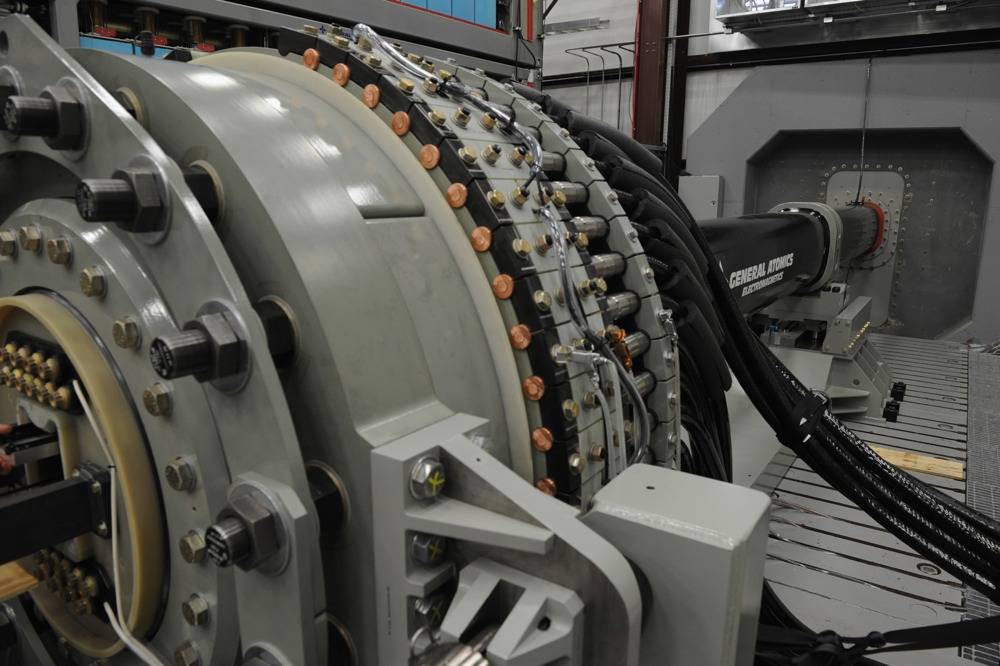
File Chemical Explosive-free Railgun
Chemical Explosive-free Railgun

The US Office of Naval Research's (ONR) Electromagnetic (EM) Railgun program is evaluating the second of two industry railgun prototype launchers.

The EM Railgun launcher is a long-range naval weapon that fires projectiles using electricity instead of traditional gun propellants such as explosive chemicals. Magnetic fields created by high electrical currents accelerate a sliding metal conductor, or armature, between two rails to launch projectiles at 4,500-5,600 mph. 


The Navy is pursuing development of the launcher system through two industry teams -- General Atomics and BAE Systems -- to reduce risk in the program and to foster innovation in next-generation shipboard weapons.

"It's exciting to see how two different teams are both delivering very relevant but unique launcher solutions," said Roger Ellis, EM Railgun program manager.

General Atomics has delivered its prototype launcher to Naval Surface Warfare Center (NSWC) Dahlgren Division, where engineers have engaged in a series of tests similar to the evaluations conducted on the prototype demonstrator made by BAE Systems that arrived Jan. 30. 

"We're evaluating and learning from both prototype designs, and we'll be folding what we learn from the evaluations into the next phase of the program," said Ellis. 


The EM Railgun laboratory demonstrator based at NSWC-Dahlgren Division fired a world record setting 33-megajoule shot in December 2010. One megajoule of energy is equivalent to a 1-ton car traveling at 100 miles per hour.
Email AddThis Feed Button
Maritime Reporter May 2013 Digital Edition
FREE Maritime Reporter Subscription
Latest Maritime News    rss feeds

Technology

Mobdock Facilitates Onsite Underwater Ship Repair

In February, Hydrex diver/technician teams carried out underwater stern tube seal repairs on a 139-meter container vessel in Port Everglades, Fla., close to the company’s office in Clearwater.

BWT CASE STUDY: Hyde, PG & OSVs

While much of the focus on Ballast Water Management issues is on the big ship, blue water fleet, there is a growing large need for BWMS on large modern offshore vessels, too.

Odyssey to Open “SHIPWRECK!” Exhibit in Times Square

Odyssey Marine Exploration, Inc., will ring the Opening Bell at the NASDAQ MarketSite in New York on Thursday, May 23, 2013, at 9:30 a.m. to celebrate the grand

Navy

Austal-built JHSV 2 Completes Navy Acceptance Trials

Joint High Speed Vessel 'USNS Choctaw County' (JHSV 2) has successfully completed Acceptance Trials in the Gulf of Mexico. This milestone achievement involved

Northrop Get Navy 'Star Wars' Laser Contract

The U.S. Navy selects Northrop Grumman for the initial phase of the Solid State Laser Technology Maturation (SSL-TM) program. SSL-TM is a research and development project to mature solid-state,

Today in U.S. Naval History: May 21

Today in U.S.Naval History - May 21 1850 - Washington Navy Yard begins work on first castings for the Dahlgren guns 1917 - USS Ericsson fires first torpedo

Eye on the Navy

Today in U.S. Naval History: May 21

Today in U.S.Naval History - May 21 1850 - Washington Navy Yard begins work on first castings for the Dahlgren guns 1917 - USS Ericsson fires first torpedo

Today in U.S. Naval history: May 17

Today in U.S. Naval history - May 17 1940 - FDR announces plans to recommission 35 more destroyers 1942 - USS Tautog (SS-199) sinks Japanese sub, I-28; while

Today in U.S. Naval History: May 16

Today in U.S. Naval History - May 16 1820 - Congress becomes first U.S. warship to visit China 1919 - Three Navy flying boats begin first trans-Atlantic flight


mobi | rss feeds | archive | history | articles | privacy | contributors | top news | about us | copyright