

EU NAVFOR Piracy Update
EU NAVFOR hosted a press conference on 20 February 2012 to present an update on Operation ATALANTA, piracy off the Horn of Africa and a view towards future developments. The briefing was hosted by Operation Commander Rear Admiral Duncan L. Potts with Deputy Operation Commander Rear Admiral Rainer Endres and the NATO Deputy Chief of Staff Operations, Commodore Bruce Belliveau.
Countering piracy in the Indian Ocean is an international concern having become a sophisticated criminal business exploiting the geographic feature of the Gulf of Aden and the Arabic Sea. Every day 3 million barrels of oil and 50 per cent of the world’s container trade are at sea in this area constituting approximately 1 trillion US dollars in trade. The cost of piracy is a strategic concern; an NGO has recently estimated the cost at 7 billion US dollars per year, adding 1.68US dollars to every kilogramme of trade moved in the High Risk Area.
The mandate for EU NAVFOR – ATALANTA is the protection of vessels of the World Food Programme (WFP) delivering food aid to displaced persons in Somalia; the protection of African Union Mission on Somalia (AMISOM) shipping, the deterrence, prevention and disruption of acts of piracy and armed robbery and monitoring fishing activity off the coast of Somalia, seeking to disprove what is often said by suspected pirates, that they are only fishermen that have their fishing grounds denied.
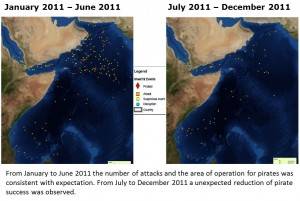
In 2011 the previously observed seasonal increase of pirated vessels in the autumn has been broken. While in the first quarter of 2011 pirates took 19 ships, in the remaining 9 months, they only took 6 ships.
The reason for the reduction is industry adopting “Best Management Practices for Protection against Somalia Based Piracy” (BMP) protective measures coupled with Private Armed Security Teams (PAST) embarking on merchant vessels and increased military presence and operations in the region.
In his briefing to journalists, the EU NAVFOR Chief of Staff, Captain Phil Haslam explained: “The final mile towards an attack on a merchant vessel needs to be crossed in the open, in manoeuvrable and fast skiffs. Denying pirates this capability by disrupting skiffs, pirates cannot press home their attack and have to return back to their beaches. And returning to the beach, maybe repeatedly, without weapons and other equipment investors have paid for to get a big return, must come at a cost for those failed pirates.”
Moreover, the continued coordination between EU NAVFOR, NATO and the Combined Maritime Forces (CMF) allows greater impact. “All forces are coordinated to disrupt piracy. The closest unit will react to a reported piracy attempt”, said Commodore Belliveau. Also, independent national warships and maritime patrol aircraft from China, India, Japan, Russia and a number of others others operate in the region to increase the overall counter-piracy capability.
EU NAVFOR is conducting a constabulary operation “Operating in this legal framework restrains what we can do”, said Rear Admiral Potts. “EU NAVFOR does all it can to tip the risk-reward-balance for pirates but every action has also to be assessed with a look not only to legality but also to the impact on the wider region as well. I will not order military action that could undermine efforts of the EU or UN and other actors in Somalia.”
Additionally, there are efforts in Somalia by the Transitional Federal Government and regional governments in Puntland and Galmadug to fight piracy on shore.
Prosecution Process
One priority for further development must be to focus on the legal finish. As constabulary operation EU ANVFOR ATALANTA seeks to deter and disrupt piracy. Worldwide over 1000 pirates, out of a community of approximately 3000-5000, have been prosecuted in 21 countries. Suspected pirates can be prosecuted by the flag states of attacked vessels, by regional states such as the Republic of Seychelles, Kenya or Mauritius to name but three, or any other third states which wish to exercise its jurisdiction over the suspected pirates or armed robbers. Suspected persons may not be transferred to a third State unless conditions relevant to international law, notably international law on human rights are met. In particular, no one shall be subjected to the death penalty, to torture or to any cruel, inhuman or degrading treatment.
Only when those channels of prosecution are closed, does EU NAVFOR and other anti-piracy forces consider releasing suspected pirates. Often the reason for releasing suspects is that there is no accuser. “The dhow community, which is often the victim with their crews held hostage and their ships being used as mother ships, does not wish to make a complaint when released, but go about their business and are unwilling to go to court therefore any case collapses at this stage”, said Captain Haslam.
A significant focus is also looking at the conditions on land which allows piracy to flourish. The military deals only with the symptoms: “Root causes of piracy are the lack of governance that allows for impunity and funding by investors to equip pirates to go to sea” said Rear Admiral Potts. Additional to humanitarian and development efforts towards eradicating the root causes of piracy, the European Union is planning for a new training mission in order to add to the fight against piracy off the Horn of Africa and the Western Indian Ocean. Regional Maritime Capacity Building (RMCB) would consist of two components addressing two main objectives: to strengthen the sea going maritime capacity of Djibouti, Kenya, Tanzania, and the Seychelles and to train and equip the Coastal Police Force in the Somali regions of Puntland, Somaliland and Galmudug, as well as train and protect judges in the Somali region of Puntland.
As long as the strategic conditions in Somalia do not change, piracy is not solved. “The anti-piracy forces have had some success in 2011, but all gains to date are reversible. Piracy is not over, the pirates’ intent is clear and they are as adaptive and agile as ever” said Captain Haslam. With $79.8 (from 25 Ransoms) in 2010, $146.2 Million (30) in 2011 and already $9.4 Million (2) earned in 2012, piracy remains for some, a successful criminal endeavour.