
BRAZIL: U.S. Find New Opportunities

While the U.S. economy may be in the doldrums, smart U.S. companies are looking increasingly to exports to help their bottom lines. A major market for U.S. exports is Brazil. This article examines new market opportunities in the oil and gas, shipbuilding and port infrastructure in Brazil, and identifies certain financing sources available to U.S. companies seeking to participate in these markets.
Brazil’s growth in recent years has been amazing. Over the past 5 years, real GDP growth in Brazil has averaged 4.3% annually (as compared to 1.3% annually in the U.S.), reaching 7.5% in 2010. This growth will only be enhanced as Brazil prepares to host the final games of the soccer World Cup in 2014 and the Summer Olympics in 2016. Brazil is investing heavily in new infrastructure ahead of the games, with a significant amount of that construction focused in the State of Rio de Janeiro. Rio State forecasts $102 billion in investments from 2011 through 2013, in such areas as oil and gas, energy, shipbuilding, steel production, ports and roads, sports complexes and hotels, and the environment. Investment in the State of Rio's oil and energy sectors alone is forecast at $75 billion. Brazil is also investing $2.7 billion in a Superport at Açu, to be completed in 2012 and forecast to handle 350 million tons a year.
Opportunities for U.S. Companies in Brazil's Maritime and Energy Markets
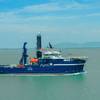
The boom in the Brazilian offshore oil and gas market, including a new market in pre-salt oil and gas reserves, is also providing multiple opportunities for U.S. maritime and energy companies. Petrobras, the partially state-owned oil and gas giant, is at the forefront of this growth. The company predicts investments of $108 billion in domestic oil & gas exploration and production by 2014, which will include the acquisition of 53 new drilling units, 504 support ships, 84 production platforms and 30 oil tankers. While Petrobras expects a “good portion of these can be expected to be placed with [Brazilian] companies,” there is room for U.S. companies to take advantage of this boom—and many are.
According to a recent study by Booz & Company cited by the Agência Nacional do Petróleo, Gás Natural e Biocombustíveis (ANP), the Brazilian petroleum regulator, there are either few or no Brazilian suppliers in approximately 80% of the equipment categories that will be procured for pre-salt development, particularly in the case of high-technology equipment. In addition, significant opportunities exist for a wide variety of service providers focused on the maritime and energy sectors, such as providers of subsea engineering and installation services and vessel support services.
Due to the Brazilian Government's strict local content policies, which are expected to become only more stringent over time, forward-looking U.S. companies may consider establishing production facilities in Brazil, either alone or in partnership with Brazilian companies. Many U.S. companies are already on the ground in Brazil, such as Baker & Hughes, FMC and General Electric, to name a few. This trend is creating additional opportunities for U.S. companies all along the maritime and oil & gas supply chain, such as those engaged in design and engineering, materials fabrication, and vessel construction.
Financing Opportunities for U.S. Companies
The U.S. Government offers a variety of financing programs, which can support U.S. companies intending to do business with Brazil. Such programs include those offered by the U.S. Maritime Agency (MARAD), and the Export-Import Bank of the United States (Eximbank). Other U.S. Government financing programs potentially available to U.S. exporters, not discussed in detail in this article, are offered through the Small Business Administration and the Overseas Private Investment Corporation (OPIC).
Title XI Loan Guarantees for U.S. Shipbuilding Exports to Brazil
The Title XI loan guarantee program administered by Marad can be used, in certain circumstances, to finance U.S. shipbuilding for the export market. In March 2011, MARAD approved a $241 million loan guarantee to Boldini, S.A. for the construction of five platform supply vessels expected to be chartered to Petrobras and built at Eastern Shipyard’s facility in Panama City, Florida. This contract is expected to bring 300 new jobs to the Panama City, FL area, as well as enhance our balance of trade with Brazil, which is already in positive territory.
The terms of the Title XI program are exceedingly favorable, as long as it continues to exist, and include up to 25 year financing and guarantees of up to 85% of the amount of the loan. However, the Title XI program may be of limited value to U.S. shipyards going forward. The House has proposed a rescission of most of the remaining Title XI funds while the Senate is looking to rescind only one-half.
Eximbank Financing for U.S. Exports to Brazil
Eximbank is actively implementing the President’s stated goal of doubling U.S. exports by 2014, and looking to assist exporters to Brazil. According to Fred Hochberg, the Chairman of Eximbank, “Brazil is a powerhouse among South American economies and offers tremendous opportunities for U.S. exporters in many sectors.”
Eximbank offers several forms of financing, including loan guarantees, direct loans, letter of credit guarantees, and insurance. Generally, Eximbank guarantees are available to support 85% of the contract price of eligible U.S. goods and services with financings of up to 15 years (or 18 years in certain exceptional circumstances). In April 2009, Eximbank offered to consider up to $2 billion in financing to secure the purchase of U.S. goods and services by Petrobras. Eximbank estimates that the financing will help create and maintain over 16,000 U.S. jobs.
To date, Eximbank has approved a request from JP Morgan Chase Bank, N.A, acting as the lender, for an Eximbank guarantee of a $308 million loan facility for Petrobras, under Eximbank's medium-term loan guarantee program. According to Eximbank, this facility was made operative in May, 2011, and is being used to finance Petrobras’s general purchases of U.S. manufactured oil and gas equipment and services. Exports by approximately 150 companies are being supported by this loan guarantee, including those by Dresser Rand, FMC Technologies, and National Oilwell Varco.
In March 2011, Eximbank announced that it had authorized $1 billion in export credit financing for the State of Rio de Janeiro. As noted above, this is the staging area for many oil and gas projects as well as the focus of infrastructure development in anticipation of the World Cup and Olympics. This financing could be used to support U.S. exporters providing goods and services related to marine port or oil and gas infrastructure construction in the State of Rio.
Eximbank can also support working capital financing for exporters of U.S. goods and services to Brazil through its working capital guarantee program, and can insure export receivables originated by Brazilian customers of U.S. exporters.
Conclusions
Smart U.S. companies are looking to rapidly growing overseas markets for their next sales. Eximbank is a major source of financing for these sales. Congress should reauthorize this agency and let more deals benefit U.S. companies. For those deficit hawks, it’s important to note that Eximbank does not get any U.S. tax dollars, but rather exists on fees and interest charges on all loan-related transactions. However, it does have to be reauthorized for FY2012, and legislation is presently pending in Congress to do just that. Reauthorization of Eximbank is strongly supported by the U.S. Chamber of Commerce and other business groups.
Congress should also stop and think about the potential growth in U.S. shipbuilding that the Brazilian market presents and encourage the Title XI program be used for this purpose. Finally, when considering infrastructure projects to finance in the U.S., we should not forget our own critical port infrastructure needs. Without a thriving port program, exports of U.S. goods and services to promising markets such as Brazil's will be adversely affected, undermining the Obama Administration's stated goal of stimulating the economy through growth in U.S. exports.
About the Authors
Joan M. Bondareff - [email protected]
Joan M. Bondareff, of counsel at Blank Rome, focuses her practice on marine transportation, environmental, and legislative issues. Email: [email protected], Tel: 202.772.5911
Ernest W. Chung - [email protected]
Ernest W. Chung, partner at Blank Rome, concentrates his practice in the areas of project finance and development, and has significant experience representing borrowers and lenders on transactions involving U.S. Eximbank products.
(As published in the December 2011 edition of Maritime Reporter & Engineering News - www.marinelink.com)