MAN & Maersk: Innovative Diesel Engine Partnership


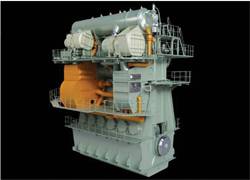 Graphic of the second-generation EGR system (orange) integrated with its host engine
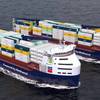
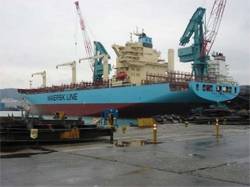
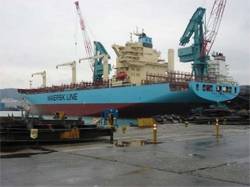 Library picture taken during the construction of a sister ship identical to the new building #2358
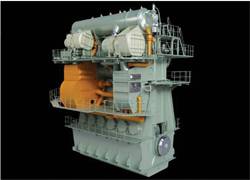
MAN Diesel & Turbo announced the first order for its second generation EGR system, to be applied aboard a Maersk Line container vessel – the 4,500-teu new building #2358. The system will be fully integrated with the vessel’s main engine, a two-stroke MAN B&W 6S80ME-C9 type to be built by Hyundai Heavy Industries’ engine & machinery division. The EGR system enables the meeting of the imminent IMO NOx Tier-III emission levels due to come into force by 1 January 2016. Søren H. Jensen, Vice President and Head of Research & Development at MAN Diesel & Turbo said: “We have taken an important step forward in the development of exhaust gas recirculation with the release of this second-generation system. This configuration will mirror the final design for our Tier-III NOx EGR engine programme. The main focus has been on integration of the entire EGR system into one unit which is a part of the engine as a charge-air cooler. The EGR unit comprises a cooler, a scrubber, a water mist catcher and a blower unit, and is designed to be fitted on the engine in the same way as a charge-air cooler. Since the first-generation EGR was tested in service, we have achieved significant techn ical advances as well as improvement in performance. We have optimised the performance of the EGR so that the system recirculates 40% of the exhaust gas so as to meet the Tier-III reduction criterion.”
The new EGR generation comprises a compact design that entails only minor changes to the engine outline, to the extent that the new engine type does not require any major design changes by shipyards. The new building #2358 from Hyundai’s shipbuilding division is in the C-class series of 22 container vessels ordered by the Maersk Line and will be delivered in early 2013. Upon delivery, the vessel will serve the trade route between East Africa and the Far East. For a test period of three years, the engine will be operated partly with IMO Tier III NOx emission levels.
Exhaust gas reduction Shipping is the most effective transport means of moving goods and accounts for over 70% of global tonnage. Generally, ships use HFO as fuel, which contains sulphur and which during combustion, forms NOx and SOx. However, the environmental effects of ship emissions are under increased focus and the UN is currently introducing regulation aiming at drastically reducing NOx and SOx emission levels over the next decade.
MAN Diesel & Turbo’s EGR system ensures full fuel flexibility, ranging from HFO to distillates and natural gas, and reduces NOx by directing part of the exhaust gas back into the engine’s scavenge air. This reduces the oxygen content of the air in the combustion chamber, thereby reducing the combustion temperature and, as a result, reduces the NOx formation. Tests at MAN Diesel & Turbo’s Diesel Research Centre, Copenhagen have shown that reaching the IMO’s forthcoming Tier III NOx emission requirements is possible with EGR in its own right.
The target group for MAN Diesel & Turbo’s EGR system is owners of ships of over 2,000 dwt, a segment that today comprises some 18,000-20,000 vessels operating globally. The EGR system offers great value and has a number of unique selling points, including its environmental performance, global seafaring flexibility, added resale value of ships, and its disposal with the requirement for daily maintenance.