
Ice Crushing Propeller Dynamics



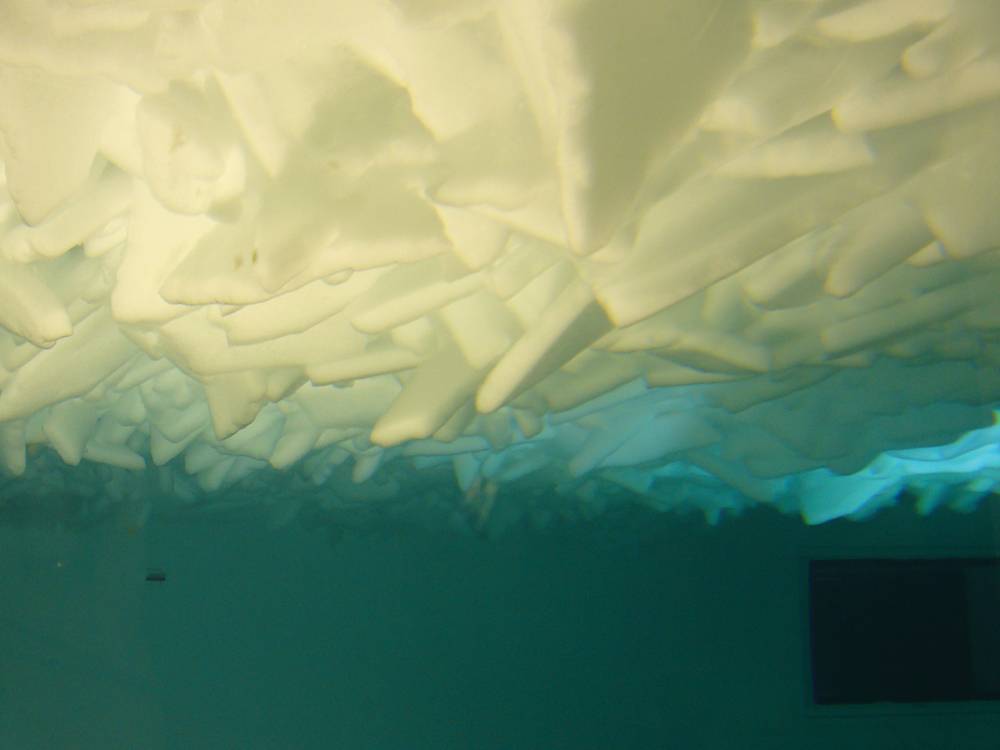
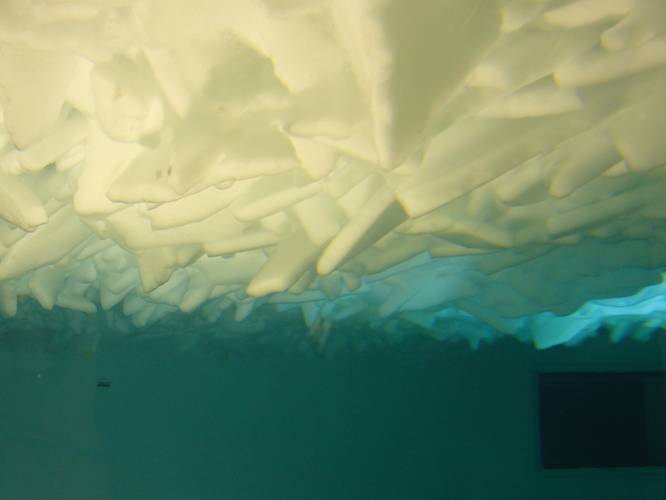 Modelled ice ridge seen from below.

When a captain of an ice-going vessel stands on the bridge looking at the enchanting world around him he wants to hear the comforting sound of ice smoothly being crushed by the heavily loaded propeller he is controlling. But the question is if the industry is ready – can our captain really enjoy his trip in ice covered waters – or is there still work to be done? Ops in the Arctic regions are intensifying as a result of more transportation through the northern route and due to increasing offshore, research and recreational activities. All these activities increase the need for more fundamental knowledge about ice loads on propulsors so better guidelines can be provided for the safe operation of ships in Arctic regions. The ice loads associated with operations in ice are fairly well documented for the Baltic Sea but for the new operational areas, such as the Polar regions, there are still many unknown factors. During the last three years the CRS working group PROPOLAR has been attempting to gain better insight into the practical operation of ice going vessels and it is investigating the fundamentals of propeller-ice interaction. The aim of the working group was to provide operational guidelines for propulsion systems and to improve the technical design guidance, specifically for azimuthing propulsors but also for propellers in general.
Podded Propulsors
Ice induced loads have been described in literature and they have been investigated in model and full scale tests but a clear definition and understanding of the most important physical phenomena are still lacking. The parameters that are most important for the dimensioning and operating of azimuthing propulsors in ice need to be better understood. At this moment, only a limited number of publications are available which relate to ice loads on an azimuthing propulsor, particularly when it comes to the pod housing.
In a bid to develop an analytical model to determine the ice loads on podded propulsors, analytical models based on the latest rules described in IACS were used. Formulations for PODs were derived by using the scarce full-scale data available. The selected methods were coupled with the use of more detailed measurements. Naturally, it would be preferable to do these measurements at full scale but due to limitations and constraints, this is rarely achievable but model tests represent an attractive alternative. However, measuring ice impacts at model scale faces some specific challenges. To determine the ice loads on a propeller, a model test setup was designed capable of measuring the highly dynamic forces and torque in all directions. This setup has been extensively calibrated and tested in controlled conditions. Finally, the setup was used for actual ice impact measurements in cooperation with AARC of Helsinki. The AARC hi-tech ice tank was used to measure propeller-ice impacts including synchronised, high-speed video recordings, which gave a unique insight into the propeller ice contact and the corresponding loads.
Captain Interviews
In parallel, interviews with captains of ice going vessels were done to map the major risks and challenges that are perceived and experienced by the individual operators. This helped gain insight from those with direct experience of ice operations in Russia, Finland, Sweden, the USA and the UK.
Typical topics of interest concerned the main risk elements such as voyage planning and preparation, which ship type and Ice Class is required but also the development of operational procedures for manoeuvres when operating in ice. Navigation in ice requires up-to-date information about the ice conditions, such as ice thickness and ice coverage. Modern ice-cover prediction systems, combined with satellite recordings, meteorological and oceanographic prediction models, enable optimal route planning in ice-covered regions.
The work of the PROPOLAR group is almost finished. The lessons learnt are implemented in daily routines and used to enhance research in the field of the scalability of ice failure mechanisms, as well as for the understanding of the fundamental physics of ice loads on propellers.
Gerco Hagesteijn is project manager at the Ships department of MARIN, the Maritime Research Institute Netherlands. Email: [email protected]
(As published in the March 2013 edition of Maritime Reporter & Engineering News - www.marinelink.com)