
Galileo Satellite SAR Package Activated
Press Release
Wednesday, January 23, 2013
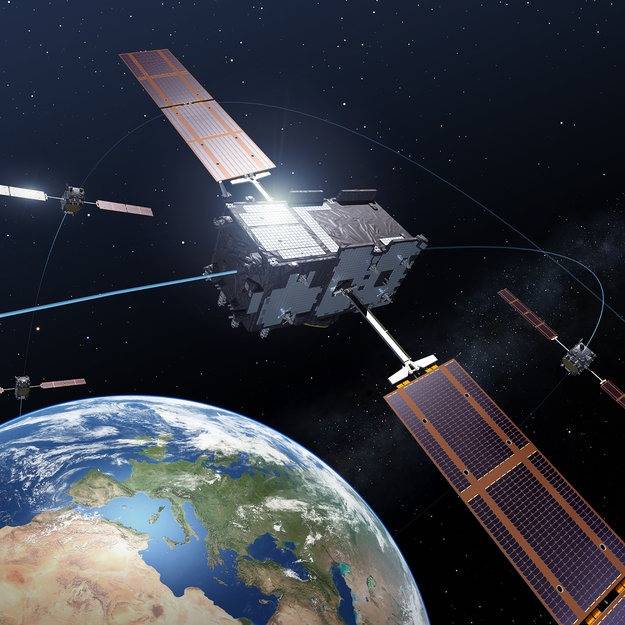
File Galileo in Transit: Photo credit ESA
Galileo in Transit: Photo credit ESA

Galileo’s search and rescue system (SAR) passes first space test to begin major expansion of the Cospas–Sarsat network.

The second pair of Europe’s Galileo navigation satellites – launched together on 12 October last year – are the first of the constellation to host SAR search and rescue repeaters. These can pick up UHF signals from emergency beacons aboard ships and aircraft or carried by individuals, then pass them on to local authorities for rescue.

Cospas is a Russian acronym for ‘Space System for the Search of Vessels in Distress’, with Sarsat standing for ‘Search and Rescue Satellite-Aided Tracking’. Ground stations – known as Local User Terminals – pinpoint the source of distress calls using signals relayed by participating satellites, then alert local authorities.

Once the satellites reached their 23 222 km-altitude orbits, a rigorous test campaign began. The turn of the SAR repeater aboard the third Galileo satellite came on 17 January. “At this stage, our main objective is to check the repeater has not been damaged by launch,” explains ESA’s Galileo SAR engineer Igor Stojkovic. The following day involved sending a signal to the repeater using the UHF antenna at ESA’s Redu Centre in Belgium, then picking up the reply from our L-band antenna.”

Redu’s antenna is 20 m in diameter, so the shape of the relayed signal was captured in great detail, out of all proportion to surrounding noise.
“We can precisely measure its power, the time the relay took and so on,” adds Igor.

More detailed system testing will follow, to completely prove this new type of SAR payload in orbit.

 

Email AddThis Feed Button
Maritime Reporter April 2013 Digital Edition
FREE Maritime Reporter Subscription
Latest Maritime News    rss feeds

Technology

Offshore Wind Spend to Average $21B per year

Douglas-Westwood (DW) forecast offshore wind installations averaging 3.2 GW per year over the next ten years with capital expenditure hitting a peak of $24.1B in 2016.

Liebherr Delivers Heavy Lift Offshore Crane For “Vidar”

In June, components weighing up to 420 tonnes each for Liebherr’s new heavy lift offshore crane CAL 45000-1200 Litronic  were loaded from Liebherr MCCtec Rostock

Macro Sensors' New Subsea LVDT Measurement Devices

US-based Macro Sensors introduces a line of submersible LVDT Position Sensors for use as part of subsea measurement systems. Macro Sensors say that their LVDTs

Maritime Safety

Breaking Down The Cost of MARPOL

Since January 8, 2009, United States (U.S.) and foreign flagged ships operating in the waters of the U.S. have been subject to MARPOL Annex VI. The Marine Environmental

Economic Impacts of STCW 2010

Our global economy and the maritime community have been greatly impacted by the implementation of the International Convention on Standards and Training, Certification

Crowley's 'Alert' Tugboat Commended for Alaska Rescue Tow

Representative Eric Feige from the Alaska State Legislature presents a letter of commendation to the 'Alert's crew for their rescue tow of drill barge 'Kulluk'.

SatCom

New SatCom Test Deliver 50 Mbps to Superyachts

VT iDirect announce that OmniAccess S.L., communications provider to superyacht & megayacht owners, has successfully launched a live satellite communications network built on iDirect's latest iDX 3.

Iridium NEXT Sets the Global Communications Bar Higher

Expected to begin launching in 2015, Iridium NEXT is the next-generation satellite constellation & the world’s largest ongoing commercial space venture. The new system,

Rolta to Provide India's National NAVTEX Network

Rolta India Ltd wins contract for establishing "National NAVTEX Network" from a subordinate office under the Ministry of Shipping, Road Transport & Highways, Government of India,


mobi | rss feeds | archive | history | articles | privacy | contributors | top news | about us | copyright