Trans-Alaska Pipeline, Crowley Workers Reach 10 Million Hours
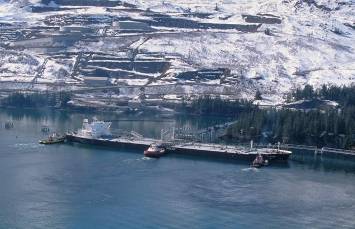
The Trans-Alaska Pipeline System (TAPS) has announced that its workforce has achieved a major safety milestone: 10 million hours worked without an OSHA Day Away From Work Case (DAFWC). Of those hours, Crowley contributed towards working 20 percent of them, or 2 million hours, safely. This means that since June 2009, no TAPS worker, including the more than 225 Crowley employees, has been injured to the extent that they missed a day of work.
For more than 30 years Crowley has provided tanker escort, response ship assist and vessel operations for TAPS operator Alyeska Pipeline Services Co. in Valdez, Alaska. The safety milestone is especially exceptional considering a majority of these employees work in the field and in environments with cold weather and heavy seas conditions.
"I am very proud of our Crowley Valdez team," said Charlie Nalen, Crowley vice president, Valdez. "Together Crowley and the rest of the TAPS workforce have just completed an amazing accomplishment. This is no accident; it is the collective excellent performance of everyone involved in this operation that has allowed this to happen, and it is something we can and must continue to do."
Ten million hours is the equivalent of 1,250,000 eight-hour workdays or 250,000 five-day workweeks. This achievement is in part a result of Crowley's company-wide commitment to a strong safety culture. Attaining 10 million hours without a DAFWC is evidence of a committed and skilled workforce, with every individual on the TAPS team contributing to this achievement.
"Safety doesn't just happen; you have to make it happen," said Rod Hanson, Alyeska's director of health, safety, environment & quality. "This is a significant achievement in any industrial setting, much less one that includes marine and arctic conditions. When people ask what 'world-class' means, I will point to this type of performance as a significant example. Thank you to the workers - and keep up the great work."
Alyeska operates the 800-mile Trans Alaska Pipeline System (TAPS), which runs from Prudhoe Bay on the North Slope south to the Port of Valdez, the northernmost ice-free port in the United States. The pipeline crosses three mountain ranges and 34 major rivers and streams. Alyeska operates out of Anchorage, Fairbanks and Valdez and at various facilities along the line. Alyeska was created to construct, operate, and maintain TAPS for the owner companies. The current TAPS owners are BP Pipelines (Alaska), ConocoPhillips Transportation Alaska, ExxonMobil Pipeline Company, Unocal Pipeline Company, and Koch Alaska Pipeline Company.