
Wärtsilä Tests New Two-Stroke Dual-Fuel Gas Engine
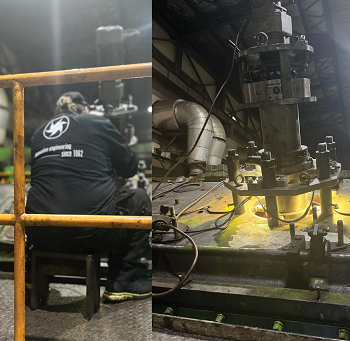
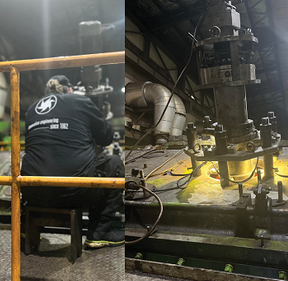
Wärtsilä has tested its new low-speed gas engine technology in trials conducted at the company's facilities in Trieste, Italy. The tests were carried out on September 19 in conjunction with Wärtsilä's Licensees Conference in Trieste. Wärtsilä successfully demonstrated that the engine performance fully complies with the upcoming IMO Tier III nitrogen oxide (NOx) limits, thereby setting a new benchmark for low-speed engines running on gas. The new RTX5 2-stroke test engine is part of Wärtsilä's 2-stroke dual-fuel gas engine technology development programme. This is an important part of the company's strategy to lower emissions, increase efficiency and to develop its low-speed engine portfolio to include dual-fuel gas engines alongside its medium-speed dual-fuel engines.
"The decision to initiate this project was announced in February 2011, just seven months ago. The fact that we have already conducted a successful test shows that our gas engine technology is at the forefront of meeting the future needs of shipping, a future that stipulates more stringent environmental regulation. This further highlights Wärtsilä's leading in-house know-how, professional approach and overall competence in this field," says Lars Anderson, Vice President, Wärtsilä Ship Power Merchant.
The tests with the RTX5 engine will continue during the autumn and winter of this year, and into 2012. More details about the engine technology and its performance will be announced upon completion of the program. The running of the test during the company's Licensees Conference is significant in that the company's low-speed engines are produced by specialized engine manufacturing companies under license. The licensees market, manufacture and sell the engines under agreed conditions. Wärtsilä has established a world-wide network of 19 licensees for manufacturing 2-stroke engines. These are located mainly in Asia (Japan, Korea, China, Vietnam), but also in Europe (Croatia, Poland and Russia) and South America (Brazil).
Environmental regulations are becoming increasingly stringent. The IMO's (International Maritime Organization) Tier III regulations, which will come into force in 2016, stipulate that NOx (nitrogen oxides) emissions must be cut by 80 per cent compared to the IMO Tier I levels. The use of liquefied natural gas (LNG) as a marine fuel is widely seen as being the most realistic means of reducing the marine industry's environmental footprint. When operating in gas mode, vessel emissions of nitrogen oxide (NOx), sulphur oxide (SOx), carbon dioxide (CO2), and particle matter are heavily reduced. At the same time, LNG fuel is often found to be more competitively priced than conventional liquid fuels, thus enabling ship owners and operators to achieve important operational cost savings.