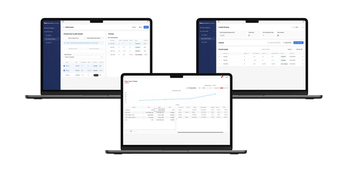


IMO
There are numerous organizations with the abbreviation "IMO," but assuming you are referring to the International Maritime Organization (IMO), here's a detailed overview:
International Maritime Organization (IMO)
The International Maritime Organization, often abbreviated as IMO, is a specialized agency of the United Nations responsible for regulating shipping. The IMO was established in 1948 and came into full force in 1959. Its headquarters are located in London, United Kingdom.
Mission and Objectives
The IMO's primary mission is to create a regulatory framework for the shipping industry that is fair, effective, universally adopted, and universally implemented. The organization focuses on several key objectives:
- Safety and Security: Establishing international safety regulations to ensure the security of life at sea.
- Environmental Protection: Setting standards to minimize the environmental impact of shipping activities.
- Legal Matters: Developing international maritime law to ensure efficient and equitable shipping practices.
- Technical Cooperation: Providing technical assistance and capacity-building programs, especially for developing countries.
- Efficiency and Facilitation: Streamlining procedures for international shipping to make maritime transport more efficient and cost-effective.
Key Conventions and Regulations
The IMO is known for several important international treaties and conventions, such as:
- SOLAS (Safety of Life at Sea): One of the most important treaties focusing on ship safety.
- MARPOL (Marine Pollution): International regulations aimed at preventing pollution from ships.
- COLREGs (Collision Regulations): Regulations for preventing collisions at sea.
- STCW (Standards of Training, Certification, and Watchkeeping for Seafarers): Setting qualification standards for seafarers.
- IMDG Code (International Maritime Dangerous Goods Code): Regulations for the safe transport of hazardous materials and dangerous goods.
Structure and Governance
The IMO consists of an Assembly, a Council, and five main Committees:
- Assembly: The highest governing body, composed of all Member States, which meets every two years.
- Council: Acts as the executive organ and is responsible for ensuring the functioning of the IMO.
- Committees:
- Maritime Safety Committee (MSC)
- Marine Environment Protection Committee (MEPC)
- Legal Committee
- Technical Cooperation Committee
- Facilitation Committee
Membership
The IMO has a wide membership, with around 174 Member States and three Associate Members as of 2023. These members are primarily countries with maritime interests.
Achievements and Impact
The IMO has made significant contributions to maritime safety and environmental protection:
- Reduction in Maritime Accidents: Implementation of rigorous safety standards has led to a marked decrease in maritime accidents.
- Mitigating Environmental Impact: Introduction of cleaner fuel regulations and restrictions on emissions has reduced the environmental impact of the maritime industry.
- Global Standards: The establishment of universally recognized standards has leveled the playing field, fostering fair competition and consistency across the global maritime industry.
If you meant another organization by "IMO company," please provide more context, and I’d be happy to share information accordingly.
- Phone: + 44 (0)20 7735 7611
- Web: https://www.imo.org/
IMO News
IMO Head to Address Interferry Conference
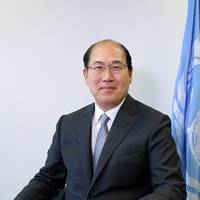
Korea’s Kitack Lim, whose term as IMO secretary-general began January 1, will address the opening conference session on October 17, following an invitation inspired by 10 years of IMO and Interferry cooperation to improve domestic ferry safety in developing nations. The campaign has recently focused on Southeast Asia, where an estimated 10,000 have died in domestic ferry incidents since the year 2000.
Lyden-Kluss, RADM Thomas Appointed IMO Ambassadors
Carleen Lyden-Kluss, Chief Executive Officer of Morgan Marketing & Communications, along with RADM Cari B. Thomas of the United States Coast Guard were recently…
IMO Confirms No-Go Yet for BWM Convention
Criteria for entry into force of BWM Convention not yet reached – further ratifications needed. Insufficient tonnage to trigger entry into force despite recent ratifications…
EC Funding Gives Green Light to IMO Energy-Efficiency Project
Network of regional maritime technology cooperation centres to be established through €10 million funding contribution. An ambitious IMO project to establish a global…
New IMO Secretary-General Sets Out His Agenda
Kitack Lim of South Korea has issued a message outlining his priorities as incoming Secretary -General of the IMO a post he assumed on January 1 following endorsement…
IMO and WCO Partner on e-Business Compendium
IMO and the World Customs Organization (WCO) have signed a partnership agreement to maintain, update, publish and distribute the IMO Compendium on Facilitation and Electronic Business.
Lim Ki-tack Will Take Office As IMO Chief Next Month
Lim Ki-Tack, who has been elected as the next secretary-general of the International Maritime Organization (IMO) in a ballot, will start his four-year term in the beginning of next year…
IMO Amendments Coming into Force on 1 January
A number of important amendments to IMO treaties enter into force on 1 January 2016, including new requirements for verification of compliance, making audits mandatory…
Full Speed Ahead with Climate-Change Measures at IMO Following Paris Agreement
The International Maritime Organization (IMO) has welcomed the historic achievement of the 2015 Paris Climate Change conference (COP21). IMO has contributed, and will continue to contribute…
IMO Urges Fishing Vessel Treaty Acceptance
The Assembly of the International Maritime Organization (IMO) has called on its Member States to accept a 2012 international fishing vessel safety agreement, in…
IMO Sets Guidelines for 2016-17
The IMO has just closed its Assembly meeting in London, which is held every second year. A number of important items were on the agenda, including the IMO work programme…
EU Needs IMO Leadership to Reduce Shipping Emissions
The European Community Shipowners’ Association (ECSA) has reiterated their support for International Maritime Organisation (IMO) as the proper leader of efforts…
IMO Assembly Elects New 40-Member Council
Category (a) 10 States with the largest interest in providing international shipping services: China, Greece, Italy, Japan, Norway, Panama, Republic of Korea, Russian Federation…
SSI Urges IMO for Action on Reducing CO2 Emissions
The Sustainable Shipping Initiative (“SSI”), a pioneering coalition of companies from across the global shipping industry, today released - ahead of discussions at COP21…
IMO Welcomes UN Resolution on Migrant Smuggling
IMO Secretary-General Koji Sekimizu has welcomed the adoption by the United Nations Security Council of a UN Security Council resolution which authorizes Member…
IMO Only Place for Global Debate on Shipping CO2
As world leaders prepare for key negotiations on climate change in Bonn and Paris later this year, IMO Secretary General Koji Sekimizu has issued a strong call for…
IMO Launches Low-carbon Project: GloMEEP
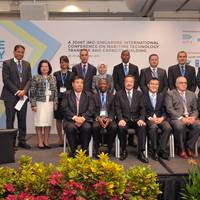
The Global Maritime Energy Efficiency Partnerships Project (GloMEEP), which aims to support increased uptake and implementation of energy-efficiency measures for shipping, was formally launched on Monday, September 28, in Singapore, at the IMO-Singapore Future-Ready Shipping 2015 conference. This Global Environment Facility (GEF)/United Nations Development Program (UNDP)/IMO project, formally designated…
Cat’s C280 Engines Meet EPA Tier 4, IMO Tier III
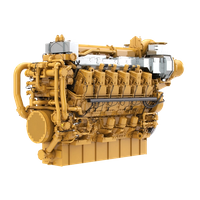
Caterpillar Marine now offers its Cat C280 medium-speed diesel engines for U.S. Environmental Protection Agency (EPA) Tier 4 and International Maritime Organization (IMO) Tier III service. The EPA Tier 4 standards applied to all new U.S. flagged vessels starting in January 2014 and IMO III standards will apply to all new vessels entering IMO NOx Emissions Control Areas (NECA) starting in January 2016.
IMO Warns on Bauxite Liquefaction Dangers
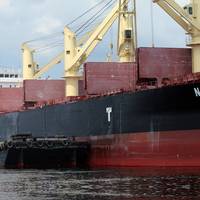
The International Maritime Organization (IMO) announced it has taken action to warn ship masters of the possible dangers of liquefaction associated with carriage of bauxite, following consideration of findings from the investigation into the loss of the 10-year-old Bahamas flag bulk carrier Bulk Jupiter, which was carrying 46,400 metric tons of bauxite when it sank rapidly with 18 fatalities in January 2015.
IMO Signs Global Maritime Energy Efficiency Partnerships Project
International Maritime Organization (IMO) the Global Environment Facility (GEF) and the United Nations Development Programme (UNDP) have signed an agreement to allocate…