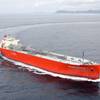

M/V Tarantella
Type Chem/oil tanker
Owner Whitefin Shipping
Builder Trogir
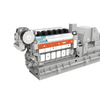
The vessel Tarantella features a variety of outstanding and unique characteristics representing an advanced concept of chemical tanker. Compared to earlier Trogir built tankers (Trogir and Azov Sea), the hull of Tarantella embodies a number of upgrading features such as: Execution of bulkheads, bottom and lower stools to facilitate drainage of the cargo /washing water to the practical minimum as described with "str 0.05" class notation; Introduction of trapezoidal corrugation (instead of rectangular) to enable 96 percent of tank surfaces to be exposed to direct jet from washing machines and therefore qualify for ETC notation; Strengthening of structure to suit for wider range of IMO 2 chemicals, which effected bulkheads and boundary of alternate tanks being strengthened for unlimited filling level of 1,600 t/cu. m. cargo density and deck structure reinforced to withstand 0.7 bar overpressure, which prevents some cargoes (pentane, pentene) from vaporization at environmental temperatures; Review of cargo tanks/double hull structure by 3-D FEM fatigue life analyze (DNV — Nauticus — newbuilding) followed with introduction of extra thickness, brackets or execution of cut-outs and similar as needed for assignment of DNV Plus — 2 notation: Structure fatigue life is 40 years. Extension of double hull further aft — to protect fuel storage tanks from leakage in case of minor shell plating damages; 2 m clearance is maintained throughout; In order to keep steel hull mass as low as possible some 31.5 percent of HTS (NV36) is introduced, mainly in cargo tanks envelope and bulkheads and partly in bottom plating. Cargo tanks' drying system is composed of one 30,000 cu. m./hr. air heater with fan, steel ducting on cargo tanks' deck with branches for flexible connections to desired tank; Nitrogen production plant of 4,500 N cu. m./hr. capacity with supply connections to each cargo tank — used for inerting of sensitive chemicals. Instead of conventional submerged hydraulically driven cargo pumps electrically driven deep well pumps are provided. Speed control by frequency converters. Redundancy, flexibility, maneuverability ease of maintenance, high electricity demand during frequent cargo discharge operation and low initial cost were decisive factors for selection of suitable propulsion/ electricity generation configuration: consisting of two medium speed engines.