
Navy Signs 3rd Virginia-Class Contract
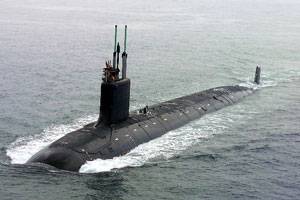
The Navy signed a five-year, $14b Multi-Year Procurement (MYP) contract for eight Virginia-class submarines Dec. 22.
The contract, the third, or Block III, for the Virginia-class, calls for one ship per year in fiscal years (FY) 2009 and 2010 and two per year in FY 2011, 2012, and 2013. The contract also meets the Chief of Naval Operations' (CNO) and Virginia Class Program's mandate to reduce acquisition costs by approximately 20 percent for the FY 2012 ships.
"This contract is a prime example of what you can do when you provide motivated people with a task and a deadline," said Virginia-class Program Manager Capt. Michael Jabaley. As Jabaley explained, "in FY 2005, then-CNO Admiral Michael Mullen said that if we could cut $400 million from the $2.4 billion authorized for that year's Virginia by FY 2012, the Navy would buy two Virginias each year. This contract achieves both goals – the price target and the two per year build rate."
To reach its cost reduction goal, the Virginia-class Program established a three-element strategy. The first element, which accounts for one-half of the required savings, involved increasing production to two ships per year in an MYP contract in order to spread the shipyards' overhead costs over more ships. To achieve the remaining cost savings, the Navy invested $600m to redesign portions of the ship for more efficient production and to improve construction processes reducing the construction span from 84 to 60 months. This upfront investment reduced the Virginia-class's total program cost by $4b – a 6:1 return on investment.
The cost reduction effort resulted in more than 100 discrete design changes that either reduced costs or shortened the construction span. The most extensive modification involves the replacement of the traditional sonar sphere with a Large Aperture Bow (LAB) Array and the 12 vertical launch tubes with two large diameter Virginia payload tubes (VPT). The LAB and VPTs, along with more than two-dozen associated modifications, save $40m per submarine beginning with the FY 12 ships.
"While we focused on cost reduction as our primary goal, we paid attention to warfighting capability and lifecycle costs in making these changes," said Rear Adm. William Hilarides, program executive officer for submarines.
In fact, the LAB Array uses life of the hull hydrophones that will provide improved passive listening capability over the traditional, transducer-populated sphere.
Further, replacing 12 vertical launch tubes with two 92-inch VPTs not only reduces construction and lifecycle costs, but also significantly expands their ability to accept future payloads.
"The payload tube interface is identical to the SSGN's tubes so what we put in one, we can put in the other, and with two hatches instead of twelve we've cut out a lot of maintenance," Hilarides concluded.
Virginia-class submarines are built under a unique teaming arrangement that includes General Dynamics Electric Boat as the prime contractor and Northrop Grumman Shipbuilding as its partner. Each shipyard builds certain portions of each ship and the two yards alternate delivering the submarines.
"This multiyear contract is a result of the Navy submarine team's careful and highly professional execution," said Assistant Secretary of the Navy for Research, Development, and Acquisition Sean Stackley. "They successfully met a challenging cost reduction plan, added capability, and did it all ahead of schedule. The Navy will benefit substantially from their success," said Stackley.
The Block III contract award is the last of many significant milestones reached by the Virginia Class Program in 2008. For the first time in 12 years, the Navy commissioned two submarines of the same class in the same year, USS North Carolina (SSN 777) May 3 and USS New Hampshire (SSN 778) Oct. 25.
The program further celebrated New Mexico's (SSN 779) christening on Dec. 13 at Northrop Grumman Shipbuilding's Newport News, Va. shipyard. The Virginia class also completed a number of technical and operational tests including the launching of three Tomahawk cruise missiles, 62 exercise torpedoes, 12 lock-in/lock-out evolutions, and eight Dry Deck Shelter flood and drain evolutions. Additionally, Virginia-class submarines spent a total of 469 days at sea in the first 11 months of the year and had four of the five ships of the class at sea at the same time in August.
The Virginia class is designed to dominate both the littoral and deep waters while conducting anti-submarine; anti-surface ship; strike; special operation forces; intelligence, surveillance, and reconnaissance; irregular warfare; and mine warfare missions. In doing so, the Virginia-class directly enables five of the six Maritime Strategy Core Capabilities – sea control, power projection, forward presence, maritime security, and deterrence.
(Source: Navy News Service)