Sailors Use Improved Navy Lighterage System
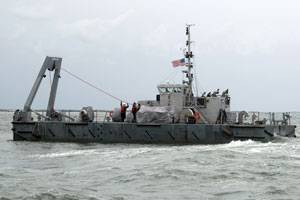
Sailors assigned to Amphibious Construction Battalion (ACB) 2 had the opportunity to test the Improved Navy Lighterage System (INLS) during the Joint Logistics Over-the-Shore (JLOTS) exercise June 15-21.
The JLOTS exercise was a test of the military's ability to move equipment and sustainment supplies to specific areas without the benefit of a fixed port facility.
The exercise increased interoperability and improved military readiness by alleviating situational sustainment issues.
INLS played a large role in the JLOTS mission by acting as a floating pier, or causeway system, which is comprised of powered and non-powered floating platforms.
INLS is used to transfer cargo from ship to shore areas where port facilities may be damaged, or nonexistent.
"The INLS is fairly new to ACB 2; we acquired the system only two years ago," said Master Chief Operations Specialist John Fedor, assigned to ACB 2. "It is vastly improved from the old Navy Lighterage (NL) systems; it is a lot safer, more maneuverable, allows the crew to get out of the weather, provides better visibility for the craftmasters and the overall system is a vast improvement of the previous system."
INLS, which is replacing the existing NL systems, is more operable in higher sea states, has a longer service life and reduces maintenance costs.
The INLS is made up of floating modules and barges that can be assembled into four platforms: the RORO discharge facility, which supports the discharge ramp from the cargo ship and serves as a pier; the floating causeway, which supports the discharge ramp from the cargo ship and transfers rolling stock across undeveloped shoreline; the causeway ferry, which is used to transport cargo from ship to shore or to the causeway; and the warping tug, which is used for assembling, towing, anchoring and salvaging operations.
ACB 2 used four INLS crafts during JLOTS, including two warping tugs and two causeway ferries.
"My particular craft is a warping tug, which acts as a salvage craft," said Boatswain's Mate 1st Class (SW/AW) Joni Custer, craftmaster assigned to ACB 2. "We do the roll-on, roll-off discharge facility with the platform behind the seaward ship and take equipment back and forth to the shore to provide assistance to our troops."
JLOTS allowed many Sailors the opportunity to troubleshoot the system, perform maintenance on the equipment and train in a new environment.
"We haven't experienced any problems that would be abnormal out to sea," said Custer. "There are moving sandbars and a bit of heavy seas throughout the days we have to work around, but that's what these craft are made to do."