Study Backs Up Cruise Industry’s Commitment to Environment
The results of two recent environmental studies regarding cruise ship wastewater discharge provide new and significant scientific insight into the low environmental impacts of cruise ship operations on the marine environment.
Two independent yet interrelated studies by the Environmental Protection Agency (EPA) and the Alaska Department of Environmental Conservation (ADEC) provide a major step in understanding the environmental impact of cruise ships.
Significantly, results from a recent EPA study showed that the dilution of discharges from cruise ships moving between 9.1 and 17.4 knots are diluted by a factor of between 200,000:1 and 640,000:1. Measured dilutions were found to be significantly higher than the 40,000:1 initial dilution prediction made in 2000 by the cruise industry. The higher the dilution rates, the less negative impact on the water quality.
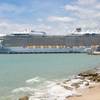
During August 2001, the EPA monitored the discharges of four cruise ships off the coast of Miami, Florida to determine how quickly ship wastewater was diluted. The EPA tracked and quantified the plume dilution and dispersal of wastewater discharge from Royal Caribbean and Carnival Cruise Line ships. The International Council of Cruise Lines worked closely with the EPA to identify and coordinate cruise ships, locations, transit routes and sailing schedules.
In July 2002, the Alaska Department of Environmental Conservation (ADEC) conducted Whole Effluent Toxicity (WET) tests on the wastewater effluent from five different cruise ships operating in Alaska waters. In these WET testing cases, the short and long-term lethal or reproductive effects on indigenous marine animal species were tested in various dilutions of discharge streams from cruise ships. Study results show that at a dilution rate of 200:1, wastewater has essentially no impact on the animal species. The ADEC scientific review panel stated that wastewater discharges from large cruise ships, while underway, are not of concern.
"These scientific studies have added to our knowledge of the impact of cruise ship discharges on the marine environment," said Michael Crye, president of the ICCL. "We hope that the results will ease the minds of those who share our goal of responsible environmental management."
Crye added, "Our substantial investments in new technology for wastewater treatment, as well as air emissions and waste reduction, underscore our dedication to environmental protection efforts. We look forward to working with these agencies to enhance our programs even further, as our commitment to responsible environmental practices is as important a priority as our commitment to the safety and security of our passengers and crew."