Wang: Container Market Strength to Continue
Arnold Wang, Chairman of Evergreen Marine Corporation, addressed delegates at the World Shipping Summit (China) 2007 on "Growing Demand as Indicated by the Shipbuilding Orderbook.
Speaking at the World Shipping Summit (China) 2007 on November 2 in Tianjin, Arnold Wang, Chairman of Evergreen Marine Corporation, addressed the audience on the subject “Growing Demand as Indicated by the Shipbuilding Orderbook”.
Noting that over the past decade, China’s remarkable economic growth has brought structural changes to global container shipping and other related industries, including shipbuilding and terminal operations, Mr Wang reflected on the impressive statistics:
“In 2006, container throughput in all Chinese ports reached 80 million TEU, or around one-fifth of the global volume. For cargoes from Asia to Europe and North America, China’s exports have accounted for more than half of market volumes. In 2006 China gained a market share of 65% in the Trans-Pacific eastbound trade, 71% with the inclusion of Hong Kong. In the Far East – Europe westbound market, a market share of 63% was recorded for exports from China alone and 72% with Hong Kong’s contribution.”
Mr Wang added that given the scale of China’s economic development, it is hardly surprising that China is now having a significant influence on the overall shape of global container transport and other related industries.
Turning to the subject of the global container ship newbuilding programme, Mr Wang continued:
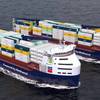
“According to Clarkson’s statistics, shipyards worldwide are expected to churn out 1,410 thousand TEU of tonnage in 2007 while in the latest building spree, vessels above 10,000TEU have increased by a notable extent. In total, ship owners have spent $51.2 billion on container vessels, including 114 vessels above 10,000TEU. It is believed that more than 150 such ULCS will be added to orderbook by the end of this year.”
BRS-Alphaliner’s newbuilding statistics echo this development, said Mr Wang:
“The ULCS fleet above 10,000TEU will grow from four to 152 ships in four years. All these gigantic vessels are expected to join the booming Far East – Europe trade.”
Mr Wang said that some people might start to wonder whether such a huge delivery of tonnage will cause oversupply and lead to market meltdown, or whether the influx of new capacity will only serve to fulfil ever increasing demand.
He believes that in order to forecast market demand/supply, it is essential to analyze the growth in real slot capacity, which can be influenced by the following factors:
Limitations of actual loading
Due to loading requirements or broken space caused by special cargo, a vessel’s actual carrying capability will not reach its nominal capacity. These factors include over-weight, out-of-gauge (over-high and/or over-wide), and dangerous goods, etc. For a 4,000TEU vessel, the effective slot space can fall to under 3,00TEU when the above-mentioned factors are taken into consideration.
Replacement of ageing fleet
Ageing vessels account for a notable share of the total existing fleet. More than 5% of current tonnage would normally have been scrapped having reached the age of 25 years. In other words, one out of every 20 newbuildings will be used to fill the vacuum created by the disposal of ageing vessels.
In consideration of low productivity and high maintenance costs, the ageing fleet will be gradually renewed. With part of the newbuilding fleet reserved for the replacement of the ageing fleet, the growth of effective capacity supply will slow down as a result.
Capacity demand for feeder expansion
To maintain the efficiency of the overall network, feeder services have to be upgraded in proportion to the expansion of mainline services. The tonnage requirement for feeder expansion will reduce the capacity growth of long-haul services.
For example, if a carrier were to deploy 10,000TEU vessels to upgrade an existing Far East – Europe service that was using 6,000TEU ships, shifting the 6,000TEU vessels to replace 3,000TEU ships in a Far East – Mediterranean service. The 3,000TEU ships are then used to expand regional feeder networks. The cascading effects only supply 7,000TEU of effective slots to the Far East – Europe (including Mediterranean) trade.
Port congestion
In the Far East, China in particular, the handling capacity and capability of container ports is being constantly upgraded in line with bullish cargo growth. In Europe, as in the US, there are also a number of major expansion plans but due to environmental concerns, lengthy consultations and public enquiries are creating major delays measured in years, not months. These bottleneck problems will gradually influence operational efficiency and restrain effective capacity growth.
Longer trade routes
On the one hand, the booming Far East – Europe market brings huge cargo volumes to carriers. But on the other hand, the longer trade route requires more vessels than other trades and imposes mitigating effects on actual capacity growth. With most ULCS newbuildings deployed on the Far East – Europe trade, the growth of effective slots will be slower than the nominal capacity increase, and this will help to stabilize the global container shipping market.
For instance, it takes four to five ships to run a Far East – US West Coast weekly loop but it requires eight to nine ships for a Far East – Europe weekly service. The deployment of eight 8,000TEU vessels can form two weekly services on the Far East – USWC trade and increase weekly capacity supply by 16,000TEU. In contrast, the same eight vessels can only constitute one weekly service when shifted to the Far East – Europe trade and reduce the capacity increase by half.
Crowding-out effect of way cargo
Long-haul services can also carry way-cargo, and thus dilute capacity supply for the main trade. For example, Far East – Europe services can serve the Red Sea market en route to Europe. Far East – US East Coast all-water services can carry cargo in transit to South America.
Mr Wang also commented on the relationship between global economic growth and container volumes:
“There used to be a proportional connection between the growth rates of global economic development and container volume. Under normal circumstances, the increase rate of container cargo is around 2.4 times that of economic growth. But due to the impact of outsourcing trends, the situation has started to change in recent years. The ratio climbed to 2.8 and 3.6 for 2000 and 2003 respectively.
“In 2004 and 2005, with the outsourcing trends more or less established, the ratio fell to the previous level. According to forecasts by the IMF (International Monetary Fund), the global economic growth rate will range between 4.2% and 4.3% during 2006 - 2010. Based on the cargo multiple of 2.4, global container cargo volumes are expected to increase by 10-11% in the coming years.
“The pointers above indicate that cargo volumes will continue with stable growth while the tonnage supply will increase slower than expected. Therefore, it is believed that the container shipping market will continue to flourish unless the global economy is impacted by unexpected catastrophes.”