Ecore: A Step Change in VLOC Design
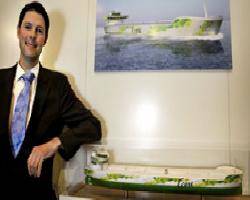
Together with FKAB, TGE Marine, Cargotec and MAN Diesel & Turbo, DNV has participated in a joint industry project to develop Ecore, a Very Large Ore Carrier concept designed to lower fuel costs and improve loading efficiency.
Based on existing technology, the Ecore concept represents a step change in VLOC design. Powered by two-stroke dual fuel ME-GI engines, this concept features a more ballast friendly hull shape, a large centre cargo hold layout and introduces a highly efficient self-loading system.
According to DNV project manager Pål Wold, these elements will not only improve the VLOC’s performance but also help lower fuel costs and corresponding emissions. “Working closely with our partners, we recognised that significant improvements can be achieved on both the machinery and hull side by using existing technology,” he says. “Our goal was to combine proven systems and design concepts to demonstrate how fuel costs can be reduced and loading efficiency improved.”
Pål Wold notes that while Ecore may challenge existing ideas on the design of VLOCs, the concept is built on real data. The project team sent out a survey to shipowners, cargo owners and brokers to ensure the project was consistent with market demand, and designed the vessel for a recognised trade – iron ore between China and Australia. “Ecore is grounded in market reality and applies existing technology to real-world issues,” he says.
For example, the cargo centre-hold layout and midship-form was developed to minimise the need for ballast, and enable more efficient cargo handling and allow space for LNG tanks to be stored below the main deck. The self-loading system enables the shore-based loader to operate at a single point along the vessel, which is safer and reduces the time spent in port. At the same time, the ME-GI gas engines developed by MAN Diesel & Turbo make it possible to utilise both conventional fuels and LNG, thus providing a solution which will be robust in a range of fuel price scenarios.
While Pål Wold acknowledges that LNG fuel creates challenges with regard to bunkering and re-training onboard personnel, Ecore’s analysis of the competence issue have revealed that solutions are being developed. “Engine makers – including MAN Diesel & Turbo – are already developing training modules to build competence,” he says.
The Ecore project demonstrates, that significant saving can be achieved, with regard to reducing fuel cost and increasing loading efficiency, when existing technology is used in an innovative way.
Source: DNV