First of Four GPA 688SC PSVs Launched in Brazil
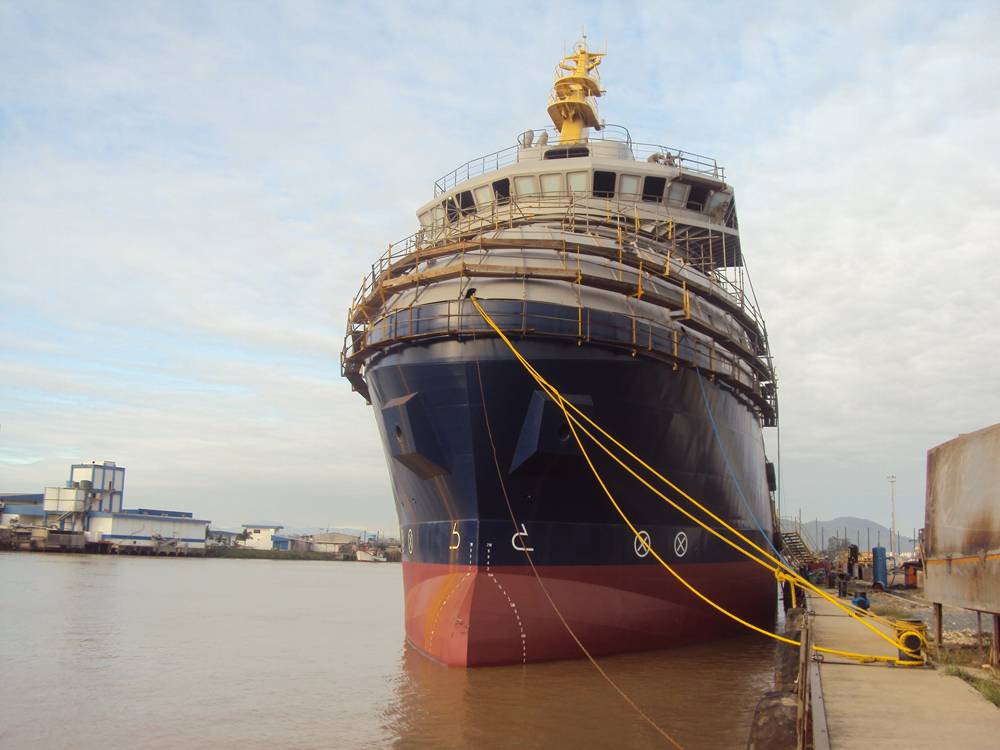
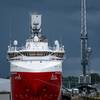
In April 2012, the Starnav Perseus, the first of four GPA 688SC PSVs (PETROBRAS PSV 4500) was launched at Brazilian shipyard Detroit Brasil Ltda., a subsidiary of Detroit Chile.
Naval Architecture and Marine Engineering firm Guido Perla & Associates, Inc. (GPA) provided the Basic/Class Design and Detailed Construction Engineering after successfully competing in PETROBRAS’ demanding bidding process with a cost-efficient, technically convincing design. Throughout the design and engineering process, GPA worked closely with the shipyard and equipment suppliers to meet all of PETROBRAS’ requirements for these vessels owned and operated by Brazilian-based Starnav Serviços Marítimos Ltda. During the construction process, GPA also provides onsite supervision at the yard in Itajai.
As one of the global leaders in the design of modern offshore vessels with over 140 vessels in service or under construction for various operators, GPA brought an extensive level of knowledge and experience to this demanding project, setting a high value on technical and economical benefits to both the operator and shipyard. GPA’s expertise resulted in a design characterized by optimized cargo capacity, improved fuel consumption, ease of maintenance, redundancy, excellent maneuverability and highest safety.
For the PSV 4500 PETROBRAS tender, GPA developed a modern look vessel, the GPA 688SC PSV, with a special hull shape and new deckhouse styling. This design also has the capability to be easily transformed into the PSV 3000 (GPA 675 PSV), another vessel specified by PETROBRAS, by removing part of the parallel midbody section and making some modifications on the tank farm area. This characteristic is extremely valuable for the shipyard as it offers a high degree of flexibility in production by retaining a large part of the hull for both models, thus reducing cost of production and increasing efficiency of construction. GPA designs are developed with the goal of high volume series construction and this flexibility is in accordance with that attribute of the GPA designs.
“Detroit Brazil together with its operating company Starnav has worked as a team with GPA in implementing the construction of these vessels. This has been a team effort with the companies’ staff working together with the single purpose of designing and building a vessel that best meets their production and operational requirements while meeting the requirements of the tender and high quality and safety standards. We are very happy to be working with such great team partners,” says Mr. Guido F. Perla, Chairman of GPA.
The GPA 688SC PSV, measuring 90.00 meters in overall length, has a deadweight capacity of 4500 MT, thus the designation of the vessel. The vessel’s mechanical and cargo systems meet PETROBRAS requirements for four segregated liquid cargo systems with independent exclusive tanks, piping systems and cargo pumps. All of them are controlled by a fully automatic cargo management system and are capable of carrying synthetic oil-based mud (1,160 m³, Segregation 1), hydrocarbonated oil-based mud (290 m³, Segregation 2), water-based mud (590 m³, Segregation 3), and brine (1,494 m³, Segregation 4). In addition, the vessels are equipped with tanks capable of carrying fresh water (172m3), dry bulk (340 m3), ship’s fuel oil (261m3), ship’s fuel oil day (38m3), fuel oil overflow (55m3), lube oil (4.5m3), dirty oil (13.6 m3), oily water (13.6 m3), sewage (13.4 m3), as well as ship’s ballast (2,060m3),
The hull is capable of more deadweight than the 4500 tons due to its large size. This large size comes from having the physical tank volume as required by PETROBRAS of having dedicated exclusive tanks of single cargo use for each of the segregations of liquid cargo.
The vessels are optimally equipped for all conditions with the most advanced diesel-electric propulsion system, consisting of MTU engines, azimuthal propulsion units by SCHOTTEL and the Integrated Engine Control Room (ECR) by EPD.
Running on four MTU generators rated for 1,845 kW and one MTU emergency generator rated for 176 kW, GPA sees several benefits for the operator as these generators provide a powerful and compact, robust and quiet solution. They also offer the highest cost-effectiveness and profitability due to low consumption values, long maintenance intervals, and a low-maintenance engine design. The generators are located on the maindeck, a concept GPA pioneered several years ago, fully utilizing the flexibility of the diesel-electric propulsion system. The concept increases the cargo capacity below deck by about 30% while offering a high degree of power management flexibility inherent of the diesel-electric system, allowing to bring on power in small increments matching the power demand of the operational profile of the vessels keeping the generator engines at appropriate loadings, operating at their highest efficiencies. Thus, fuel consumption and CO2 reject are reduced by 20-30% compared to conventional systems.
An additional benefit of the installation of the engine room on the main deck concept is the notable reduction of noise and vibration levels in the accommodation areas, achieved by adding an extra deck level of attenuation between the accommodations and the bow thrusters and cargo machinery, two of the prime contributors to noise onboard these types of vessels.
This propulsion configuration is optimized by combining it with two high efficiency azimuthal twin propellers combi drives rated for 2,500 kW each and two tunnel thrusters rated for 900 kW each delivered by SCHOTTEL. Combined with GPA hull shape, the SCHOTTEL units provide economic operation meeting the speed requirement of PETROBRAS. The ECR provided by EPD is a completely pre-tested, pre-manufactured self contained system and designed as an integral part of the ship’s structure that was first brought to market on the GPA-designed GPA 654 PSV in 2007. Since then, GPA continued to work closely with EPD, integrating the system on more than fifty offshore vessels designed by GPA. The system allows for the equipment to be installed and tested in a controlled environment. During construction, the ECR is lowered onto the vessel, secured and connected to power and control cables externally. This proven approach greatly reduces the possibility of equipment damage while in shipyard and reduces start up time.
In addition to operational performance benefits, GPA’s designs also offer an extremely economical, cost-efficient solution due to certain simplified construction methods inherent on every GPA design and based on many years of working together with clients in developing the most practical, economical and simplest vessels to construct. GPA maintains a successful track record of designs following these proven standards, such as single-curvature hull forms and other structural arrangements together with the flexibility of using any type of equipment manufacturer that best suits the project in hand. This combination enables shipyards to increase their efficiency by either constructing the same number of vessels in less time or constructing more vessels in a given time frame. GPA believes that the best and possibly the only way of controlling cost is by reducing hours of construction.
The GPA 688 PSVs, providing accommodations for 30 crew members, will bear the class notation ABS, +DPS-2, +A1, Offshore Support Vessel, Circle E, +AMS and +ACCU.
The vessels are under an 8-year contract for PETROBRAS and will be operating in the offshore fields in Brazil.