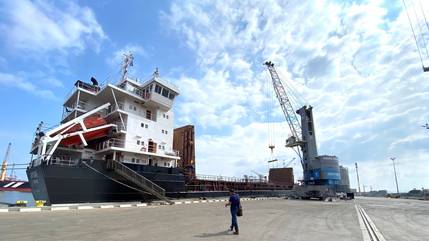
Great Ship - CSL Niagara
M.V. CSL Niagara, which was delivered by Port Weller Dry Docks this past July, is the largest seaway capable vessel on the Great Lakes. The two self-unloader resulting was formulated by joining the aft end of M.V. J.W. McGiffin to a complete new forebody built and outfitted by PWDD. Beginning with the new forebody being floated out of the building dock, McGiffin was then docked and its old forebody was cut and floated off — the new forebody was re-docked and joined to McGiffin's stern shortly after. Taking advantage of new maximum seaway dimensions resulting in cargo lifts, the vessel was selected to celebrate strong links between Canada Steamship Lines and the Niagara Region.
Resulting from the handiwork of CSL's technical team and CSE Marine Services, the objective at hand was to produce an efficient design that would span for another quarter-century. Niagara's cylindrical bow design provides more displacement and an additional 600 tons of cargo lift over other designs.
From a structural standpoint, the vessel is longitudinally framed — unlike traditional lakers. As a result, there is a lighter, more efficient design, which is complimentary to PWDD's state-of-the-art production processes. Bulb sections provided by Fundia were utilized due to their stability for application of the high quality coating system by International Paints. Other steel shapes were supplied by Salit Steel, while the steel manufactured by Algoma Steel and supplied by Samuel Plate was blasted and primed by both PWDD and Blastech Corporation.
By far, the total concept of the vessel is its self-unloading system. The existing boom and loop belt were retained and joined to a new arrangement of hold and transfer conveyors. In cooperation with EMS-Tech, the system was designed to be efficient and maximize cargo cubic and discharge at 6,000 STPH. A total of 146 suspended roller track gates were constructed by Pascol Engineering for installation by Port Weller adding to the two conveyor belts, which were implemented on garland rollers from Haak Industries. Unloading and ballast systems are remotely controlled by 14 closed-circuit television cameras installed by Canal Marine, while cargoholds are serviced by a series of hatches, fitted with one-piece steel covers, removable by crane. Outstanding in this vessel is a new 1,000 kW Kamewa bow thruster that was installed to assist the bigger vessel when maneuvering. Utilizing the same idea, a new Pascol-constructed steering nozzle was installed.