
Strike Group Commanders Visit Oil Terminals
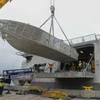
As the sun-sets over the Khawr Al Amaya Oil Terminal (KAAOT), another day passes safely under the watchful eye of masters-at-arms assigned to Mobile Security Detachment Two Five (MSD-25). MSD-25 members are currently training the Iraqi military on proper watch standing and security procedures during their six-month deployment to the Iraqi oil terminals. Mobile Security Detachment Two Five is combining efforts with coalition forces under the flag of Commander Task Force Five Eight (CTF-58) in support of maritime security operations (MSO) by standing security watches on KAAOT and Al Basrah Oil Terminal (ABOT). U.S. Navy Photo by Photographer's Mate 1st Class Aaron Ansarov
From U.S. Naval Forces Central Command/U.S. 5th Fleet Public Affairs
Two U.S. Navy admirals visited the Al Basrah and Khawr Al Amaya oil terminals April 20 to support the coalition forces currently in command of Combined Task Force (CTF) 158 in the Northern Persian Gulf.
Rear Adm. Garry E. Hall, Expeditionary Strike Group (ESG) 2 Commander, and Rear Adm. Kevin M. Quinn, Carrier Strike Group (CSG) 3 Commander, met with Royal Navy Commodore Nick Lambert, commander CTF 158, to discuss U.S. forces continuing to work alongside coalition and regional partners to support maritime security operations (MSO).
Hall said that in addition to showing commitment to coalition forces in the Northern Persian Gulf, it was an opportunity to discuss strategies.
“In light of recent events, we discussed with our coalition partners ways to prevent similar situations from reoccurring,” Hall said.
The trip for both strike group commanders also gave them a better understanding and greater appreciation of the importance of operations in the Persian Gulf's maritime environment.
“Being flexible is one of our strengths. ESGs, CSGs and other forces may combine to form an Expeditionary Strike Force,” said Hall. “This force would provide the necessary power projection and combat capability for a wide range of maritime operations. It would contain increased power, enhanced flexibility, and improved responsiveness to permit operations in any environment.”
MSO help set the conditions for security and stability in the Persian Gulf and protect Iraq’s sea-based infrastructure, which provides the Iraqi people the opportunity for self-determination.
CTF 158’s primary mission in the Persian Gulf is maintaining security in and around both of the oil terminals in support of U.N. Security Council Resolution 1723, which charges the multinational force with the responsibility and the authority to maintain security and stability in Iraqi territorial waters and also supports the Iraqi government’s request for security support.