Pirate Horizons in the Gulf of Guinea
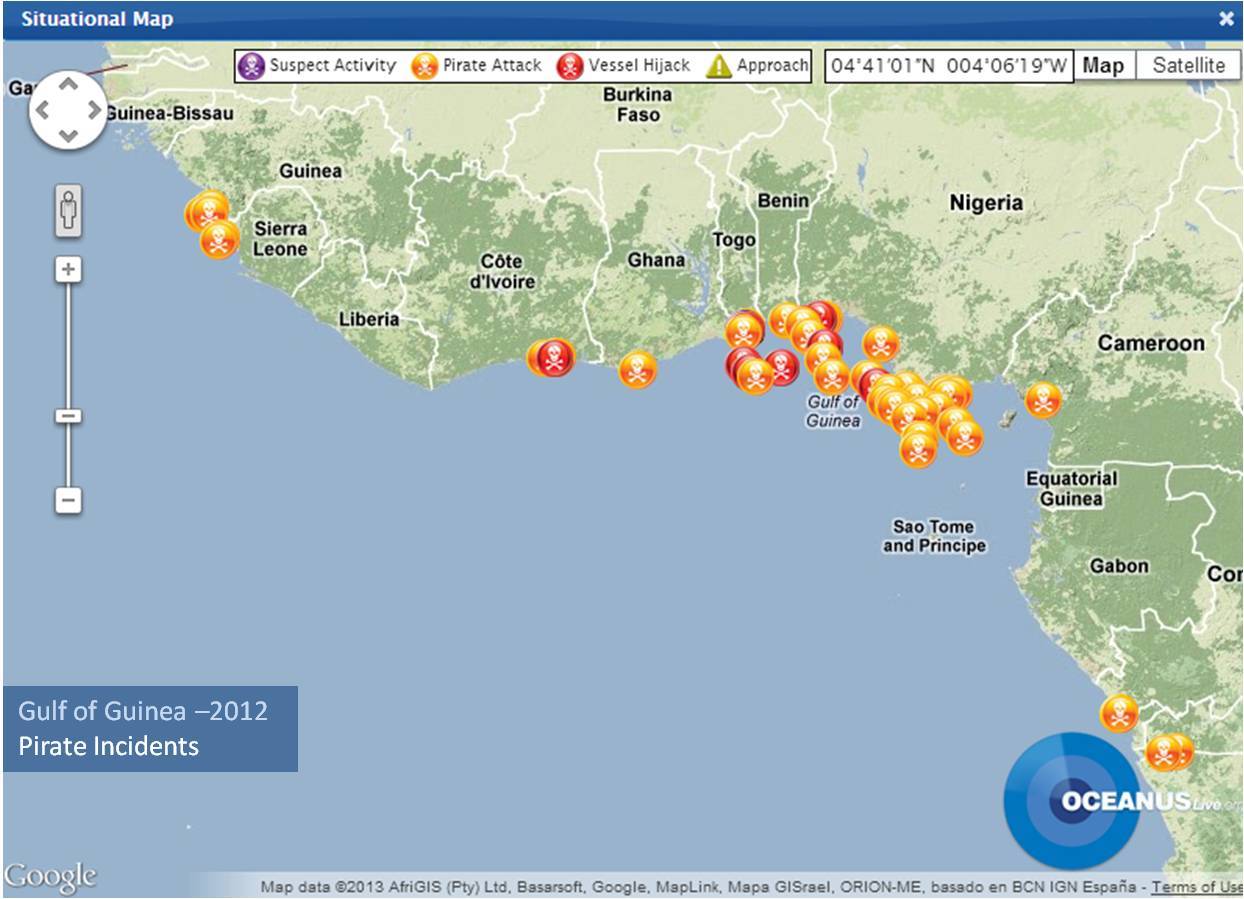
This article deals with the evolution of piracy in the Gulf of Guinea.
It was proclaimed in 2012 that the Somali pirate business model had been broken by a combination of coordinated naval patrols, heightened vessel security, and the ubiquitous presence of armed guards aboard valuable ships. The International Maritime Bureau (IMB) attributed only 71 attacks to Somali pirates in the first 11 months of 2012, down from 237 the previous year. However, attacks are on the rise across the continent in the Gulf of Guinea, with 51 incidents recorded for the same period.
While several commentators, particularly within the shipping industry, have raised the alarm that the Gulf of Guinea will overtake the Horn of Africa as the world’s piracy hotspot, very distinct geopolitical conditions prevent the Somali business model from being easily transported to West Africa. To begin with, it is the abject failure of onshore authority in Somalia’s pirate-prone regions that allows the hijackers to keep their prey anchored for months at a time while they conduct ransom negations. By contrast, the states bordering the Gulf of Guinea are weak and corrupt, but not failed.
West African pirates may not yet be able to secure multi-million dollar ransoms, but they have begun to emulate many of the successful tactics of their Somali counterparts. An analysis of recent trends demonstrates that the region’s highly organized pirate gangs have altered their tactics, targets and hunting grounds in order to counteract efforts against them.
Geographic Displacement
A 2009 government amnesty offering to militants in the Niger Delta is credited for temporarily reducing Nigerian piracy, as the number of incidents reported fell from a high of 42 in 2007 to a low of 10 in 2011. These figures masked the full extent of the piracy problem, however, as it is estimated that 50-80% of pirate attacks go unreported in West Africa. While the IMB reported 40 incidents of piracy in Nigerian waters in 2008, an author’s interviews with corporate security managers working in the region found there to be 173 confirmed attacks that year.
While Nigerian waters were relatively calm in 2011, neighboring Benin—which had only reported one act of piracy in the previous five years—was suddenly struck with a spree of at least 20 attacks. The Nigeria-based criminal syndicates, pressured by heighted security in their own waters, had moved westward to find easier targets. Highlighting the vulnerability of vessels operating in the thought-to-be-safe waters of Benin, eight of the 20 vessels attacked were successfully hijacked and had large quantities of equipment, fuel or cargo stolen.
As a response to the shared threat they face, the maritime forces of Nigeria and Benin began engaging in joint naval patrols in late 2011. Predictably, incidences of piracy declined in Beninois waters but were soon to reemerge elsewhere.
Though it has only 34 miles of coastline, West Africa’s 2012 piracy hotspot was Togo. The IMB recorded 15 pirate attacks in Togolese waters last year, more incidents than in the past five years combined. Other regional states that have seen a sharp increase in piracy include Ghana and Côte d'Ivoire, the latter marking the furthest point west that the Nigeria-based criminals have expanded.
Despite an increase in naval patrols, attacks have also increased once again in Nigerian waters. The fight against piracy in the region was recently likened to sitting on a balloon—“push down on one side and pops up at the other; push on the other side and it pops up somewhere else.”
According to maritime risk consultant Michael Frodl, the pirates are moving further out to sea not just to avoid coastal patrols, “but also to take advantage of ships letting down their guard in waters assumed to be safer.” The majority of ships attacked off Benin and Togo in recent years have been at anchor or drifting, meaning that evasive maneuvers cannot be taken.
The limited range of the pirates’ small skiffs once acted as a check on their offshore expansion. Following the Somali model however, West African pirates have overcome this limitation by using motherships—converted fishing trawlers that allow supplies and multiple skiffs to be transported further afield for more extended piracy ventures. Attacks have now been launched against vessels that are over 120nm from the coast.
A Change in Tactics and Targets
Though Niger Delta-based insurgents were able to launch a number of concerted attacks against offshore oil infrastructure in the mid to late 2000s, the majority of maritime crime in the region has been a low-tech and opportunistic affair. This appears to have changed in the last two years, however, as a number of notable attacks reveal a high level of sophistication and operational capacity on the part of the criminal gangs.
The pirates that hijacked the Abu Dhabi Star off the coast of Lagos in September demonstrated military-like organization, as they swarmed the vessel with four high-powered speed boats, boarded with a dozen heavily armed men in full combat dress, and immediately disabled the captured ship’s communications equipment. Signifying advanced logistical capabilities, the MT Orfeas was recently hijacked from anchorage off Côte d'Ivoire and then sailed 600nm back to the waters of Nigeria where its captors pilfered 3,000 tons of gasoline. The kidnapping of crew members from the tug Bourbon Liberty appears to exhibit a heightened level of operational intelligence, as the ship was attacked at the precise moment when its escort vessel had returned to shore to resupply.
These attacks are by no means atypical, as a 2011 UN assessment mission concluded that the region’s pirates were "resorting to sophisticated modes of operations and utilizing heavy weapons."
Diversifying the Business Model
Though cargo theft remains the primary modus operandi of the Gulf of Guinea’s pirates, there has been a sharp rise in incidents of hostage taking during oil bunkerings. Early 2012 witnessed a doubling in the number of attacks on oil tankers, with periods of captivity often lasting days as vessels are directed to another pirate-controlled ship where the fuel is transferred and then taken elsewhere for sale. While these extended duration robberies were once rare events in the region, there have been almost 20 such hijackings recorded in the last two years.
Bunkering has become part of a larger international web as Lebanese and Eastern European criminal interests reportedly arrange the black market sale of stolen crude and refined cargos. Shipping industry guidelines have also recognized that recent attacks appear to be the result of “intelligence-led planning,” where ships transporting valuable products such as gasoline are “targeted in very well coordinated and executed operations.” In this sense, Nigerian gangs are better connected to global criminal networks than their Somali counterparts, as first hand research has largely dismissed earlier reports that Somalia’s pirates were being financed and fed vessel intelligence by international cartels.
The increase in large scale bunkering has coincided with a brazen string of kidnappings for ransom in the Nigerian littoral. Though whole ships cannot be held for Somali-style ransom, West African gangs have proven apt at kidnapping foreign personnel as a source of additional income. When the Bourbon Liberty was hijacked off Nigeria in October seven European sailors were taken hostage while the Nigerian crew members and the ship itself were left to drift. The vessel’s French owners secured their employees release two weeks later through an alleged ransom payment.
Shipping and oil companies attempt to keep ransom negotiations confidential so as to not encourage further kidnappings, but the crime continues to be a lucrative venture. December witnessed three separate maritime kidnappings off the Nigerian coast in which a total of 12 expatriate personnel were specifically targeted and taken hostage. Examined together, rising incidences of both extended duration bunkerings and kidnap for ransom indicate that the myriad criminal syndicates operating in the Gulf of Guinea have developed diversified business models.
Constant Vigilance
Maritime crime is now a transnational emergency in the Gulf of Guinea. Already spreading from Nigeria to Benin, Togo, and Côte d'Ivoire, it is likely that Liberia, Cameroon and Equatorial Guinea will come under increased stress from pirates and oil thieves this year. Though the crisis is regional, the inter-governmental response has been limited to joint patrols between Nigeria and Benin and a series of security meetings that include other states.
A central problem is lack of maritime security capacity in the region. Nigeria is the only state that possesses a frigate, corvette or aerial surveillance capabilities, but it has thus far found it difficult to bring these assets to bear in a coordinated manner for a sustained length of time. Private security providers are similarly hampered by the fact that national law prevents them from deploying armed guards aboard ships operating in the territorial waters of regional states.
It is imperative that regional states, the international community and private actors adopt a more proactive and coordinated approach to combating maritime crime in the Gulf of Guinea. So long as maritime security provision remains piecemeal and nationally orientated, the robbers will remain one step ahead of the cops.