
Inventing the iBoat



It all started back in the mid 1990’s when the seemingly new fangled internet became a tangible information portal for home computer users. As the prohibitive costs started to dissipate, the so called ‘e’-volution took off, thus making access to email, blogs, and personalized web pages more tangible and popular, even to the point of being expected. Today, the internet has nearly become lifeblood and people are all but helpless without some form of streaming connection to the information superhighway. This need for linking in does not dissolve when people go to sea and thus, the age of the iboat is upon us.
Staying Connected – for a reason
Staying connected at sea used to be expensive, spotty, and depressingly slow. As highlighted in last month's issue of MarineNews, satellite technology has come a long way and now several affordable options exist that ensure 24/7 connectivity in all corners of the world. Similarly, computers, smart phones, tablets, and other networked devices have found their way onboard and are becoming a staple in the modern fleet. Such technologically advanced devices are often identified with a few signature features that may include wireless communication, touch screen navigation, GPS technology, and integral accelerometers. Potential examples for interfacing these virtually intelligent devices include navigation systems, weather systems, record keeping, alarm and monitoring systems and more. The possibilities for using this equipment are vast, making it entirely feasible to receive text messages from your bilge pumps, view a live video feed of the engine room from your stateroom bunk, or even turn on your boarding lights before you reach the gangway. Do you really need such contemporary gadgets? Those who do follow the fad claim to save time, money, and reduce stress by making some ship tasks easier.
If You’re Appy and You Know It:
If an opportunity for a system upgrade or new vessel construction is forthcoming, discuss with your builder and designer about what available smart systems might make sense for your application. Some solutions like Edoc’s Helm Marine Operations software are slanted towards fleet management and are most applicable for shoreside administration. Other apps like Maretron’s N2KView keep the crew up to date on any mobile device with a complete monitoring of the vessel systems, inclusive of everything from the ship’s ice maker to the rudder position. There is no longer a need to run to the bridge for a status report. Consider how handy it would be to take a web-cam enabled tablet down into the engine room and host a live video conference with a shore side technician who can provide virtual guidance when troubleshooting. Some operators love their app-driven apparatuses so much that they are never out of arm’s reach - even when manning the helm.
Designer Applications:
Boat builders and naval architects are also tapping into apps for useful data on performance metrics and input for new design features. With the newfound ability to capture and analyze fairly accurate data with an inexpensive app comes the potential to actually improve and enhance a vessel’s design. Currently, apps exist for such purposes like calculating propeller slip, sensing vibrations, recording noise levels, measuring RPM’s, and detecting vessel accelerations. One new app even has the potential to record vessel accelerations and alert the crew before motions become potentially unsafe for the vessel and crew. The Small Craft Motion Program (SCraMP), an app developed by Dr. Leigh McCue-Weil, measures all 6 degrees of freedom: roll, pitch, yaw, surge, sway, and heave. SCraMP can be customized and programmed for each individual vessel to provide a warning index that indentifies the probable onset of sea sickness, crew fatigue, or excessive stresses to the hull. Dr. McCue-Weil hopes that SCraMP will provide mariners with a sense of awareness that, prior to now, they may have not been able to fully comprehend or assess.
Applicable Regulations:
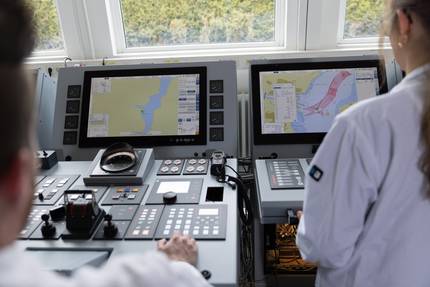
Having such smart technology can be helpful but also dangerous. Our dependence on technology is in some cases replacing common sense. The sacred art of celestial navigation has been superseded by a new found faith in cellular navigation. A smart boat is never a substitute for a skilled mariner, yet mariners can easily be lured into trusting a digital display. With so many graphics and vivid screens, the eye can easily be caught. Such distractions in the wheelhouse have proven to be the instigator in several accidents. Currently, there is no marine regulated metric for the accuracy of smart applications nor is there an approved standard operating procedure. At present, standards are however being refined and developed specifically for e-Navigation. It is hard to say if the Coast Guard will develop standards and regulations for smart devices. In 2004, the USCG saw the benefit of advanced technology and issued a requirement for certain vessels to procure and operate an Automatic Identification System (AIS). At first, many vessel owners were claiming that AIS was unnecessary and the added cost couldn’t be justified, but now they have found an added level of comfort in looking at a pilot house display and knowing “who is who” out in the channel.
Wrapping it Up:
Smarter boats are the trend, but danger lurks when the mariner becomes too engrossed or negligently relies solely on the technology when making decisions. It is easy to be duped by the factual façade that a digital display emits. The virtual watchman can only do so much. Neglecting to upgrade and implement the latest technology will however cause your operation to lag behind the competition. Bear in mind that while the end-user interface is typically quite simple, installing the various components and getting them to talk to each other can be a complex process. For an iBoat to work properly, connectivity is key. Remember, in the i-world the only thing worse that low signal or no signal is the loss of power – that, and dropping your smart device overboard.
(taken from MarineNews magazine's June 2012 print edition)
Joe Hudspeth is Business Development Manager at All American Marine, Inc., a manufacturer of high speed passenger ferries, excursion vessels, and work boats, in Bellingham, WA. Hudspeth has been involved with maritime sales, marketing and product development since 2000. He currently serves as a regional co-chairman for the Passenger Vessel Association and participates on several committees concerned with marine industry issues. Reach him at [email protected]