
First Person: Whales & ROVs in Patagonia
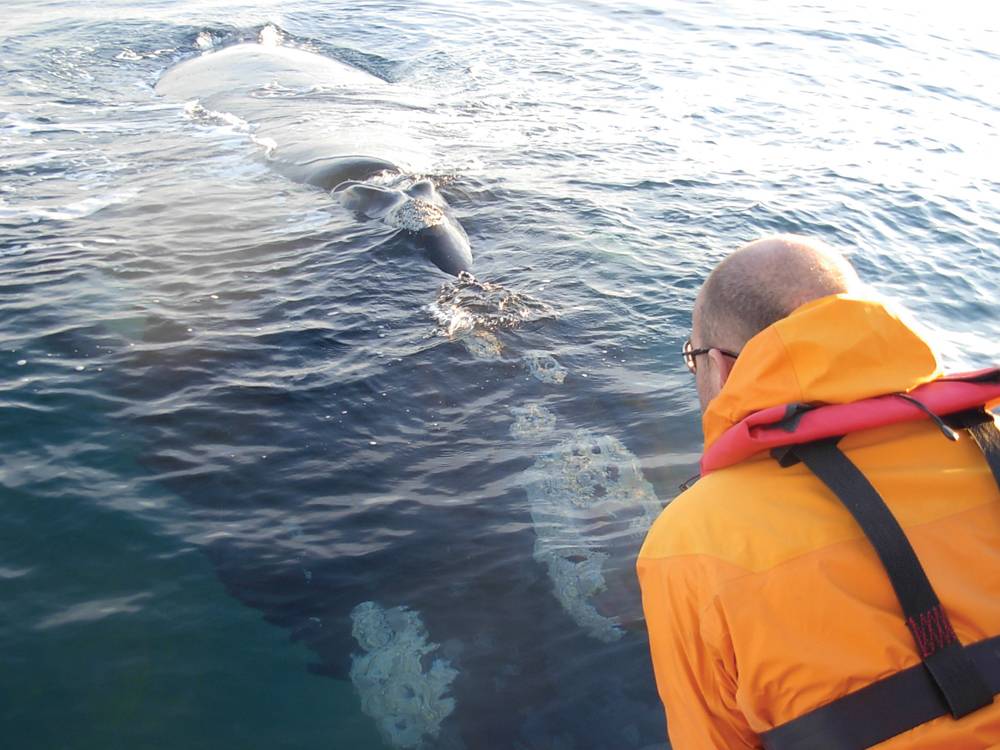
Several years ago I found myself on a tourist boat that carries out whale watching tours in Península de Valdés, Patagonia, Argentina. This location became famous over the last 30 years, due to the massive yearly encounter of the southern right whales (Eubalena australis) during their mating and birth period from May to December. The southern right whale got its name due to the friendly behavior and the fact that they float when the animal is dead. This was the ‘right’ whale to chase.
In the northern hemisphere, their cousins the northern right whales (Eubalena glacialis) have been nearly extinguished. With a current estimated population of 300 – 500 animals remaining, it appears that there are too few for a marine mammal population to recover.
The southern right whale had a bit more luck, and several thousands remained alive (the actual estimate today is around 7,000 animals).
As many as 1000 to 1500 of these friendly giants visit the coasts of Peninsula de Valdés each year. Until the early 70s this event was known only by the local fishermen. Dr. Roger Payne and Dr. Bernd Würsig are reportedly the first researchers to realize the incredible potential this areas offers to the research on whales and marine mammals. Not only whales live in these waters, also dolphins, orcas, sea lions, sea elephants and an incredible number of birds are present part of the year or living permanently along these amazing coasts.
It was not until the early 80’s that the first visitors came here to join a very archaic kind of whale watching. Some local divers used their small boats and took few enthusiastic ‘Indiana Jones’-type passengers to see the whales. An increasing interest by local, national and finally international tourists was the responsible for a growing whale watching activity, culminating in Unesco’s declaration of world heritage in 1999. Argentina declared this species the first natural monument of the country in 1984.
During the last decade, the laws and ordinances for the activity of whale watching has been increased and only six companies are allowed to navigate with the whales, in a strictly controlled and professional manner.
Tourist Onboard
And there I was, sitting in one of these boats as a tourist together with my wife Cristina and our two sons Emilio and Enrique. As a physical oceanographer I had been involved in the research of dolphin’s communication in the late 80’s and early 90’s. Still a student at that time, I already carried out my own projects in southern Spain and Italy, with a bunch of fellows, enthusiastic of interdisciplinary research (not really in vogue at that time). Since several projects I submitted to the European community were rejected with the simple judgment of ‘interesting but not fundable,’ I decided to create my own company and to build the equipment I thought I needed for my research. With this idea in mind, Mariscope Meerestechnik in Germany was born.
The guide took us a couple of miles away from the location of Puerto Pirámides and along the trip we saw Whale spouts, some fins and tails and far away a whale jumping. The excitement was high, but our guide told us that this was just the beginning.
What we saw a couple of minutes later is impossible to describe. Even after several hundreds of hours working with these animals it still is impossible to describe the feeling when the boat stops, and a 15-16 m, 30-40 ton whale of approaches the boat gently, ever mindful of the strange animals above screaming and shouting. More than that it is incredible to watch the giant observe the diver underwater, at a distance of less than 1 meter with its eye, as big as plate.
The diver is never the one who observes, it is always the whale observing the diver. After the first tour a second followed, and my drive as a researcher led to some small talk with the guide. I was sure that since the early years of Dr. Payne and Dr. Würsig, the knowledge on the habits and behavior had increased enormously and that the ongoing research was carried out under the highest standards. The knowledge has been increased in fact, but ongoing researchwas under-financed and at a low level. I reasoned that “surely hundreds of hours of observations with ROVs have been carried out,” but was surprised to find, according to the guide of 20 years, Claudio Nicolini, that the use of ROVs to make study of the whales had never been conducted.
As ROV manufacturer and scientist this was exactly the information I needed to take an immediate decision: to do it.
Two months later we were again on site but this time with ROV. But with the technology arrived bureaucracy too; and our initial request to put something in the water was immediately rejected.
Another hurdle was transport to the whales, as the limited number of carriers was focused on taking tourists – 50 to 70 per trip – and making money, so bringing an ROV into the water was not as commercially viable.
But then we were let to PININO.
“He is the owner of Whales Argentina, you will recognize him immediately because he is really an old sea bear,” we were told.
But this marked the start of an ongoing research work and amazing friendship with
A few months later we started to carry out the first trials with ROVs near the whales. First, we needed to know how these animals react to a machine, particularly the noise being made underwater and the closer proximity than a diver normally takes. The result was astonishing, as there was no change in the behavior. We were able to approach the animals without any problem most of the times. On occasion, the whales came to see the ROV, as they do with the tourist boats. On many occasions, they simply ignored the vehicle, allowing us to observe and document their behavior.
And then, one day, was our absolute highlight: We saw to tails rising nearly simultaneously out of the water, and the ROV operation was immediately initiated. A few minutes later we were looking at the mating of two right whales under water and were able to record the complete scene with perfect details. The distance between the ROV and the whales was just a few centimeters, but the whales kept going on with their business without any sign of interference with the machine.
From the first experiments we have modified the ROVs to get better research results. Now we are trying to record the feeding behavior of the whales at a depth of around 100 m. This is a difficult task, since the ROV has to dive nearly as fast as the whales do. The first results are encouraging. Additionally, we are carrying out research using actual satellite images analyzed by my wife Cristina, a PhD in Satellite Oceanography. Combining Oceanographic direct measurements, Satellite images and ROV observations, we are getting astonishing information, impossible to collect without the most advanced technologies in each of these scientific areas.
-------------
A new feature in the pages of Marine Technology Reporter, “First Person” seeks insights from those working in the field as to their unique personal and professional stories. For details on appearing in this spot, Email: [email protected] for full details.
(As published in the September 2012 edition of Marine Technology Reporter - www.SeaDiscovery.com)