NOAA Satellites Help Rescue 207 in 2011
press release
Wednesday, January 25, 2012
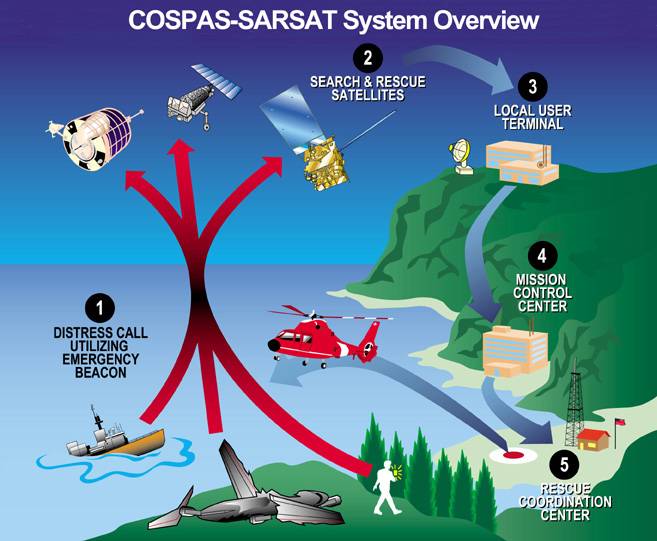
File SARSAT System Overview (NOAA Photo).
SARSAT System Overview (NOAA Photo).

In 2011, NOAA satellites were critical in the rescues of 207 people from life-threatening situations throughout the United States and its surrounding waters.


The satellites picked up distress signals from emergency beacons carried by downed pilots, shipwrecked boaters and stranded hikers, and relayed the information about their location to first responders on the ground. NOAA’s polar-orbiting and geostationary satellites are part of the international Search and Rescue Satellite Aided Tracking System, called COSPAS-SARSAT. This system uses a network of satellites to quickly detect and locate distress signals from emergency beacons onboard aircraft and boats, and from smaller, handheld personal locator beacons called PLBs.


Of the 207 saves last year, 122 people were rescued from the water, 14 from aviation incidents, and 71 in land situations where they used their PLBs. Other rescue highlights from the year include:


  • Alaska had the most people rescued on land last year with 39, followed by Florida with 11, and California with 8.
  • NOAA SARSAT played a critical role in the rescue of a group of student hikers from a grizzly bear attack in Alaska by directing first responders to the scene.
  • In the pitch of night, two people were rescued from a life raft after their boat sank 140 miles off the coast of Marco Island, Fla.
  • An elderly hiker was rescued 74 miles south of Colorado Springs, Colo., during a heavy snowstorm.


“With each rescue, this system performs the way it was intended — as a real, life-saving network,” said Chris O’Connors, program manager for NOAA SARSAT.


When a NOAA satellite finds the location of a distress signal, the information is relayed to the SARSAT Mission Control Center based at NOAA’s Satellite Operations Facility in Suitland, Md. From there, the information is quickly sent to a Rescue Coordination Center, operated by either the U.S. Air Force for land rescues or the U.S. Coast Guard for water rescues.


Since 1982, COSPAS-SARSAT has been credited with supporting more than 30,000 rescues worldwide, including more than 6,700 in the United States and its surrounding waters.


By law, owners of emergency beacons are required to register them with NOAA at:  http://www.beaconregistration.noaa.gov. That registration information often helps provide better and faster assistance to people in distress. It may also provide information about the location of the emergency, how many people need assistance, what type of help may be needed and other ways to contact the owner. At the end of 2011 NOAA’s registration database contained over 329,000 registrations.


NOAA’s mission is to understand and predict changes in the Earth's environment, from the depths of the ocean to the surface of the sun, and to conserve and manage our coastal and marine resources. Join us on Facebook, Twitter and our other social media channels.

Email AddThis Feed Button
Maritime Reporter February 2012 Digital Edition
FREE Maritime Reporter Subscription
Latest Maritime News    rss feeds

People & Company News

Vessel Design with the Crew in Mind

Before any keel is ever laid, naval architects spend considerable time in determining how exactly the vessel must come together. All great marine craft still need

Australia to be Largest Gas Exporter?

Oil and gas professionals tip Australia to become world’s largest gas exporter by 2030.     Delegates at the 2012 Australasian Oil and Gas Conference

ISS Launches Operations in Saudi Arabia

Joint venture with Al Bakri Group set to create leading maritime and cargo services business in the region. Inchcape Shipping Services (ISS), the world’s leading maritime services provider,

Maritime Security

Statement from SOS SaveOurSeafarers

Following Tuesday’s conference on Somali piracy organised by the UK’s Foreign & Commonwealth Office and held at the IMO’s London headquarters,

Seafarer Voices: Piracy on the High Seas

A YouTube video series describing pirate attacks.   Among discussions of anti-piracy measures in the Gulf of Aden and special courtrooms in the Seychelles and Mauritius,

The Pirate Surge That Never Was

  In September 2011, as the monsoon began to blow itself out, there were grave warnings from a number of sources and analysts that the shipping industry could

Casualties

Lloyd's Register Safety Alert

Safety alert: Steering gear control wheel potentiometer failure resulting in vessel grounding.   Applicabilty: All shipowners and operators.   Following

ASA Member Completes WA Recovery Operation

American Salvage Association member salvages Hydrogen Reactor outside of Seattle. A member of the American Salvage Association (ASA) responded to a call on December 9 to salvage a 485-ton,

ISU Names Hoddinott General Manager

TITAN Salvage’s Mark Hoddinott Accepts Position as General Manager at ISU.   TITAN Salvage's Mark Hoddinott has accepted the position of general manager

Maritime Safety

Vessel Design with the Crew in Mind

Before any keel is ever laid, naval architects spend considerable time in determining how exactly the vessel must come together. All great marine craft still need

Lloyd's Register Safety Alert

Safety alert: Steering gear control wheel potentiometer failure resulting in vessel grounding.   Applicabilty: All shipowners and operators.   Following

Statement from SOS SaveOurSeafarers

Following Tuesday’s conference on Somali piracy organised by the UK’s Foreign & Commonwealth Office and held at the IMO’s London headquarters,

Government Update

This Day in Naval History - Feb. 22

From the Navy News Service:   1865 - A Union squadron under the command of Rear Adm. David Dixon Porter bombards and captures Wilmington, N.C. 1870 - After arriving on USS Nipsic,

Statement from SOS SaveOurSeafarers

Following Tuesday’s conference on Somali piracy organised by the UK’s Foreign & Commonwealth Office and held at the IMO’s London headquarters,

Roundtable Associations: Timing Not Right for MBM

The RT fully supports the adoption at IMO of mandatory Energy Efficiency Design Index (EEDI) for new ships and the Ship Energy Efficiency Management Plan (SEEMP) for all ships.


Maritime Careers / Shipboard Positions Maritime Standards Naval Architecture Navigation Offshore Oil Pipelines Pod Propulsion Port Authority Salvage Shipbuilding / Vessel Construction
mobi | rss feeds | archive | history | articles | privacy | contributors | top news | about us | copyright