Marine Design: Air Supported Vessels Impress
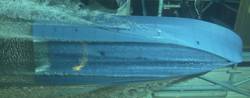
Effect Ships International AS (ESI) is reporting extraordinary results from tank testing of two Air Supported Vessel (ASV) hull forms, a catamaran- and a mono candidate. A reduction in hull resistance of up to 50%; or more than 40% net powering cut, after deduction of fan powering, has been documented with the ASV mono concept.
Lately, air assisted hulls forms have gained increasingly more interest from the maritime sector. In December 2011, Marine Link, presented results from Marin on air lubrication techniques, reporting claims of up to 15% power reduction for” inland ships operating at normal speeds”. In January 2012 Mitsubishi referred to their Mitsubishi Air Lubrication System (MALS) pumping air bubbles onto a ship’s hull to reduce friction, claimed to reduce the power and fuel consumption by up to 10%.
So which one is the better to reduce hull water resistance and fuel consumption, air supported technique, air lubrication or air bubbles?
Ulf Tudem, spokesperson for ESI, comments: “It is unquestionable that a full separation between the vessel’s hull and water, by means of a proper layer of air (ASV) will reduce resistance more than use of an air and water mix (air lubrication) on the same underwater area. “Bubbling the hull” will have the least hull resistance reducing effect of the three concepts. However, a fair assessment must be carried out on vessels of similar size, weight and speed with the same operational conditions. The high fuel cost is forcing the industry to look outside the box for more efficient solutions. A significant reduction in fuel consumption will not only reduce operational cost but will also positively influence the second hand value of the most economical to operate ships. The environmental benefits will also play an important role.”
In BB GREEN, a project under EU 7th Framework, a seven partner strong European consortium is developing the world’s first Zero emission fast ASV commuter ferry, to be operated on battery power only; and with a design speed of 30 - 35 knots. The vessel will have a length of approx 20 m with a beam of 6 m; and will be designed to carry up to 100 Pax and a number of bicycles.
The first hurdle to overcome is to develop a hull with a markedly reduced hull resistance, and with load carrying capability to handle the weight of the battery pack and passengers.
The BB GREEN ASV Mono hull, now tank tested at SSPA, is designed for relatively sheltered waters. Low hull resistance over a wide range of speeds and modest wake wash have been key design objectives. State of the Art planing hulls has been used as the bench mark. Resistance tests were carried out at speeds from 10 knots all the way to 50 knots, full scale values.
To the amazement of the SSPA test team the ASV displayed a very low resistance already from 10 knots, corresponding to approx half that of the planing craft. Between 15 and 35 knots the hull resistance curve was almost flat, and above this speed the increase was modest.
Wake wash was also pleasantly low, and well below the levels set by the Dutch Authorities for operating i.e. around Rotterdam, which is a targeted operational area for the BB GREEN. Dutch ferry operator Aqualiner is the end user partner in the project.
ESI will soon start another ASV Mono project; design development of a 24 m fast ASV Environmental Ferry, for operation on routes along the Norwegian coast. A soft motion hull form will be developed tailor made for use of Volvo Penta IPS propulsion system. The project will be supported by Innovation Norway. Collaboration partners will be Br. Aa, Diab and ferry operator Torghatten Nord. SSPA (Sweden) and Studio Sculli (Italy) will also contribute.
In Indonesia the first ASV fast crew boat is under construction, a 22 m constructed by Pt. Eka Multi Bahari.
ESI is a leader in design of air supported hulls with more than 10 years dedicated research and development leading to their worldwide patented ASV technology. The company has already successfully tested a range of ASV catamaran hulls for fast ferries as well as 125 m + RORO/ROPAX designs. Tank testing at SSPA Sweden has been frequently used. More than 1.200 fully instrumented test runs have been completed. In addition large manned models have been tested at sea, research supported by EU (5th Framework project EFFISES), Norwegian Research Council and Innovation Norway. ESI has also produced a 20 m full size ASV mono vessel, demonstrating a 50 + % fuel consumption reduction over comparable market leading conventional vessel at a wide range of speeds.