Testing Breaking Waves vs. Offshore Wind Turbines
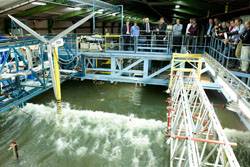
More than 60 representatives of the international offshore wind industry gathered last week at the Offshore Wind Seminar, organized by the Maritime Research Institute Netherlands (MARIN) and the Energy research Centre of the Netherlands (ECN). This seminar included a visit to unique model tests in the MARIN facilities of breaking waves against an offshore wind turbine. This pilot series of model tests, with a special model of an offshore wind turbine with realistic flexibility, was completed and confirmed that breaking waves can induced significant oscillations and accelerations in the turbine.
Dr. Bas Buchner, Vice President of MARIN and leader of its Renewable ENergy Team (RENT), said, “MARIN wants to contribute to the development of reliable offshore renewable energy with this expertise from the maritime industry. Breaking waves can occur quite often in the shallow water areas of fixed wind turbines. Considering the relatively flexible foundations and towers of offshore wind turbines, we realized that the impulsive loading of breaking waves might result in resonant vibrations of the structure. This can have significant effects on the loads in the tower and accelerations in the critical mechanical systems at nacelle level . But we did not want to state this as a problem without a confirmation, so we developed these pilot model tests within our own R&D.”
For this purpose a special model was developed by MARIN’s specialists in the field of hydrodynamic loading and structural response. The model material and set-up was chosen such that the model had the correct flexibility and natural periods, a technique recently developed to investigate the vibrations of ships in extreme waves.
The initial results of the tests confirm that the tower can vibrate due to the breaking waves. Erik-Jan de Ridder, the responsible MARIN Project Manager, said, “When a large wave hit the foundation and tower, the tower started to vibrate at its natural periods. At nacelle level this resulted in large horizontal accelerations, in one case even up to 0.5g (5m/s2). Although these results need further analysis, the first observation is that these values are large and will impact the design and operation of the turbine.”
The test results will now be further analyzed together with MARIN’s partner ECN based on its extensive expertise in turbine design, mechanics and dynamics. Aart van der Pal, Manager Integral Wind Turbine Design of ECN, said, “Breaking wave loads can affect the extreme and fatigue loads on the foundation, tower, turbine blades, shaft, gearbox and generator, aspects that have not been studied in detail so far. This will need to be taken into account in the design process.”
Together with a number of other partners, MARIN and ECN are in the process of starting up a Joint Industry Project (JIP) with the acronym ‘WiFi’: Wave impacts on Fixed turbines. As independent institute in the Offshore and Shipping industry, MARIN has a lot of experience in leading JIPs. The objective of the WiFi JIP is to develop a design methodology for offshore wind turbines that includes the effect of steep and breaking waves.