NOAA Releases Study on Deepwater Horizon Controlled Burns
Wednesday, September 21, 2011
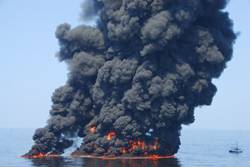
File Black smoke billows from a controlled burn of surface oil during the 2010 Deepwater Horizon oil spill. A new study by NOAA and the Cooperative Institute for Research in Environmental Sciences (CIRES) found that controlled burns released more than one million pounds of sooty black carbon into the atmosphere.
Black smoke billows from a controlled burn of surface oil during the 2010 Deepwater Horizon oil spill. A new study by NOAA and the Cooperative Institute for Research in Environmental Sciences (CIRES) found that controlled burns released more than one million pounds of sooty black carbon into the atmosphere.

During the 2010 BP/Deepwater Horizon Gulf oil spill, an estimated one of every 20 barrels of spilled oil was deliberately burned off to reduce the size of surface oil slicks and minimize impacts of oil on sensitive shoreline ecosystems and marine life.


In response to the spill, NOAA quickly redirected its WP-3D research aircraft to survey the atmosphere above the spill site in June. During a flight through one of the black plumes, scientists used sophisticated instrumentation on board, including NOAA's single-particle soot photometer, to characterize individual black carbon particles. The black smoke that rose from the water’s surface during the controlled burns pumped more than 1 million pounds of black carbon (soot) pollution into the atmosphere, according to a new study published last week by researchers at NOAA and its Cooperative Institute for Research in Environmental Sciences (CIRES) in Boulder, Colo.This amount is roughly equal to the total black carbon emissions normally released by all ships that travel the Gulf of Mexico during a 9-week period, scientists noted.


Black carbon, whose primary component is often called soot, is known to degrade air quality and contribute to warming of the Earth’s atmosphere. The new study, published online this week in Geophysical Research Letters, provides some of the most detailed observations made of black carbon sent airborne by burning surface oil.


“Scientists have wanted to know more about how much black carbon pollution comes from controlled burning and the physical and chemical properties of that pollution. Now we know a lot more,” said lead author Anne Perring, a scientist with CIRES and the Chemical Sciences Division of NOAA’s Earth System Research Laboratory (ESRL) in Boulder, Colo.
Global surface temperature Anomalies - August 2011.


Black carbon is the most light-absorbing airborne particle in the atmosphere and the reason for the black color in the smoky plumes that rise from the surface oil fires. Black carbon can also cause warming of the atmosphere by absorbing light. Prolonged exposure to breathing black carbon particles from human and natural burning sources is known to cause human health effects. During the 9 weeks active surface oil burning, a total of 1.4 to 4.6 million pounds (0.63 to 2.07 million kilograms) of black carbon was sent into the atmosphere of the Gulf of Mexico, the study estimated.


The study found that the hot soot plumes from the controlled burns reached much higher into the atmosphere than ship emissions normally rise, potentially prolonging the amount of time the black carbon can remain in the atmosphere, which would affect where the black carbon ends up. The researchers also found that the average size of the black carbon particles was much larger than that emitted from other sources in the Gulf region, and that the emitted particles produced were almost all black carbon, unlike other sources such as forest fires that tend to produce other particles along with black carbon. “The size and makeup of the black carbon particles determine how fast the particles are removed from the atmosphere by various processes, which ultimately affects their impact on climate,” says Perring. Larger particles are removed from the atmosphere more quickly and thus have smaller climate impacts. And, those same properties of black carbon are important for assessing human health impacts.


Finally, Perring and her colleagues found that of the oil that was burned, 4 percent of the mass was released as black carbon, an important metric rarely observed during cleanup of an oceanic oil spill, which could help guide future decision-making. The new paper, Characteristics of Black Carbon Aerosol from a Surface Oil Burn During the Deepwater Horizon Oil Spill, has 15 co-authors from NOAA ESRL and CIRES and can be found on the Geophysical Research Letters website. As part of its response to the Deepwater Horizon oil spill, the unified federal response team used controlled burns to remove oil from the open water in an effort to minimize impacts to the shoreline and marine and other wildlife. For more information about the federal response to the Deepwater Horizon oil spill and ongoing restoration efforts in the Gulf of Mexico, visit RestoreTheGulf.gov.
Email AddThis Feed Button
Maritime Reporter May 2013 Digital Edition
FREE Maritime Reporter Subscription
Latest Maritime News    rss feeds

Environmental

Spying Oil Spills from Space

The Australian Maritime Safety Authority (AMSA) is trialing the use of satellites to detect oil spills in Australian waters. Satellite-based Synthetic Aperture

Second Hybrid Ferry Launched on the Clyde

A cutting edge ferry, which is the second of two hybrid vessels, was launched on the Clyde today at Ferguson's shipyard in Port Glasgow. The ferries are being built

Wärtsilä to Supply Direct Electric Heating for Chevron African Offshore Oilfield

Wärtsilä was contracted to supply its Direct Electric Heating (Wärtsilä DEH) system for Chevron Overseas Congo Limited's Lianzi offshore development project, located

Education/Training

Vice President Biden Addresses USCG Class of 2013

Vice President Joe Biden welcomed the U.S. Coast Guard Academy’s Class of 2013 as the Coast Guard’s newest officers, saluting their service and emphasizing the

Lloyd’s Approves Hyundai LNG Carrier Training Facility

Hyundai Merchant Marine subsidiary has been granted Approved Training Provider status for their facilities and LNG carrier training courses to SIGTTO Training Standards.

Ambrey Risk Launches New Training Website

Maritime security specialist, Ambrey Risk, based in Herefordshire, U.K., launched a new training and recruitment website: www.ambreytraining.com, outlining their

Salvage

Two Vessels Grounded off Scotland Coast

Two ships ran aground Tuesday off the west coast of Scotland, according to Herald Scotland. The first vessel, the 87-meter passenger cruise vessel Serenissima,

NOAA Report Examines Shipwreck Oil Pollution Threat

NOAA presented to the U.S. Coast Guard today a new report that finds that 36 sunken vessels scattered across the U.S. seafloor could pose an oil pollution threat

American Salvage Association to Consider Non-Tank VRP's

New regulations for non-tank vessel response plans (VRP) to be discussed at upcomingNational Maritime Salvage Conference One issue on the conference agenda will

Coast Guard

Overboard Sailor Rescued off French Coast

A British man has been rescued after falling overboard from a yacht off the coast of Ushant in France. Brixham Coastguard received a 999 call just after 3 p.

Vice President Biden Addresses USCG Class of 2013

Vice President Joe Biden welcomed the U.S. Coast Guard Academy’s Class of 2013 as the Coast Guard’s newest officers, saluting their service and emphasizing the

Bollinger Delivers Coast Guard FR-Cutter

Bollinger Shipyards, Inc. deliver  'Paul Clark', the sixth Fast Response Cutter (FRC) for the United States Coast Guard. The announcement was made by Bollinger

People in the News

DHS Unveils Official Portrait of Former Secretary Tom Ridge

Secretary of Homeland Security Janet Napolitano hosted the first U.S. Department of Homeland Security (DHS) Portrait Unveiling Ceremony in honor of Governor Tom

Vice President Biden Addresses USCG Class of 2013

Vice President Joe Biden welcomed the U.S. Coast Guard Academy’s Class of 2013 as the Coast Guard’s newest officers, saluting their service and emphasizing the

'Ones to Watch' CIO Award for Two NNS Employees

Two Huntington Ingalls Industries' Newport News Shipbuilding (NNS) division employees were recognized recently at the CIO Leadership Event. Deborah Morewitz and

Government Update

Spying Oil Spills from Space

The Australian Maritime Safety Authority (AMSA) is trialing the use of satellites to detect oil spills in Australian waters. Satellite-based Synthetic Aperture

DHS Unveils Official Portrait of Former Secretary Tom Ridge

Secretary of Homeland Security Janet Napolitano hosted the first U.S. Department of Homeland Security (DHS) Portrait Unveiling Ceremony in honor of Governor Tom

Vice President Biden Addresses USCG Class of 2013

Vice President Joe Biden welcomed the U.S. Coast Guard Academy’s Class of 2013 as the Coast Guard’s newest officers, saluting their service and emphasizing the


mobi | rss feeds | archive | history | articles | privacy | contributors | top news | about us | copyright