Arctic Nautical Charts: NOAA Plans Updates
Press Release
Tuesday, February 26, 2013
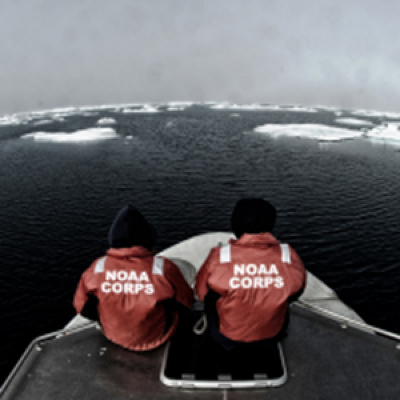
File Two NOAA Corps Officers aboard
Two NOAA Corps Officers aboard 'Fairweather': Photo credit NOAA

Less sea ice and more ship traffic means new charts needed for safety.

NOAA’s Office of Coast Survey has issued an updated Arctic Nautical Charting Plan , as a major effort to improve inadequate chart coverage for Arctic areas experiencing increasing vessel traffic due to ice diminishment.

NOAA plans to create 14 new charts to complement the existing chart coverage. For example, seven of the charts will complete chart coverage from the Alaska Peninsula to Cape Lisburne at the edge of the North Slope, and more charts support the future maritime transportation infrastructure in the coastal areas north of the Aleutian Islands.

“As multi-year sea ice continues to disappear, vessel traffic in the Arctic is on the rise,” said Rear Admiral Gerd Glang, NOAA Coast Survey director. “This is leading to new maritime concerns about adequate charts, especially in areas increasingly transited by the offshore oil and gas industry and cruise liners.”
“Given the lack of emergency response infrastructure in remote Arctic waters, nautical charts are even more important to protect lives and fragile coastal areas,” Glang said.

Commercial vessels depend on NOAA to provide charts and publications with the latest depth information, aids to navigation, accurate shorelines, and other features required for safe navigation in U.S. waters. But many regions of Alaska’s coastal areas have never had full bottom bathymetric surveys, and some haven’t had more than superficial depth measurements since Captain Cook explored the northern regions in the late 1700s.

“Ships need updated charts with precise and accurate measurements,” said Capt. Doug Baird, chief of Coast Survey’s marine chart division. “We don’t have decades to get it done. Ice diminishment is here now.”


Email AddThis Feed Button
Maritime Reporter May 2013 Digital Edition
FREE Maritime Reporter Subscription
Latest Maritime News    rss feeds

Technology

Polytunnel Helps Museum Salvage WWll Airplane

A team of restoration experts is currently hard at work salvaging a unique World War II aircraft from the bottom of the English Channel. Using cutting edge restoration

AUV Manufacturing a Growth Industry Says New Report

Strong revenue growth will continue over the next five years as AUV's (Autonomous Underwater Vehicle) are increasingly used in commercial scenarios predicts IBISWorld's market research.

Duma Looks Deep Down for Energy

US's Duma Energy Corp. says it has received new 3D seismic data in its search for deeper oil reserves in its Galveston Bay producing fields. This new data, which

Navigation

McMurdo Widens Range with New Transponder

McMurdo, a business of the Orolia Group, announced that Smartfind M5 AIS Class A Transponder is now available. The Smartfind M5 Automatic Identification System (AIS) Class A Transponder,

Raytheon Anschuetz Introduce Shipborne Training Simulator

Raytheon to unveil at upcoming CANSEC 2013 Expo an onboard navigation simulator that allows operators to train with the system they will use at sea. Raytheon Anschuetz,

Australian Reef Protected by New Safety Initiative

To protect the World Heritage-listed Ningaloo Coast in Western Australia’s north-west region, the Australian Maritime Safety Authority (AMSA) to establish an area ships should avoid.

Arctic Operations

GAC Pushes Further into the Arctic with Polar Logistics Group

GAC Norway AS and Polar Logistics Group ApS (POLOG) formed a strategic partnership to further strengthen GAC's network within the Arctic Circle. The move is

U.S. Coast Guard Commandant Papp Reveals Arctic Strategy

Uncharted Ice: The U.S. Coast Guard's New Arctic Strategy.   U.S. Coast Guard Commandant Bob Papp today revealed the nation's and the Coast Guard's blueprint for Arctic strategy.

Arctic Council Sign Oil Spill Agreement

At their recent meeting the circumpolar states of the Arctic Council have agreed to tackle oil spill disasters as a team. The Agreement on Cooperation on Marine


mobi | rss feeds | archive | history | articles | privacy | contributors | top news | about us | copyright