

Cal Poly Maritime Academy Celebrates Class of 2026

Cal Poly Maritime Academy (formerly the CSU Maritime Academy) will award 150 bachelor’s degrees and 20 master’s degrees at its commencement ceremony Saturday, May 2, at Bodnar Field.
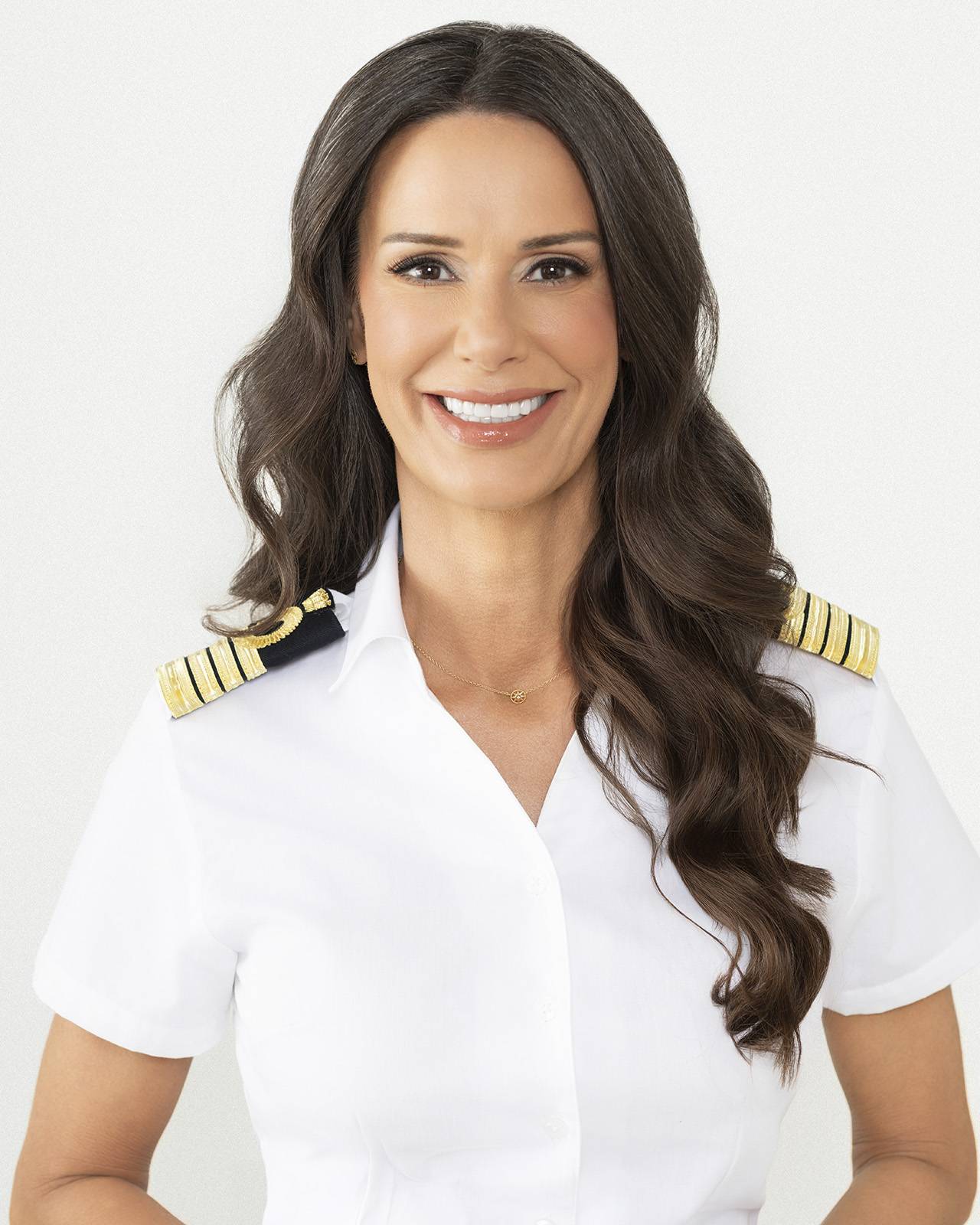
The university will also award an Honorary Doctor of Science degree to Capt. Kate McCue, who graduated in 2000 with a bachelor’s degree in business administration and is the inaugural captain of Four Seasons.
McCue is an internationally recognized maritime leader whose career spans nearly three decades at sea. In 2015, she became the first American woman to command a megaton cruise ship at Celebrity Cruises, a milestone that expanded opportunity and visibility for women in the maritime industry.
Today, she serves as the inaugural captain of Four Seasons I, helping launch a new era in luxury yachting.
A proud alumna and member of the Class of 2000, McCue’s journey from cadet to captain reflects the enduring impact of a Cal Poly Maritime Academy education and the institution’s Learn by Doing philosophy.
“Capt. McCue’s career is a powerful example of what it means to Learn by Doing,” said Armstrong. “From her time as a Cal Maritime cadet to her leadership on the global stage, she represents the excellence, determination and real-world readiness that defines Cal Poly Maritime Academy and its graduates.”
Throughout her career, McCue has led crews across the globe, navigated complex maritime environments and built a reputation for leadership, professionalism and innovation.
“My college education played a defining role in shaping my career and my confidence at sea,” McCue said. “The hands-on experience I gained as a cadet taught me how to lead, make decisions under pressure and trust my training. I’m honored to return and celebrate the next generation of maritime leaders who are learning by doing every day.”
Honorary degrees are among the highest distinctions conferred by the university and recognize individuals whose accomplishments and contributions reflect the values and mission of Cal Poly Maritime Academy.
Ceremonial traditions
A commissioning ceremony will be held at 9 a.m., where 14 graduating midshipmen will take an oath of office and commission as officers in either the U.S. Navy Reserve Strategic Sealift Officer Force or U.S. Navy. Additional cadets will earn their licenses following the completion of upcoming summer sea training.
The commencement ceremony will follow at 11 a.m., where the degree-eligible students will be celebrated in front of a crowd of their families, faculty and staff members, city and county elected representatives and university leaders.
The occasion marks the final graduating class of Cal Maritime students, as the university is integrating with Cal Poly in San Luis Obispo, and future graduates will receive Cal Poly degrees.
This year’s class will join a network of nearly 4 million alumni across the California State University system who are making a global impact.
“We are so proud to celebrate the remarkable achievements of the class of 2026,” Cal Poly President Jeffrey D. Armstrong said. “The hands-on learning these students have gained by navigating challenges on land, in labs, through work experience and aboard the Training Ship Golden Bear have prepared them to build successful careers and communities across California and the world.”
Tradition is rich throughout the ceremony: To begin, Summer Sea Term Corps Cmdr. Jenny Scott will ring the ship bell three times and welcome guests and graduates. At the end, outgoing Corps Cmdr. Tyler Venator will ring it again three times to signify “last watch” for the members of the Corps of Cadets of the class of 2026.
Cadet success
As a high school senior, Tyler Venator dreamed about studying mechanical engineering in college — but not of taking notes in a large lecture hall. He sought a more hands-on education and turned to his family for advice.
“My father suggested Cal Maritime, because he went here and he thought the engineering program aligned with my interests,” Venator said. “After I saw the campus and the ship, the Training Ship Golden Bear, I knew I wanted to come here.”
Four years later, Venator is ready to begin his career in shipbuilding and repair at General Dynamics NASSCO in San Diego, in the only full-service shipyard on the West Coast, and over time, move into project management.
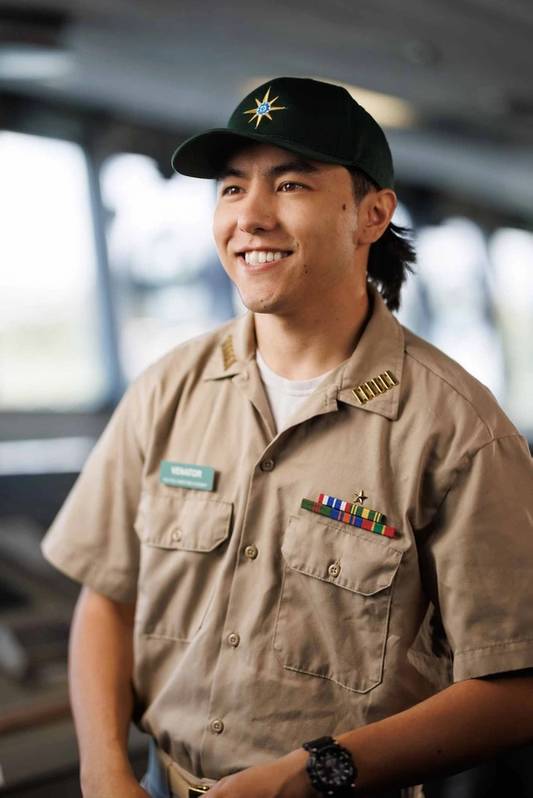
The Santa Clara, California, resident stands apart from his class peers; he rose through the ranks to become commander of the Corps of Cadets, as shown by the six-bars on his collar.
“I’m the senior-most cadet on campus in terms of leadership,” the 22-year-old said. “We’re like a pyramid structure. We’re self-governing, self-run. So, my job is to manage the day-to-day activities, making sure we’re adhering to standards set by the Coast Guard and the Maritime Administration,” a U.S. Department of Transportation agency that promotes, develops and regulates the nation’s waterborne transportation system.
Cadets aren’t just students — they’re part of a crew. Every undergraduate in a license-track major (that identifies graduates as qualified mariners capable of operating and managing commercial vessels) is in the corps, but any student on campus can join, he said.
“You’re a student everywhere else, but you’re a cadet here, and what that means is you are paying attention to detail, your timeliness, your professionalism,” Venator said. “This is a leadership laboratory. So, you’re going to get opportunities and networking events that you would not have elsewhere.
“Wearing a uniform every day is one example of our attention to detail. Showing up to formation at 7 o’clock in the morning is another example. So, when we produce our graduates, they are instantaneously ready to be leaders in whatever industry they choose to go into.”
He embraced the Learn by Doing ethos from the first day he put on his khaki uniform. “We’re getting our hands on: on engines, on pumps. We’re getting dirty,” he said — especially on days when cadets don their dark-blue coveralls — a working uniform. “That means we are on our way to or coming from a class where we’re probably getting dirty.”
And they put what they learn into practice. License-track cadets go on three cruises, two aboard the school’s 500-foot training ship (also a floating classroom and lab for students in marine transportation and engineering) and a summer internship on a commercial vessel.
Last summer’s two-month sea term aboard the Training Ship Golden Bear departed Vallejo in May with a crew of 273 and stops in San Diego, Hawaii, Guam, the Northern Mariana Islands and Seattle before returning in early July.
The unique experience enriches global awareness while learning in an immersive classroom rolling through Western Pacific waters. This is accomplished while developing navigation, engineering and maritime leadership and career skills from duty on the bridge to the deck and into the engine room.
Venator believes that ethos helps every student prepare for careers as a seafarer.
“The combination of hands-on learning and built-in leadership experience sets us apart,” he said. “Unlike many universities, we don’t just develop students in the classroom. Our rigorous academics are paired with extensive practical training, and our graduates also stand out because of the leadership responsibilities they take on as cadets.
“By the time they graduate, all first-class cadets (seniors) will have more than a year of experience leading teams of underclassmen.”
As a freshman, formation days began in uniform at 6:30 a.m., a standing order where each cadet is accounted for, receives orders and prepares for their day’s training or duties. Classes stretch to 10 p.m. and are sometimes followed by a night watch shift.
“The friends I made, who were all going through the same grind, definitely helped me push through,” Venator said. “What helped just as much was knowing that what I was doing mattered. It was directly tied to my future and was making me a stronger engineer.”
Those real-world, useful skills bolstered his confidence and gave him an edge as he neared graduation.
“When I first came to Maritime, I wasn’t sure of myself. I knew I wanted to be an engineer and work with my hands, but I didn’t have a clear direction beyond that,” he said. “I also wasn’t focused on becoming a professional, and even if I had been, I wouldn’t have known where to start.
“Now, I feel like a completely different person. I’m prepared to enter the workforce, confident in my skills and knowledge, and I understand what it takes to lead and to be part of a team that gets the mission done.”


