The ABC’s of DP 101
Dynamic Positioning has been around for a while, it is evolving and it is here to stay. Here to sort it all out are two of industry’s more familiar stakeholders who also explain what might come next.When it comes to critical offshore operations and vessel handling, this is not your grandfather’s marine industry, and it hasn’t been for some time. That’s because the bridge layout and equipment commonly found on any recently delivered offshore service vessel would be unfamiliar to the typical deck officer of just 20 years ago. Much of that can be attributed to the advent of dynamic positioning equipment systems.DP – perhaps like no other skill at sea – has changed the role of the deck officer. The technical requirements to qualify and operate this equipment are vast.
Shell Trading, Harvey Gulf ink LNG Transport Contract
Harvey Gulf International Marine’s CEO Shane Guidry announced today the formation of new marine transportation company, Quality Liquefied Natural Gas Transport, LLC (“Q-LNG”), owned 70% by Shane Guidry and 30% by Harvey Gulf. Q-LNG will own and operate assets providing marine transportation of liquefied natural gas (“LNG”), a critical component of U.S. LNG infrastructure, commencing with a long-term contract with Shell Trading (U.S.) Company (“Shell”) to deliver LNG as a fuel source to various ports in Florida and the Caribbean. Mr. Guidry commented, “I’m very appreciative that Shell has the confidence in me and my team to service their LNG transport needs. Mr.
Wärtsilä Nacos Platinum for Four Cruise ships
Wärtsilä has been awarded the contract to supply a broad range of integrated automation, navigation and dynamic positioning equipment, as well as the complete uninterruptable power systems (UPS) for four new cruise ships. Two of the vessels are being built at the Meyer Werft shipyard in Papenburg, Germany, while the other two vessels are to be built at Meyer Turku in Finland. The contract with Wärtsilä was signed in the second quarter of 2016. The Wärtsilä Nacos Platinum system comprises 12 multifunction workstations for combined displays of ARPA radar, ECDIS conning and dynamic positioning operations, in addition to those for automatic steering and voyage planning.
Crew Supply Vessel Delivered in Louisiana
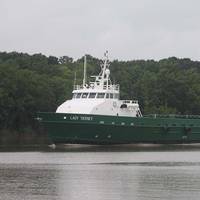
Lady Tierney, a 205-foot monohull DP-2 crew supply vessel, has been delivered for Sea Supply, Inc., a B&J Martin Inc. subsidiary, of Galliano, Louisiana. With design expertise from Incat Crowther’s Lafayette, La. office, combined with concept design and standards from the Morgan City, La. based Halimar Shipyard and the vessel owner, the ABS-classed, USCG-certified vessel will work in the Gulf of Mexico’s deep water offshore industry. For transportation of supplies, Lady Tierney features an aft cargo deck comprising of 3,950 square feet of timber covered area with a capacity of 450 LT.
First-of-type Walk-to-Work Crewboat Launched
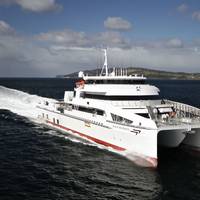
Incat Crowther announced the launch and sea trials of Muslim Magomayev, a first-of-type 70m Catamaran Fast Crew Boat (FCB). Constructed by Incat Tasmania, Muslim Magomayev is compliant with IMO HSC code and complete with a crew transfer system consisting of dynamic positioning equipment class (DP2) coupled with a walk-to-work stabilized access platform. The vessel’s operation includes fast crew transfer for 150 offshore workers to multiple offshore installations. The hull design is optimized for high speed transits with a maximized operability envelope and low incidences of sea sickness.
First of Type DP2 IMO 70m Catamaran FCB Under Construction
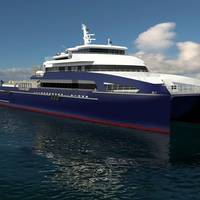
Incat Crowther announced a first of type 70m Catamaran Fast Crew Boat (FCB), compliant with IMO HSC code and complete with a crew transfer system consisting of dynamic positioning equipment class (DP2) coupled with a stabilized access platform. Construction of the vessel has commenced at the shipbuilder Incat Tasmania, with delivery scheduled for September 2014. The vessel will operate as a fast crew transfer vessel for 150 offshore workers to multiple offshore installations.
Feature: Dynamic Positioning An Amenity Becomes Compulsory
The inclusion of dynamic positioning systems has become a standard and necessary system on supply boats and many crew/supply vessels. In their simplest form, dynamic positioning systems allow an offshore vessel to "moor" adjacent to a rig or platform without the traditional mooring lines being attached to structure or the use of anchors. Instead thrusters both in the bow and the stern keep the vessel on station. The development of dynamic positioning systems and the use of them on every new supply vessel being built has a lot to do with the oil companies who own the structures being serviced by the vessels. These companies, with billion…