
Video: Navantia Launches Saudi Arabia's New Warship
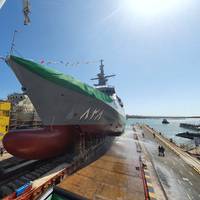
Spanish state-owned shipbuilder Navantia on Wednesday launched the first of five Avante 2200 corvettes it's building for the Royal Saudi Naval Forces (RSNF) for delivery through 2024.The five frigates were ordered in July 2018 for a cost of €1.8 billion ($2.1 billion), and first steel was cut for the series' first vessel in January 2019.Launched at the builder's San Fernando shipyard, the new vessel Al-Jubail has a length of 104 meters, a beam of 14 meters and will be able to accommodate 102 people (crew and additional personnel).
USN AEGIS Cruiser Modernization Program

frigate USS Ingraham (FFG 61) during a leap frog training exercise. The exercise allows ship handlers to practice the approach and stabilization alongside and a breakaway in a simulated underway replenishment environment. Ingraham and Antietam are part of the USS Carl Vinson (CVN 70) Carrier Strike Group on deployment in the Western Pacific Ocean. U.S. Navy photo by Photographer's Mate 2nd Class Jeremie Kerns. By Edward H. The U.S. Navy’s “Cruiser Modernization” program will extend…
Feature: Adding Combat Power; Extending Ship Life
By Edward H. The U.S. Navy's "Cruiser Modernization" program will extend the service life and enhance the combat capability of 22 of the Navy's 27 multi-mission AEGIS cruisers (CG-52 through CG-73). The Cruiser Modernization is necessary to enable the CG-47 class to participate effectively in support of joint littoral campaigns. Missions include land attack, littoral undersea warfare, force protection, and anti-air defense, as well as allowing for a possible future Ballistic Missile Defense (BMD) mission. The program extends the service life of each ship to 35 years. Combat systems will be upgraded while crew size and maintenance requirements will be reduced.
Fire Protection Rules Require Further Changes
The USCG's interim rule on fire protection equipment for towing vessels requires modification to avoid unnecessary and costly burdens on owners of existing towing vessels, AWO told the USCG. Reiterating its support for the basic suite of equipment and procedural requirements contained in the interim rule ? a general alarm, fire detection system, internal communications system, remote fuel shutoff, and training and drill procedures for crewmembers ? AWO urged the USCG to modify the technical specifications for fire detection systems and fuel shutoff valves before the October 2001 deadline for installation of such equipment. The interim rule requires a fire detection system be used for no other purpose…