

A Quiet Revolution
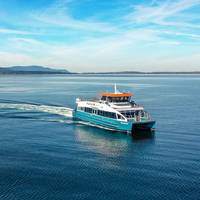
BAE Systems’ HybriGen technology is creating a path to zero emissions.The rise in planet-warming greenhouse gases is driving a need for cleaner transportation on the ground, in the air and on the water. Leaders in the marine industry are taking note, and vessel operators are making the move to green power and propulsion systems.BAE Systems is creating a path to cleaner harbors and waterways with its HybriGen Power and Propulsion system. The system has three configurations to provide operators with options on their way to zero emissions.
Azerbaijan Caspian Shipping Company's “Jafar Jabbarli” Back to Operation
“Jafar Jabbarli“ dry cargo vessel owned by Marine Transport Fleet of CJSC Azerbaijan Caspian Shipping Company has been overhauled by “Zigh” ship repair yard. A lot has been done during the overhaul which took almost a year. All corroded metal layers available in the hull, deck, cargo storage facility and other parts of the vessel with a safe load capacity of 3850 tons were replaced, and 350 tons of metal were used for this purpose. State cabins were overhauled in line with modern standards and supplied with new equipment and furniture. Main and auxiliary engines of the vessel, main and auxiliary wheels, ballast, air, water, fire extinguisher, oil and fuel systems have been overhauled.
Ocean Signal Introduces New AIS Transponders
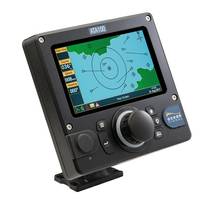
Ocean Signal has rolled out its new ATA100 Class A and ATB1 Class B AIS transponders as fully compliant solutions to increase visibility, aid collision-avoidance and enhance navigational safety for a range of commercial workboats, support vessels and fishing boats. The AIS transponders were unveiled for the first time at Asia Pacific Maritime. The ATA100 is a combined SOLAS and Inland approved single-unit device capable of exchanging dynamic and static ship data with other AIS systems and developed to meet the latest IMO carriage requirements and IEC standards.
Global Shipping Feels Fallout from Maersk Cyber Attack
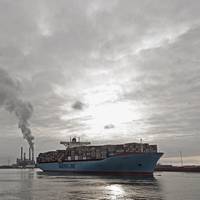
Global shipping is still feeling the effects of a cyber attack that hit A.P. Moller-Maersk two days ago, showing the scale of the damage a computer virus can unleash on the technology dependent and inter-connected industry. About 90 percent of world trade is transported by sea, with ships and ports acting as the arteries of the global economy. Ports increasingly rely on communications systems to keep operations running smoothly, and any IT glitches can create major disruptions for complex logistic supply chains. The cyber attack was among the biggest-ever disruptions to hit global shipping.
Insurance Gaps Leave Shipping Exposed to Cyber Attacks
Ships exposed through GPS systems, have limited back-up; cyber insurance typically doesn't cover jamming, property damage. Shipping companies grappling with the threat of cyber attacks on vessels are finding insurance policies often fall short, officials involved in both industries say, a risk that could feed through into global prices. Digitalisation means electricity networks, emergency services, industry and agriculture are all vulnerable to hacking by criminal gangs for extortion or, for political reasons, by militant groups or foreign states. But ships are also exposed to interference through electronic navigation devices such as the Global Positioning System (GPS) and lack the backup systems airliners have to prevent crashes.
Willard Unveils New RHIB in Australia
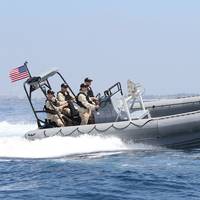
Willard Marine, Inc. unveiled its new SEA FORCE 777 this week at the Pacific International Maritime Exposition in Sydney, Australia. The military-grade, fiberglass, rigid hull inflatable boat (RHIB) is 7.77-meters long, 2.74-meters wide and designed with a deep-V hull. The Steyr SE306J38 diesel engine with ZF-63 marine gear powering a Hamilton Jet drive HJ-274 provides 300 horsepower for a nine-member crew and can achieve 32 knots. Nine Ullman Dynamics shock-mitigating seats are installed.
Maritime & Shipbuilding Italian Style
With its coastline of 7,800 km, Italy is expediently nestled in the heart of the Mediterranean Sea with the surrounding waters creating a tremendous resource for Italian economy. Businesses linked to the sea, including ocean technology firms, contribute significantly to Italy’s gross domestic product totaling more than $40 billion and representing 2.6% of total GDP. The Italian shipyard industry ranks among the top 20 in the world with ship building and boat-building accounting for 64% of the industry turnover, totaling 6.3 billion Euro in 2012, and Technological Equipment placed at 2.2 billion Euro. Italy is also a world leader in yacht production with more than 49% of the market share.
FUSION-LinkTM Technology Gains Industry-Wide Acceptance
Marine Entertainment Leader Reaches Unparalleled Adoption by Boatbuilders and Manufacturers Auckland, New Zealand – FUSION®, a worldwide leader in marine audio, announced today its innovative and award-winning FUSION-LinkTM technology has been adopted by all marine Multi-Function Display manufacturers and has seen strong acceptance in the boat builder community. Offering marine electronics manufacturers an unparalleled level of entertainment integration, FUSION-LinkTM is now available on a multifunction navigation devices from B&G, Furuno, Garmin, Humminbird, Lowrance, Murphy Instruments, Raymarine and Simrad. The company’s systems have been adopted by an extensive list of boatbuilders including Bavaria Yachts…
Cooperation Yields New Oil Spill Detection System

Moxa said it has long partnered with Intel to produce industrial computing platforms, using innovative advances in hardware and software designs to make the most of industrial-grade Intel processors, producing rugged solutions tailored for mission critical maritime applications. The recently published Intel case study ‘Marine Disaster Recovery through Intelligent Systems’ highlights how the combination of Intel processors with Moxa design and engineering has resulted in certified…
Europe Grapples with Threat of Ships Sailing Blind
Europe has yet to fully wake up to the danger of maritime disasters caused by signal jamming and blackouts of satellite navigation devices, say the proponents of a back up system on trial in British and Dutch ports. Ships increasingly rely on systems that employ satellite signals to find a location or keep exact time including the Global Positioning System (GPS) and GLONASS. But experts say such systems are vulnerable to signal loss from solar weather effects or radio and satellite interference and can also be affected by intentional jamming by criminal gangs, nation states or potentially from militant groups. The General Lighthouse Authorities of the UK and Ireland (GLA) is pioneering a radio-based back-up prototype called eLoran.
USCG – GPS testing off North Carolina
The USCG Navigation Center (NAVCEN) has issued a special notice stating that, from 3 through 10 February daily from 1600 EST to 2145 EST, the GPS navigation signal in waters off Wilmington, North Carolina may be unreliable due to testing of GPS signals used by shipboard, aviation, and handheld navigation devices. From Feb 03 through Feb 10, 2012, daily from 1600 EST to 2145 EST, the GPS navigation signal may be unreliable due to testing on GPS frequencies used by shipboard navigation, aviation and handheld systems. Systems that rely on GPS, such as E-911, AIS and DSC may be affected at an approximate testing center point of 33 45.00N, 77 00.00W, with an impact radius of approximately 75 NM from center point.
CEECO Assists Restoration Efforts for Gulf Waterway Navigation
Spectrum Sciences & Software Holdings Corp. announced today that its wholly owned subsidiary, Coast Engine and Equipment Company (CEECO), has been helping the U.S. Coast Guard rebuild portions of the waterway navigation system in the Mississippi River Delta damaged by Hurricane Katrina. This work, which has a total contract value of approximately $1.3 million, is expected to be completed in January 2006. CEECO has been building the mechanical structures for twenty-five ATON (aid to navigation) devices that house electronic equipment used to mark navigable channels and hazards. Without ATON devices, cargo, naval, and recreational vessels cannot safely move through the waters. CEECO's work has been part of the emergency effort to restore the ATON system to pre-hurricane conditions.