

Maritime Fees Spiral Deepens as US, China Trade Blows

The U.S. and China on Tuesday began charging additional port fees on ocean shipping firms that move everything from holiday toys to crude oil, making the high seas a key front in the trade war between the world's two largest economies.A return to an all-out trade war appeared imminent last week, after China announced a major expansion of its rare earths export controls and President Donald Trump threatened to raise tariffs on Chinese goods to triple digits.But after the weekend…
Hanwha to Build US-Flagged LNG Carrier
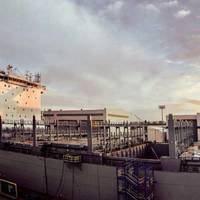
Hanwha Shipping, a U.S. subsidiary of Korean shipbuilder Hanwha Ocean, on Tuesday said it ordered an LNG carrier valued at roughly $252 million from its own Pennsylvania-based unit Hanwha Philly Shipyard.Under the agreement, the ship will be built in Korea and flagged in the United States. It is slated for delivery in the first half of 2028.The deal comes as the United States works to revive domestic shipbuilding and expand its fleet of commercial and military vessels. Hanwha…
Container Shipping Rates Plunge in Step with U.S. Demand for China Goods
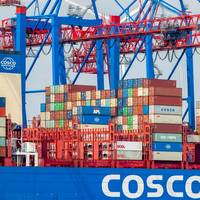
Rates for shipping cargo containers from China to the U.S. have dropped by more than half since earlier this month, as imports rebounded less than expected after the slump that followed President Donald Trump slapping 145% tariffs on China.Trump quickly reversed course by lowering the rate to 30%. That cost increase on goods from the nation's No. 1 ocean trading partner remains significant, especially at a time when U.S. economic data is signaling weakness.Rates on the closely watched Shanghai-to-U.S.
US Considers Adjusting Port Fees for Chinese Vessels After Pushback

President Donald Trump's administration is considering softening its proposed fee on China-linked ships visiting U.S. ports after a flood of negative feedback from industries that said the idea could be economically devastating, according to six sources.Among the changes under consideration are delayed implementation and new fee structures designed to reduce the overall cost to visiting Chinese vessels, according to the six sources with knowledge of the matter.The sources asked not to be named due to the sensitivity of the issue.The White House and the Office of the U.S.
Dozens of tankers drop hook as US sanctions bite
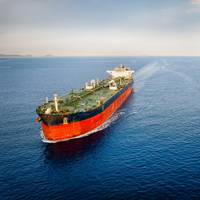
At least 65 oil tankers have dropped anchor at multiple locations, including off the coasts of China and Russia, since the United States announced a new sanctions package on Jan. 10, ship tracking data showed on Monday.Five of those tankers were stationary off Chinese ports and a further seven dropped anchor off Singapore, with others halting near Russia in the Baltic Sea and the Far East, according to Reuters' analysis based on MarineTraffic and LSEG ship tracking data.The U.S.
Container Rates Soar on Concerns of Prolonged Red Sea Disruption
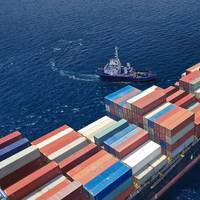
Container shipping rates for key global routes have soared this week, with U.S. and UK air strikes on Yemen stirring concerns of a prolonged disruption to global trade in Red Sea, one of the world's busiest routes, industry officials said on Friday.U.S. and British warplanes, ships and submarines launched dozens of strikes across Yemen overnight in retaliation against Iran-backed Houthi forces for attacks on Red Sea shipping, widening regional conflict stemming from Israel's war…
Surging VLCC Rates Impact US Crude Oil Shipments to Asia
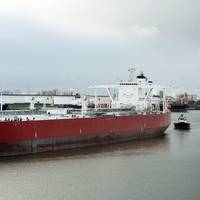
The economic incentive to import oil from the U.S. Gulf Coast to Asia has closed as the cost of booking supertankers on the route has surged amid a jump in bookings for the vessels, traders said this week.With the arbitrage for U.S. shipments closed, Asian refiners may make up some of the difference with similar Middle Eastern crude oil after top regional producer Saudi Arabia cut their sales prices for February, which is expected to carry over to other regional crudes. The spur…
Baltic Dry Bulk Index Doubles in November
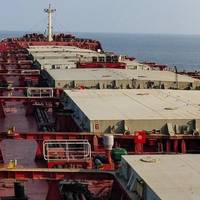
The Baltic Exchange's dry bulk sea freight index .BADI gained for the sixth consecutive session on Thursday, more than doubling in November to hit an one-and-a-half year peak helped by mounting supply of tonnage and cargo demand.The overall index .BADI, which factors in rates for capesize, panamax, supramax shipping vessels, was up 241 points or 8.9% at 2,937.
Black Sea Shipping Traffic Slowing after Russia, Ukraine Warnings
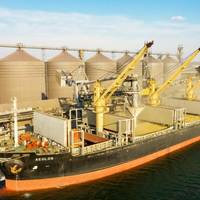
The number of ships looking to pick up grain cargoes from the Black Sea area has fallen 35% this week versus the previous week with growing uncertainty over whether commercial traffic could be hit as Russia continues to pound food facilities in Ukraine.Moscow's direct attacks on Ukraine's grain for four days running followed a vow by Kyiv to defy Russia's naval blockade on its export ports following Moscow's withdrawal earlier this week from a UN-brokered safe sea corridor agreement.
Russian Oil Sanctions Fuel Demand for Old Tankers
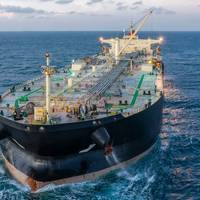
The market for old oil tankers is booming, and it's all down to efforts by Western nations to curb trade in Russian crude.As Western shipping and maritime services firms steer clear of Russian oil to avoid falling foul of sanctions or harming their reputations, new companies have leapt into the void, and they're snapping up old tankers that might normally be scrapped.The European Union banned all seaborne Russian crude imports from Dec. 5, with a fuel import ban to follow in February.
China Concerns Drive Baltic Index to Another Low
The Baltic Exchange's main sea freight index, which tracks rates for ships carrying industrial commodities, continued its run of record lows on Friday, haunted by reduced China imports. Demand woes across all vessel segments continued to haunt the index, which registered a record low for a fourth session running. The overall index, gauging the cost of shipping dry bulk cargoes including iron ore, cement, grain, coal and fertiliser, fell 3.6 percent to 429 points. The downturn in dry bulk shipping has worsened significantly in recent months as demand for iron ore and coal has declined in the face of slower economic growth in China. "The first part of the year is typically the weakest point for dry bulk freight rates…
Tanker Rate Spike Dents Efforts to Store Oil Glut at Sea
Record high freight rates are creating more headaches for traders looking to house millions of barrels of unsold crude oil and who already face potential losses due to record high stocks. They have to decide on whether to use tankers for longer term storage until they can sell their cargoes, or dump them at even more discounted prices in order to keep wells running. This is expected to come at a bigger cost as rates for supertankers have soared - reaching their highest since 2008 at over $100,000 a day last month and currently around $70,000 a day. Some have already been caught out with extra oil, and had no choice but to keep it on vessels. Trade sources said the expensive freight meant this was not a money-making play - and is unlikely to become one any time soon.
Higher Rates Across All Vessel Segments Propels Baltic Index
The Baltic Exchange's main sea freight index, which tracks rates for ships carrying dry bulk commodities, rose on Friday, propelled by higher rates across all vessel segments. The index, which factors in the average daily earnings of capesize, panamax, supramax and handysize dry bulk transport vessels, was up seven points, or 1.2 percent, at 591 points. The capesize index rose 16 points, or 3.93 percent, to 423 points. Average daily earnings for capesizes, which typically transport 150,000-tonne cargoes such as iron ore and coal, rose $126 to $4,174. The panamax index rose four points, or 0.65 percent, to 617 points. Average daily earnings for panamaxes, which usually carry 60,000 to 70,000-tonne cargoes of coal or grains, increased by $28 to $4,941.
Baltic Index Advances with Rising Cry Commodity Vessel Demand
The Baltic Exchange's main sea freight index, which tracks rates for ships carrying dry bulk commodities, was lifted on Thursday by higher demand across all vessel segments. The index, which factors in the average daily earnings of capesize, panamax, supramax and handysize dry bulk transport vessels, was up 13 points, or 2.28 percent, at 584 points. "The spot dry bulk market is in line for a positive jolt as three key pieces have lined up positively for the first time in several months: rising steel prices, wider steel margins and cheaper imported iron ore into China," said Omar Nokta of Clarkson Capital Markets. The panamax index rose nine points, or 1.49 percent, to 613 points.
Long-range Clean Tanker Markets Rally on Higher Bookings
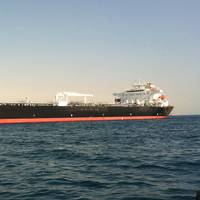
Long-range clean tanker rates rallied on Wednesday as buoyant demand for cargoes reduced vessel availability with expectations of further gains. Long Range 1 tankers, carrying 55,000 tonne loads from the Middle East Gulf (MEG) to Japan, reached W111.64 in the Worldscale measure, or $9,721 a day when translated into average earnings, its highest since mid December last year. That compared with W109.28 or $8,920 a day on Tuesday and W102.86 or $6,779 a day last Wednesday. Larger Long Range 2 or LR2…
Leading Shipping Equity Analyst Joins Clarkson Capital Markets
Clarkson Capital Markets, the investment banking arm of shipping services group Clarkson PLC, says it has enhanced its equity research coverage with the appointment of Omar Nokta as Managing Director of Shipping Research. Omar will be based in CCM's New York office. Omar brings significant sector experience and expertise to Clarkson Capital Markets. He joins CCM from Global Hunter Securities LLC where he was Senior Shipping Analyst. Prior to this he was Senior Research Analyst at Dahlman Rose, where he helped build the company into one of the leading shipping focussed investment banks, advancing its energy, commodities and metals and mining product offering.
Tankship Charter Rates Slump on Persian Gulf to Asia Route
Losses widen for oil tankers hauling 2-million barrel crude cargoes on the industry's benchmark route According to Bloomberg, VLCC's on the Saudi Arabia-to-Japan voyage are losing $5,529 a day, according to data accessed by Bloomberg from the Baltic Exchange in London. Returns have been negative for 18 sessions in a row and were at minus $5,130 on July 27. The ships were earning $41,093 on April 2, the highest level this year. Earnings fell as the number of vessels hired declined and ship-fuel prices advanced, Omar Nokta, a New York-based analyst at investment bank Dahlman Rose & Co., said in a report. Source: Bloomberg
NYMAR to Sponsor Capital Markets and Port Infrastructure Forum
A forum entitled “New York Maritime Matters: Capital Markets: Today and Tomorrow” will be held on September 20th at the Lincoln Center Campus of Fordham University School of Law. Sponsored by New York Maritime (NYMAR) and the Fordham University School of Law, the seminar will be held from 4-6pm, followed by a wine reception. This forum will explore the recent volatility in the capital markets and the impact on shipping, as well as examine capital requirements for port infrastructure. Led by AMA Capital Partners’ Managing Director Peter Shaerf, a panel of shipping experts including Sophocles Zoullas (CEO, Eagle Bulk), John Wobensmith (CFO, Genco Shipping & Trading) and Omar Nokta (Analyst, Dahlman Rose) will discuss the recent volatility in the shipping capital markets.
Traders Book Oil Tankers to Store 25m Barrels at Sea
Some of the world's biggest oil traders have booked supertankers to store at least 25 million barrels at sea in recent days, seeking to take advantage of the crash in crude prices and make a profit down the line. Floating storage levels are expected to increase further in coming weeks as trading companies adopt a strategy that was last used in 2009 when prices slumped and led to over 100 million barrels of oil being parked on tankers at sea before stocks were sold off. The play is also driving up tanker hire rates, and shipping firms have seen their share prices surge in recent days. In the past week, trading firms including Trafigura…
Tankers Booked to Store Oil at Sea
Oil traders have booked up to 20 tankers to store an estimated 40 million barrels of crude at sea, rising from 25 million barrels last week, as they soak up a stocks glut in anticipation of future profits, shipping and oil market sources said. The more than 50 percent fall in spot prices since June enables traders to make money by storing the crude for delivery months down the line, when prices are expected to recover. The sources said the volume of oil earmarked for floating storage had risen in recent days. Some of the tankers could nonetheless still be used for conventional oil transportation. "Floating storage remains a major focus in the tanker market as charterers have been fairly active in securing VLCCs (very large crude carriers) on time charters…
Baltic Sea Freight Index Falls to Lowest Level Since 1986
The Baltic Exchange's main sea freight index, which tracks rates for ships carrying dry bulk commodities, spiralled downwards to its lowest level in nearly three decades as rates for all the four vessel types continued to flounder. The overall index, which gauges the cost of shipping resources including iron ore, cement, grain, coal and fertiliser, was down 34 points, or 5.11 percent, at 632 points, the lowest since August 1986. The index is also seen by investors as an indicator of global industrial activity. Brokers said the dry bulk market was expected remain in the doldrums due to weak commodity demand at present especially from top global importer China.