

NTSB Issues Recommendations Following Fire on Laid Up Laker
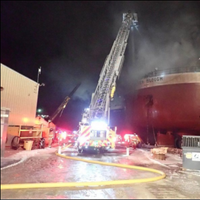
The United States' National Transportation Safety Board (NTSB) issued three safety recommendations following its investigation into the February 1, 2021, engine room fire aboard the bulk carrier Roger Blough.The Roger Blough was docked in winter layup at the Fincantieri Bay Shipbuilding facility on Sturgeon Bay, Wis. when a fire started in the engine room. The cargo-unloading conveyor belts then ignited, causing extensive damage throughout the aft section of the vessel. The shipkeeper on board departed the vessel without injury. No pollution was reported.
Winter Work on the Great Lakes
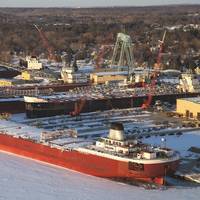
Along the 1,600-mile, ice gray arch of the St Lawrence Seaway, the 2020 Great Lakes commercial shipping season will lurch back to life on March 25 when the Soo Locks at Sault Ste. Marie, Mich. reopen.The ceremonial opening signals a passage with passable ice and the 114th Great Lakes season for its fleet of 45 venerable lakers. Most of these huge self-loading freight haulers are at least 50 years old, rust free, and fit; American steel sailing on a freshwater sea.To handle Great Lakes cargo…
The Art of Navigation
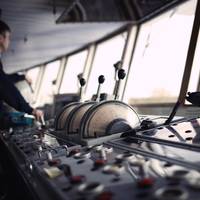
There are countless examples of how an over reliance of GPS navigation and the electronic charting systems, as well as the use of dead reckoning without a known fixed starting point – instead “eyeballing” the situation – are leading vessels in to danger. August 21, 2017 was the Great American Eclipse, and the science fiction fantasy fan in me wondered if this is when I would get my superpowers back. The navigator in me pondered if I was in the zone of totality and took a sight of the sun and moon, at the moment of totality would it count as two lines of position on my chart.
Roger Blough Lightering Complete
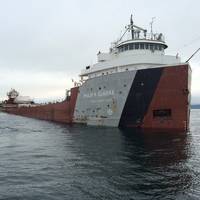
Lightering operations were completed Tuesday, as the U.S. Coast Guard continues to monitor and respond to the motor vessel Roger Blough, Tuesday, after the vessel ran aground May 27 on Gros Cap Reef in Whitefish Bay in Lake Superior. The cargo on board the Roger Blough was successfully offloaded onto two vessels, the Philip R. Clarke and Arthur M. Anderson. Each of the receiving vessels have departed the Waiska Bay anchorage to deliver the iron ore to its intended destination. A detailed damage assessment of the Blough will be conducted once favorable weather conditions are met.
Roger Blough Lightering Operations Continue
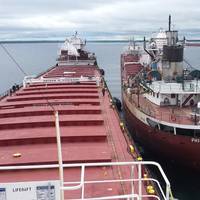
The U.S. Coast Guard continues to monitor and respond to the motor vessel Roger Blough after the vessel ran aground May 27 on Gros Cap Reef in Whitefish Bay in Lake Superior. Lightering operations continue while the vessel is anchored in Waiska Bay to transfer its cargo to the Philip R. Clarke and Arthur M. Anderson. The Arthur M. Anderson joined the cargo transfer efforts Saturday. A detailed damage assessment will be conducted once the iron ore is completely off-loaded from the Blough.
Roger Blough Safely Anchored in Waiska Bay
The U.S. Coast Guard continues to monitor and respond as the motor vessel Roger Blough is safely anchored in Waiska Bay, Saturday afternoon, after the vessel ran aground May 27 on Gros Cap Reef in Whitefish Bay in Lake Superior. The vessel made way under its own power to Waiska Bay where it will be further evaluated for repairs and it’s remaining cargo transferred to other vessels. Lightering operations ended early Saturday morning and the vessel was refloated at 10:45 a.m. The Philip R. Clarke arrived on scene with the Blough Thursday afternoon, and lightering operations started Friday at 5:45 a.m. Plans continue to progress to lighter the Blough’s iron ore and conduct detailed damage assessments through the combined efforts of Canadian partners, company representatives and the U.S.
Lightering Operations Begin on Grounded Bulker
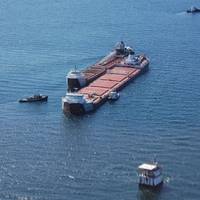
The U.S. Coast Guard continues to monitor and respond as lightering operations begin on the motor vessel Roger Blough, Friday, after the vessel ran aground May 27 on Gros Cap Reef in Whitefish Bay in Lake Superior. The Philip R. Clarke arrived on scene with the Blough Thursday afternoon, and lightering operations started Friday at 5:45 a.m. The safety perimeter has been increased from 500 yards to 750 yards. Plans continue to progress to safely free the Blough from Gros Cap Reef through the combined efforts of Canadian partners, company representatives and the U.S. Coast Guard.
Update on Roger Blough Salvage
The U.S. Coast Guard continues to monitor and respond to the motor vessel Roger Blough, Wednesday, after the vessel ran aground Friday afternoon on Gros Cap Reef in Whitefish Bay in Lake Superior. Plans continue to progress to safely free the Blough from Gros Cap Reef through the combined efforts of Canadian partners, company representatives and the U.S. Coast Guard. DonJon-Smit salvage divers have completed their underwater survey of the Blough's hull and the salvage plan is being revised to reflect on-scene conditions. Lightering operations are scheduled to begin by Friday, June 3, with the motor vessel Philip R. Clarke identified as the receiving vessel.
Roger Blough Salvage Underway
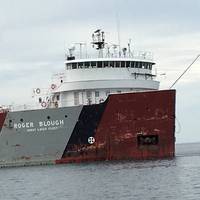
Salvage divers from DonJon-Smit plan to begin an underwater survey of the hull of 833-foot U.S. cargo vessel Roger Blough, which ran aground Friday afternoon on Gros Cap Reef in Whitefish Bay in Lake Superior. The divers aim to identify any damage the freighter may have sustained during the grounding. The U.S. Coast Guard said it continues to monitor and respond to the motor vessel, along with Canadian partners and company representatives. A preventative booming was put in place, though the Coast Guard believes there is minimal chance of a fuel spill.
Freighter Runs Aground in Lake Superior
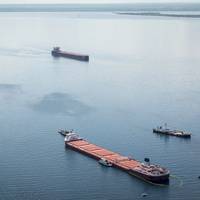
The U.S. Coast Guard informs it is continuing to monitor and respond to the 833-foot U.S. cargo vessel Roger Blough, which ran aground Friday afternoon on Gros Cap Reef in Whitefish Bay in Lake Superior. The chance of a fuel spill is minimal and flooding on the vessel is stable, the Coast Guard said. The Roger Blough crew is said to be in good condition with no reported injuries. Plans to free the grounded freighter continue to progress through the combined efforts of Canadian partners, company representatives and the U.S. Coast Guard.
Soo Locks Open for Cargo Ships
Despite the chilly temperatures and heavy snowfall the U.S. Army Corps of Engineers opened the Soo Locks for the start of the Great Lakes shipping season. The Edwin H. Gott, a 1,004-foot freighter, was the first ship to enter the Poe Lock. The Gott was followed by the Roger Blough, with both ships going upbound into Lake Superior to collect iron ore. The locks at Sault Saint Marie, Michigan are among 16 locks that form the St. Lawrence Seaway navigation system, which extends from Duluth, to the Atlantic Ocean. "We're looking forward to the new shipping season," said Mark Barker, president of the Interlake Steamship Company based in Ohio. Since the Soo Locks closed in January, the Army Corps of Engineers has spent 9.5 million dollars on repairs. The St.



