
NAPA Expands Design Tool to Streamline Class Approval
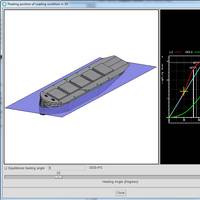
Maritime software house NAPA released a new application to extend the NAPA Statutory Compliance solution with NAPA Release 2015.1. Once available only to ClassNK customers using ClassNK Manager, this new application integrates ClassNK Manager’s expanded functionality into the NAPA Statutory Compliance tool. This integration has expanded and developed the tool for all customers to speed the classification approval process and improve the overall efficiency of ship design. Developed with substantial investment from ClassNK and close cooperation with shipyards in Japan…
Evergreen Installs ClassNK-NAPA Green Software
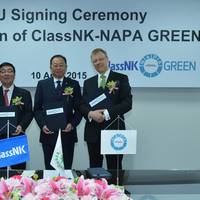
Evergreen Line has commenced installation of ClassNK-NAPA GREEN software on chartered container vessels. At the conclusion of a competitive tender process, ClassNK-NAPA GREEN software - developed by NAPA, global maritime software house and classification society ClassNK - was chosen to provide a total solution for planning, monitoring and optimizing ship operations. Enabling greater understanding of the operation of its chartered fleet to improve efficiency is the key driver behind the adoption of ClassNK-NAPA GREEN, the developer said.
ClassNK Acquires Maritime Software House NAPA
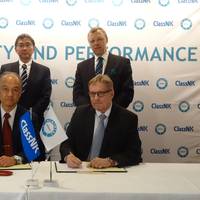
Classification society ClassNK agreed to acquire maritime software house NAPA in a deal that the classification society said aims to improve safety and performance for the whole maritime industry. According to ClassNK, the acquisition will enhance the success and capabilities of both organizations. For ClassNK, which has worked with NAPA for nearly 10 years, the deal is a chance to expand and improve the wide range of services it offers to shipowners and shipyards, whilst also providing NAPA with the support to accelerate expansion of existing operations and access new markets.
BMT Defense Applies NAPA Software in New Vessel Design
Naval design and engineering company BMT Defense Services Ltd. included a software package created by maritime software house NAPA during the design process for the new logistics and support vessel (LSV) ordered by the Norwegian Defense Logistics Organization (NDLO). Naval architects have applied NAPA for Design to the vessel's stability and hydrodynamics modeling to produce a compartmentation model that can provide hull form throughout the design process to production. The model will support the lifetime eco-efficiency of the vessel, either in combination with NAPA for Operations systems and the NAPA Loading Computer, or as a standalone system that provides vital information on the vessel when it cannot be observed.
PT Logindo Vessels Get Tero Software
Norwegian maritime software house Tero Marine has won a contract with Indonesian offshore company PT Logindo to implement software on several of its vessels. The contract covers software implementation on three ships but with the possibility of being extended to include the Indonesian company’s entire fleet of 35 vessels. Tero Marine hopes the contract can help open several doors in the region. “Logindo is a fast growing company, and one of the biggest in offshore shipping in the region. Over a relatively short period of time, they have expanded their fleet with a large number of vessels and are an exciting company for us to work with,” explained Satish Kanakasabai, Technical Manager at the Tero Marine office in Singapore.
Tero Marine Acquires Close Competitor

Norwegian maritime software house Tero Marine AS has taken a controlling stake in rival company Teomaki AS. Norwegian maritime software house Tero Marine has acquired 95 percent of the shares in one of its closest competitors, Teomaki. Both companies develop IT control and management systems for offshore and maritime companies. Jan Erik Hårvei, CEO of Tero Marine, is delighted with the acquisition. “Teomaki’s products will be continued and they will form an excellent addition to our already solid portfolio.
Noon Fuel Reports Don't Cut It Says NAPA
NAPA asserts that traditional noon reports don’t give the quantity or quality of data needed by owners in modern shipping. NAPA, a maritime software house for ship design and operations point out that bunker fuel readings for most international vessels are taken as daily ‘noon reports’ - collected onboard and send to the shipowner on a daily basis during a vessel’s voyage. However, with bunker fuel costs at sustained record levels and environmental legislation pertaining to emissions of Greenhouse Gases (GHGs), Sulphur Oxide (SOx), Nitrogen Oxide (NOx) now in force, many ship owners and management companies have come under more scrutiny from charterers…