MAN Brings Latest Tech to Marintec
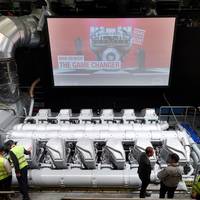
MAN Diesel & Turbo has brought its new 45/60CR and ME-LGI engines, as well as its innovative HP-SCR emissions reduction technology to Marintec 2017, which is being held this week in Shanghai. MAN recently revealed its new flagship engine, the successor to its 48/60CR engine in the company’s 4x line of high-performance diesel engines. The MAN 45/60CR marine diesel engine will initially be available as 12V and 14V versions that boast power outputs, of 15,600 and 18,200 kW respectively, with inline versions following at a later stage.
MAN Debuts New SCR for Two-stroke Engines
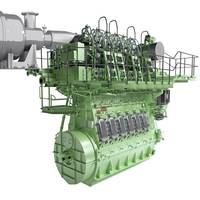
MAN Diesel & Turbo and its licensee Mitsui Engineering & Shipbuilding introduced its new high-pressure selective catalytic reduction (SCR) system, MAN SCR-HP, at an event in Tamano, Japan on April 11. The MAN SCR-HP is available for two-stroke engines of all bore sizes and reduces – through internal catalytic reaction – NOx exhaust emissions to IMO Tier III limits. With specially developed honeycombs and honeycomb materials, as well as an integrated mixing unit, the overall size of the reactor has been drastically reduced compared to typical market designs and its medium-speed counterpart.
Cat’s C280 Engines Meet EPA Tier 4, IMO Tier III
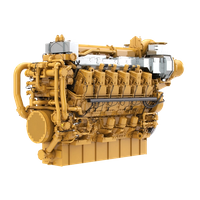
Caterpillar Marine now offers its Cat C280 medium-speed diesel engines for U.S. Environmental Protection Agency (EPA) Tier 4 and International Maritime Organization (IMO) Tier III service. The EPA Tier 4 standards applied to all new U.S. flagged vessels starting in January 2014 and IMO III standards will apply to all new vessels entering IMO NOx Emissions Control Areas (NECA) starting in January 2016. The C280 engines are available in eight-, 12- and 16-cylinder models spanning a power range from 2…
Air Emission Regulation Update

In March this year, The U.S. Environmental Protection Agency proposal to designate waters off the North American coasts as an Emission Control Area was adopted by IMO, the International Maritime Organization. The North American ECA is a key part of a comprehensive EPA program to address harmful emissions from large ships. Which are the time schedules of upcoming emission regulations? How are marine engine manufacturers preparing for the tighter air emission limits being adopted? Henrik Segercrantz explores.
IMO Group Agrees on Pollution Reduction Measure
Draft amendments to revise the MARPOL regulations on the prevention of air pollution from ships were agreed by the IMO Sub-Committee on Bulk Liquids and Gases (BLG) when it met last week (4-8 February) for its 12th session. Following lengthy and technically challenging discussions in the Air Pollution Working Group, the Sub-Committee agreed a draft revised Annex VI to the MARPOL Convention and amendments to the NOx Technical Code. These will now be submitted to the Marine Environment Protection Committee (MEPC), which meets for its 57th session from 31 March to 4 April 2008. A number of options remain open for discussion at the MEPC, which is expected to approve the amendments prior to their formal adoption at MEPC 58 (6 to 10 October 2008).
NOx Emissions from Merchant Ships
Pollutant emissions produced by the global merchant fleet has always been suggested to represent a considerable contribution to anthropogenic emissions, with nitrogen and sulfur compounds being currently in the focus of public's interest. Emissions such as nitrogen oxides, NOx (the sum of NO and NO2) lead to enhanced tropospheric ozone formation over their natural background level and thus affect the greenhouse warming. A considerable portion of ship emissions is released far off the continents — in clean areas of the atmosphere. This particularly effects the southern hemisphere with its natural low emission level. So far, all earlier…