

Ulsan Port Completes Its First Green Methanol STS Bunkering for Bulk Carrier
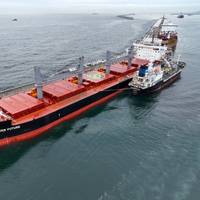
Ulsan Port Authority (UPA) has completed Korea’s first methanol bunkering for a dual-fuel bulk carrier at Ulsan Port.The STS for a bulk carrier, conducted on September 28, 2025, follows Ulsan Port’s world-first successful methanol bunkering demonstrations for container ships (PTS/STS) in 2023-2024.With the latest achievement, Ulsan Port has expanded its bunkering track record from container ships to bulk carriers.The operation was conducted for Green Future, a methanol dual-fuel bulk carrier chartered by NYK Bulk & Projects Carriers…
Ulsan Hosts First Ship-To-Ship Methanol Bunkering Operation
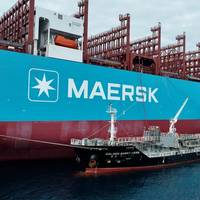
The Korean Ministry of Oceans and Fisheries and Ulsan Port Authority have announced a world first with the completion of a ship-to-ship (STS) bunkering of green methanol to the 16,000 TEU container ship Ane Maersk at Ulsan Port, South Korea.The Ministry of Oceans and Fisheries established the relevant institutional foundation, including the ‘Guidelines for Approval of Self-Safety Management Plan for Methanol Supply’ and accumulated know-how through two methanol supply demonstrations…
World’s First Methanol-fueled Containership Bunkers in Korea
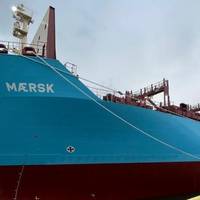
Maersk's first-of-its-kind methanol dual-fuel containership made history on July 16 when it became the first to bunker methanol.The newly built vessel bunkered 1,000 metric tonnes of the cleaner burning fuel at Odfjell Terminals Korea in Ulsan before embarking on its 21,500-kilometer maiden voyage toward Copenhagen, where she will be officially named in September.“This journey is an important step in our efforts to reach net zero greenhouse gas emissions by 2040, as it will allow…
KR Signs On to Help Bring Methanol Bunkering to Ulsan
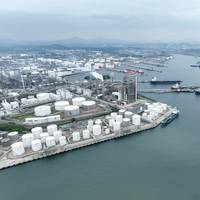
Classification society Korean Register (KR) and Ulsan Port Authority (UPA) have signed an MOU to support methanol-fueled ships and establish the South Korean port as a low-carbon, eco-friendly energy hub.The agreement was made in response to the low-carbon energy transition underway in the shipping and port industries. Methanol is a clean burning marine fuel which produces 99% less sulfur oxides (SOx), 80% less nitrogen oxides (NOx) and 25% less greenhouse gases compared to conventional…
Bunkering Halted at at Key South Korean Ports as Typhoon Hits
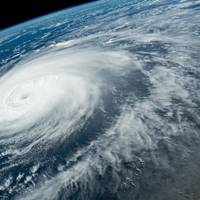
Ship refuelling operations were temporarily halted at South Korea's Busan and Ulsan ports on Tuesday after typhoon Hinnamnor hit the country's southern region, trade sources said.The halt in operations also paused spot premiums for low-sulphur bunker fuel offered at these ports this week at about $60 per tonne over Singapore fuel oil quotes, bunker fuel traders at South Korean companies said.Operations are likely to resume gradually later in the week, though fresh slots for bunkering are likely to start only from next week onwards…
Singapore Continues to Harmonize LNG Bunkering Standards
To develop the world’s first set of harmonised LNG bunkering standards, a network comprising Antwerp, Rotterdam, Singapore and Zeebrugge, subsequently expanded to include Jacksonville and Norway, was formed. Taking reference from documents by organisations such as the International Association of Ports and Harbours (IAPH), the International Organisation for Standardisation (ISO) and the Society for Gas as a Marine Fuel (SGMF), this set of harmonised standards will ensure that key areas of the LNG bunkering process are aligned across ports carrying out LNG bunkering operations. The standards can also provide a guide to ports seeking to be LNG bunker-ready.
Singapore Plans to Shape Bunkering for World's Future
Maritime and Port Authority of Singapore (MPA) introduced several new initiatives at SIBCON as part of Singapore’s continued efforts to enhance bunkering processes and prepare the bunkering industry to meet future demands. MPA previously announced the mandatory adoption of MFM for Marine Fuel Oil (MFO) deliveries in the Port of Singapore from 1 January 2017. MPA is on track for implementation with 110 bunker tankers already approved to perform MFO deliveries through MFM in the Port of Singapore. More than 23 bunker tankers have also been scheduled for installation and testing over the next two months. Moving ahead, MPA will put in an additional S$0.5 million to fund the test-bedding of the use of MFM for Distillates deliveries.