

GTT to Design LNG Tanks for CMA CGM's New Containerships
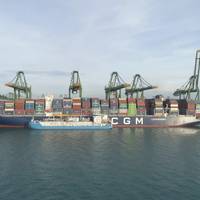
Engineering firm GTT said it has been chosen to design the cryogenic fuel tanks of 12 new liquefied natural gas (LNG) fueled containerships for the CMA CGM group.The vessels have been ordered from Chinese shipyards Hudong-Zhonghua Shipbuilding (Group) Co. Ltd. and Jiangnan Shipyard (Group) Co., who will each build six vessels, able to carry 13,000 and 15,000 containers respectively. The order of the six 15,000 TEU vessels completes the order of five similar container vessels signed…
RAL, MTU Team Up on LNG Pushboat

Natural gas is quickly becoming the “fuel of choice” for the maritime industry, not only for its potential in reducing environmentally hazardous gas emissions, but also for its reduced cost when compared to other fossil fuel-based alternatives.For natural gas to become a preferred marine fuel, its availability needs to improve, and this fact alone has hindered its growth in some parts of the world. Some of Robert Allan Ltd.'s clients are actively engaged in developing the required infrastructure to make natural gas more readily available.Robert Allan Ltd.
First LNG Bunker Vessel Coming in 2020
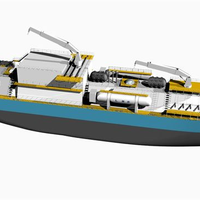
Wärtsilä was tapped to supply an integrated package of sustainable solutions for China’s first seagoing LNG bunker vessel, scheduled for delivery in 2020.The ship is being built by the Dalian Shipbuilding Industry Corporation (DSIC) for an affiliate of the ENN Energy holdings, one of the largest users of LNG in China. It has been designed by China Ship Design & Research Center Co. Ltd. Wärtsilä will provide the vessel’s cargo handling system, the Wärtsilä 34DF dual-fuel main engine…
Marine Fuel: World First for Megaboxer MV Sajir
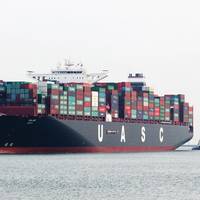
"With the conversion of SAJIR, we are the first shipping company worldwide to convert a container vessel of this size to natural gas propulsion." Richard von Berlepsch, Managing Director Fleet Management at Hapag-LloydIn its more than 170 years of existence, the Hamburg-based Hapag Lloyd has used all kinds of solid and liquid fuels to generate energy for the propulsion of its ships. And now the shipping company has announced that it intends to convert the propulsion system of its 15…
Baleària Builds World's First Gas Engine-Powered High-Speed Catamaran
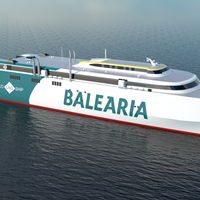
The shipping line Baleària, a pioneer in the application of liquefied natural gas in sea transportation, has marked another milestone with the construction of the world's first passenger and cargo fast ferry powered by dual LNG engines. The fast ferry is being built at the Armon shipyard in Gijón, as announced yesterday by Baleària President Adolfo Utor at the inaugural conference of the 57th Naval Engineering and Maritime Industry Congress currently being held in Valencia.Capacity and investmentWith a length of 125 meters and a beam of 28 meters…
Five Baleària Ferries to Run on LNG
The Mediterranean ferry company Baleària said it will invest €60 million ($70.2 million) over the next to years to retrofit five ferries to run on liquefied natural gas (LNG) and is planning to further expand its gas-powered fleet.The use of LNG in these five vessels — Naples, Abel Matutes, Sicily, Bahama Mama and Martin i Soler — is expected to reduce more than 45,000 tons of CO2 annually, 4,400 tons of nitrogen oxide (NOx) and eliminate sulfur and particulate emissions completely.Naples will be the first ferry to adapt the gas propulsion, with conversion work planned for the winter months, Baleària said in a press release.In addition to the gas remotorization of these five ferries…
First Mobile MTU Gas Engines for Rederij Doeksen
The first two preproduction units of the new mobile MTU gas engine from Rolls-Royce have completed performance tests and were accepted by the customer at the beginning of December. MTU delivered the first two of a total of four 16-cylinder Series 4000 gas engines, each with an output of 1,492 kW, for two new catamarans. From 2018, the two aluminum vessels will operate ferry services on the Dutch Wadden Sea. They are currently being built by Strategic Marine’s shipyard in Vietnam for the Dutch shipping company Doeksen.
Marine Propulsion Market Poised for Growth -Report
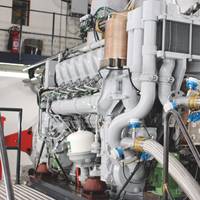
The marine propulsion engine market was valued at $9 billion in 2015 and is projected to reach $12 billion by 2022, growing at a CAGR of 4.1 percent from 2016 to 2022, according to a new report published by Allied Market Research. Diesel propulsion system segment is expected to maintain its dominance throughout the forecast period. Asia-Pacific accounted for the highest share of 51 percent in 2015, and is anticipated to maintain this trend. Increase in production and sales of ships globally and rise in international seaborne trade drives the market growth.
Insights: Kunkel Weighs in on Propulsion Technology
LNG? Methanol as fuel? Hybrid systems? Tier 4? Reducing noise? Cutting emissions without crushing fuel economy? Marine News readers have questions and Bob Kunkel has answers. Kunkel, President of Alternative Marine Technologies, previously served as the Federal Chairman of the Short Sea Shipping Cooperative Program under the Maritime Administration and Department of Transportation from 2003 until 2008. A past Vice President of the Connecticut Maritime Association, he is a contributing writer for Maritime Professional and Marine News. A graduate of the Massachusetts Maritime Academy, Kunkel sailed as a licensed engineer and eventually continued his career in ship construction at NASSCO, San Diego, Hyundai Heavy Industries, S. Korea, Chengxi Shipyard and Dalian New Shipyard in China.
Wärtsilä Joins LNG-powered Bulker Project
Wärtsilä is to team up with an international group of shipping industry companies and organisations in a project to develop a concept for equipping future dry bulk carrier vessels with LNG propulsion. Project Forward is led by Athens-based Arista Shipping. It began officially in May 2015 with the aim of developing a commercially feasible LNG powered dry bulk carrier design capable of complying with the International Maritime Organization's (IMO) Energy Efficiency Design Index 2025 standards, as well as with all relevant emission reduction regulations. In addition to Arista Shipping, the other parties involved in the project are Finnish ship designer Deltamarin…
MAN Diesel & Turbo Acquires Cryo’s Marine Fuel & Bunkering Business

MAN Diesel & Turbo Sverige AB, a wholly owned subsidiary of MAN Diesel & Turbo SE (part of MAN and Volkswagen Group), acquires the marine fuel gas supply system (FGSS) business from the Sweden based Cryo AB, part of the Linde Engineering Division and a manufacturer of cryogenic equipment for the storage, distribution and handling of liquefied gases. It will be integrated into the company’s four-stroke marine business. “Natural gas is rapidly gaining importance as a fuel for marine applications, which is why this acquisition is of major strategic relevance for us”, says Dr.
ABS Issues LNG Bunkering Advisory
Report explores the benefits and challenges of natural gas power from the perspective of fuel providers and operators. Classification society ABS published a new Advisory about LNG Bunkering in response to the industry's growing interest in gas propulsion, LNG Bunkering: Technical and Operational Advisory, exploring the benefits, challenges and solutions associated with fuelling vessels equipped with LNG power systems. The report is available to the public through the ABS website, www.eagle.org. "Ship owners, operators, designers and shipyards around the world are considering the advantages that operating on natural gas may provide," said Roy Bleiberg, ABS' Director of Global Gas Solutions.
ABS Releases Guide for LNG Fuel Ready Vessels

Notation reflects increased demand for review and approval of machinery elements on vessels designed for conversion to LNG fuel. ABS has published the ABS Guide for LNG Fuel Ready Vessels to support members and clients in preparing newbuildings for future conversion to gas propulsion. The Guide formalizes the process for clients who wish to plan for conversion to LNG fuel at a future date by providing a detailed review and approval and an associated class notation. "ABS is a leader in LNG as fuel…
The Versatile ATB Enters the LNG Game
EBDG’s LNG bunkering barge design receives ABS approvals as the maritime industry increasingly looks to LNG as a fuel of the future. In early June, Federal Maritime Commissioner William P. Doyle told listeners at an LNG Bunkering conference in Vancouver, Canada that “Liquefied Natural Gas (LNG) bunkering in North America is moving forward … There is an abundant supply of natural gas in North America. Utilizing natural gas as a marine fuel would help ship owners and operators comply with the MARPOL Annex VI requirements to reduce air pollution from ocean going vessels.” That much is true. It’s also true that there is any number of ways for vessel operators to get to the Promised Land. Nevertheless, LNG – as a fuel – has certainly stepped out into the lead on that mission.
Market Improving for German Equipment Suppliers
The German Engineering Federation (VDMA) reported a good order situation for German marine and offshore oil and gas equipment suppliers, but the upsurge in incoming orders is not making the sector euphoric. “The boom in world ship newbuilding orders in 2013 gave us strong order growth, particularly from China and Korea. Here our ongoing export commitment in the global market is paying off: Germany remains the leading country for marine equipment suppliers worldwide. At the same time, we registered above average growth in incoming orders in the offshore oil and gas area,” stated Dr. Alexander Nürnberg, Chairman of VDMA Marine and Offshore Equipment Industries, at the association’s press conference held in Hamburg on Wednesday.
INSIGHTS Focus: Robert Kunkel Talks Power and Propulsion
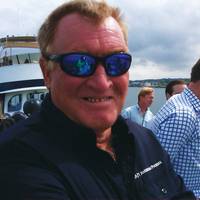
Those MarineNews readers who are not familiar with Bob Kunkel probably should be. That’s because Kunkel, President of Alternative Marine Technologies, previously served as the Federal Chairman of the Short Sea Shipping Cooperative Program under the Maritime Administration and Department of Transportation from 2003 until 2008. He is a past Vice President of the Connecticut Maritime Association, a contributing writer for many maritime and technical trades publications, including Maritime Professional Magazine and MarineNews.
LNG Marine Fuel Taking Hold in America: FMC Commissioner Speaks
In his speech at the LNG Export & Export & Infrastructure Conference Federal Maritime Commissioner Doyle gives insights on the consequences of the adoption of Liquefied Natural Gas (LNG) as a marine fuel in the United States. I am a Commissioner with the U.S. Federal Maritime Commission. The Federal Maritime Commission is an independent regulatory agency responsible for regulating the nation’s international ocean transportation for the benefit of exporters, importers, and the American consumer. I should emphasize that my thoughts and comments here are mine and mine alone – they do not reflect the position of the Commission, and they should not be construed to represent the positions of any of my fellow Commissioners.
BV to Class Largest Gas-fuelled Ro-pax Fleet
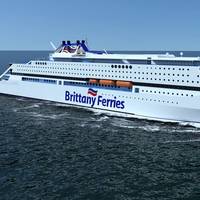
International classification society Bureau Veritas (BV) is to class a gas-fuelled major ro-ro passenger ferry newbuilding and oversee the conversion of three existing ro-pax ferries to LNG power for Brittany Ferries. A major risk analysis carried out by Bureau Veritas together with Tecnitas was integral to the decision process for Brittany Ferries to switch part of its fleet to gas fuel. Jean Jacques Juenet, passenger ship manager, Bureau Veritas, said, “We are proud to be deeply involved in this major project…
Wärtsilä's Tier III Gas Engines for Large LNG Carrier
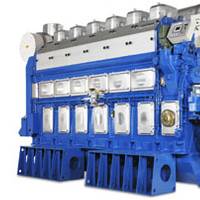
Wärtsilä has been selected to supply its flexible gas propulsion solution for a series of new LNG carriers to be built at the Samsung Heavy Industries shipyard in South Korea. The selection of Wärtsilä gas engines is indicative of the current emphasis by owners on the latest technology, and a growing environmental commitment to reducing fuel consumption and lowering emissions. By installing the Wärtsilä 50DF engines, the ships will be capable of meeting the IMOs strict Tier III emission requirements.
Wärtsilä, Shell Sign Deal to Promote LNG as a Marine Fuel
Wärtsilä and Shell Oil Company have signed a Joint Co-operation Agreement aimed at promoting and accelerating the use of liquefied natural gas (LNG) as a marine fuel. The agreement was signed in August 2011 and will run for several years. Supplies of low cost, low emissions LNG fuel will be made available to Wärtsilä natural gas powered vessel operators, and other customers by Shell. The Joint Cooperation Agreement will focus first on supplies from the US Gulf Coast, and then later expand their efforts to cover a broader geographical range. Gas fuelled marine engines are seen as being a logical means for ship owners and operators to comply with increasingly stringent environmental legislation.
Hamburg Welcomes LNG-Powered Vessel
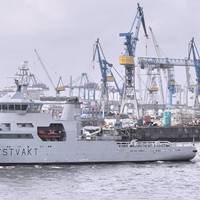
Premiere in Hamburg: First LNG-powered ship in the Port of Hamburg – A challenge for the port and initial experience from Norway. At the Überseebrücke pier, the Port of Hamburg has for the first time been able to welcome an LNG-fuelled ship. The KV BARENTSHAV belongs to the Norwegian Coastguard fleet, and is deployed on fisheries controls, sea rescue, policing, Customs inspections and environmental checks within Norwegian territorial waters. The speciality of the ship is its environmentally…
First LNG-powered Ship in Port of Hamburg
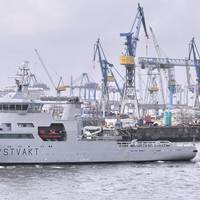
Instead of diesel fuel the KV BARENTSHAV is powered in normal conditions by Liquefied Natural Gas (LNG) and came to Port of Hamburg for the “LNG – the Norwegian Experience” conference of experts organized in Hamburg by the German-Norwegian Chamber of Commerce along with Innovation Norway and the classification society DNV Germany. Propulsion of the KV BARENTSHAV is through a propeller, driven mechanically either via the main engine or a gas-fuelled electric motor. Two engine-rooms and tanks are used, one for diesel propulsion and one for gas operation using LNG.
LNG is a Crystal Clear Alternative
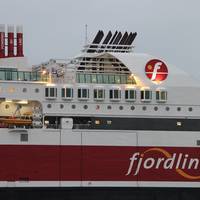
Norway-based shipping company Fjord Line’s Stavangerfjord represents a new-generation of advanced and environmentally friendly Cruise Passenger Ferry with outstanding passenger facilities in order to operate both as a day and night ferry. The vessel is built to provide passengers with pleasant experiences, even under the harsh weather conditions of the North Sea. A modern and flexible interior design provides a capacity for 1,500 passengers (1,200 passenger during winter), and a total of 306 cabins on two decks provide first class accommodation and a variety of restaurants…