

Xeneta Shares Weekly Ocean Container Shipping Market Update

The Xeneta Weekly Ocean Container Shipping Market Update provides data and intelligence including the latest freight rate and capacity movements across global trades with supporting insight from Peter Sand, Xeneta Chief Analyst.Data highlightsMarket average spot rates – 17 September 2026:Far East to US West Coast: USD 7,960 per FEU (40ft container)Far East to US East Coast: USD 11,259 per FEUFar East to North Europe: USD 4,103 per FEUFar East to Mediterranean: USD 4,434 per FEUNorth Europe to US East Coast: USD 2…
Projectile-Hit Qatari LNG Tanker Awaits Rescue Off Oman

A Qatari LNG tanker remained stranded off Oman on Wednesday after a projectile strike sparked a fire in its engine room, though industry sources said the vessel's cargo appeared secure and the risk of an explosion was low for now.The attacks on the tankers prompted Washington to revoke a licence allowing Iran to sell oil and U.S. forces to strike Iranian targets overnight. President Donald Trump said on Wednesday an interim agreement to end the war with Iran was "over", comments that triggered a 5% jump in global oil prices.The U.S.
Qatari LNG Tanker Remains Stranded After Projectile Strike

A Qatari LNG tanker remained stranded off Oman on Wednesday after a projectile strike sparked a fire in its engine room, though industry sources said the vessel's cargo appeared secure and the risk of an explosion was low for now.The attacks on the tankers prompted Washington to revoke a licence allowing Iran to sell oil and U.S. forces to strike Iranian targets overnight. President Donald Trump said on Wednesday an interim agreement to end the war with Iran was "over", comments that triggered a 5% jump in global oil prices.The U.S.
Shipping Costs Spike Amidst Iran War Anxiety

The cost of shipping a container of goods from Asia to the United States has doubled since the start of the Iran war, driven by spiking fuel prices and an uptick in demand from importers who are worried costs will only rise further as the conflict wears on."If you want to know how seriously to take the threat of an energy crisis, look at container shipping rather than oil markets because the risk is priced into the spiraling freight rates far more clearly," said Peter Sand, chief…
Iran Detains Two Container Ships for Maritime Violations

Iran said it had captured two container ships seeking to exit the Gulf via the Strait of Hormuz on Wednesday after firing on them and another vessel, in its first seizures since its war with the United States and Israel began in February.Iran's semi-official Tasnim news agency reported the seizures and added its Revolutionary Guard Corps Navy had warned that any disruption to order and safety in the strait would be considered a "red line."The seizure of one of the ships, the Panama-flagged MSC Francesca…
Xeneta Weekly Ocean Container Shipping Market Update: February 27, 2026

Peter Sand, Xeneta Chief Analyst:“The recent tariff ruling by the US Supreme Court will have knock-on impacts for ocean container shipping, but this will be nuanced and unlikely to cause a huge increase in frontloading demand, even though tariffs on some Chinese manufactured goods are lower today than a week ago.“The court ruling and political fallout actually increase uncertainty for many shippers. The TPM industry conference taking place in Long Beach next week is traditionally when long term freight contracts are negotiated…
Xeneta: Weekly Ocean Container Shipping Market Update

“Average spot rates are down this week across all main fronthaul trades out of the Far East. From Far East to US West Coast and US East Coast, it is a textbook market development with falling spot rates coinciding with a slight uptick in offered capacity,” said Peter Sand, Xeneta Chief Analyst.“It is a different story from Far East to North Europe where offered capacity has decreased week-on-week but spot rates continue to fall. This suggests an even weaker market on this trade.“2026 is expected to be a year defined by overcapacity in container shipping…
Maersk Ramps up Suez Canal Return

Maersk said on Thursday that one of its services will resume using the Red Sea and Suez Canal this month, marking a key step towards ending two years of global trade disruption due to attacks on ships by Yemeni Houthi rebels.The Danish shipping group's share price fell more than 5% on the news, reflecting the likelihood of lower freight rates as vessels gradually return to the shorter Suez route.Shipping companies are weighing a return to the critical Asia-Europe trade corridor…
Red Sea Return Imminent for Container Shipping
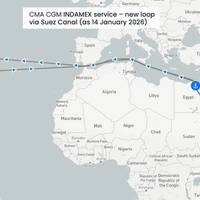
Major carrier CMA CGM has announced its INDAMEX service will transit Suez Canal on fronthaul and backhaul voyages between India/Pakistan and US East Coast in a notable step towards a largescale return of container ships to the Red Sea region.The first vessel to complete a full service loop via Suez Canal will be CMA CGM Verdi, sailing from Karachi to New York on 15 January. eeSea by Xeneta data shows voyages via Suez Canal rather than Cape of Good Hope reduces full loop transit time on this service by two weeks…
Container Freight Rates Could Plunge with End of Houthi Attacks
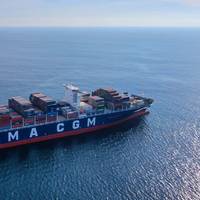
Houthi militia have reportedly ceased attacks on Israel and shipping in the Red Sea, and the impact could be seismic for global ocean container shipping, warns Chief Analyst Peter Sand at Xeneta. However, an immediate largescale return to the region will require a series of further assurances.“Details are sketchy, and you cannot base the safety of crews, ships and cargo on the word of Houthi militia. Carriers need far more assurance than that and, perhaps more importantly, so do insurance companies…
Xeneta: Israel-Iran Conflict Threatens Safety and Stability of Ocean Supply Chains

Peter Sand, Xeneta Chief Analyst, shared insights following the escalation of the Israel-Iran conflict.“Geo-politics is once again threatening the safety and stability of global supply chains so we must hope for de-escalation in the conflict between Israel and Iran, with concerns it could see a de-facto closure of the Strait of Hormuz—a vital entry point for container ships calling at ports such as Jebel Ali and the wider Arabian Gulf region," said Sand.“Any closure of the Strait of Hormuz would see services re-routed…
Hapag-Lloyd Welcomes China-US Tariff Reprieve
German container shipping firm Hapag-Lloyd on Monday welcomed an agreement between the United States and China to temporarily slash reciprocal tariffs, saying it expected to be buoyed by a resulting increase in bookings from China to the U.S.The United States will cut extra tariffs it imposed on Chinese imports in April to 30% from 145% and Chinese duties on U.S. imports will fall to 10% from 125% for the next 90 days, the two sides said on Monday.Trade between the world's two largest economies plummeted in the midst of the trade standoff…
Potential Return of Container Ships to Red Sea Following US-Houthi Ceasefire Could Collapse Freight Rates
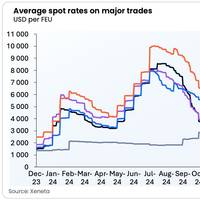
The prospect of a large scale return of container ships to the Red Sea following the announcement of a ceasefire between the US and Houthi militia in Yemen would flood the market with shipping capacity and cause a global collapse in freight rates, but the situation remains far from certain.Data released by Xeneta, an ocean and air freight intelligence platform, shows global TEU-mile demand would decrease 6% if container ships begin sailing through the Red Sea and Suez Canal again…
Trump's Tariffs Risk of Shipping Chaos
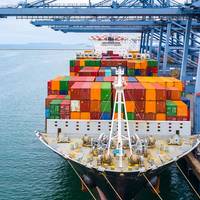
U.S. President Donald Trump's new tariff plan has the ocean shipping industry on edge as he stokes a trade war destined to stanch transport demand and send companies scrambling to manage the fallout.The Trump administration on Wednesday is set to announce "reciprocal tariffs" targeting nations that have duties on U.S. goods. That move would come after it slapped new import levies on products from Mexico, China and Canada - the top U.S. trading partners - as well as on goods including steel and autos.Major global container shipping firms like MSC…
Ocean Shipping Faces Uncertainty as Trade Threats Loom

The global ocean shipping industry that handles 80% of world trade is navigating a sea of unknowns as U.S. President Donald Trump stokes trade and geopolitical tensions with historical foes as well as neighbors and allies.That is the backdrop for this week's S&P Global TPM container shipping and supply chain conference in Long Beach, California, an annual event that marks the start of container shipping contract negotiating season.Attendees this year include industry heavyweights like container carriers MSC…
US Dockworker Strike: Talks at a Standstill
A strike by 45,000 dockworkers halting shipments at U.S. East Coast and Gulf Coast ports entered its second day on Wednesday with no negotiations currently scheduled between the two sides, sources told Reuters.The lack of progress is raising concerns among those reliant on shipments that the disruption could be prolonged.The International Longshoremen's Association union strike has blocked goods from food to automobile shipments across dozens of ports from Maine to Texas, which…
US Port Strike Leaves Huge Cargo Backlog In Its Wake
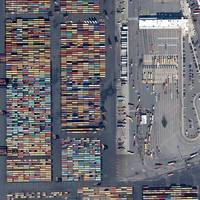
U.S. East Coast and Gulf Coast ports began reopening late on Thursday after dockworkers and port operators reached a wage deal to settle the industry's biggest work stoppage in nearly half a century, but clearing the cargo backlog will take time.The strike ended sooner than investors had expected, weakening shipping stocks across Asia on Friday as freight rates were no longer expected to surge.At least 54 container ships queued outside the ports as the strike had prevented unloading and threatened shortages of anything from bananas to auto parts.
Xeneta: Ocean Box Rates to Fall Again in February

Middle East ceasefire and Lunar New Year will see ocean container freight rates fall further in February - with carriers now taking action to slow the market decline.Latest data from Xeneta – an ocean and air freight intelligence platform – shows average spot rates from the Far East stand at USD 3 795 per FEU (40ft container) into North Europe and USD 5 085 per FEU into the Mediterranean – down 22% and 13% respectively since 1 January.Early data suggests spot rates will fall further on 1 February…
ILA 'Scaremongering' with Hyperbolic Box Rate Claims -Xeneta

The International Longshoremen’s Association (ILA) on Tuesday has gone ahead with strike action at U.S. ports from Maine to Texas and accused ocean container carriers of ‘gouging customers’.The ILA confirmed the strike in an announcement yesterday, Monday, while at the same time claiming ocean container carriers are now charging $30,000 per container in a ‘whopping increase from $6,000 just a few weeks ago’.Xeneta data – which is based on more than 450 million crowdsourced datapoints – shows the ILA claim is misleading. Average spot rates on the major fronthaul from the Far East to U.S.
East Coast Dockworkers Strike Halts Half of US Ocean Shipping
Dockworkers on the U.S. East Coast and Gulf Coast began a strike early on Tuesday, their first large-scale stoppage in nearly 50 years, halting the flow of about half the nation's ocean shipping after negotiations for a new labor contract broke down over wages.The strike blocks everything from food to automobile shipments across dozens of ports from Maine to Texas, in a disruption analysts warned will cost the economy billions of dollars a day, threaten jobs, and potentially stoke inflation.The International Longshoremen's Association (ILA) union representing 45…
European Importers Shouldn't be Spooked by Freight Rates

Ocean container carriers are desperately trying to push spot freight rates up in early November to halt the market decline and strengthen their hand during negotiations with European shippers for new long-term contracts.Latest data from Xeneta’s ocean and air freight rate intelligence platform shows average spot rates on the major fronthaul trades from the Far East to North Europe and the Mediterranean are set to increase on November 1 between 15-25%.Average spot rates currently stand at 3 390 per FEU (40ft container) into North Europe and $3…
Proposed China Vessel Fees Come with Supply Chain Risks

Analysts caution that a new proposal to impose fees on China-built container ships entering the U.S. could trigger unintended consequences, including port congestion, rising freight costs, and shifts in global trade flows.The Trump administration has announced a plan to charge a $1 million fee every time a vessel operated by a Chinese carrier docks at a U.S. port. Additionally, the Federal Notice outlines potential extra charges for any China-built ships, even if operated by carriers from other nations.
All Eyes on China as Trump Retakes the White House

Donald Trump’s victory in the US Presidential Election is has importers on edge, fearing another spike in ocean container shipping freight rates premised on President Trump's vow on blanket tariffs of up to 20% on all imports into the US and additional tariffs of 60% to 100% on goods from China.Data from Xeneta shows the last time that President Trump ramped up tariffs on Chinese imports during the trade war in 2018, ocean container shipping freight rates spiked more than 70%.



