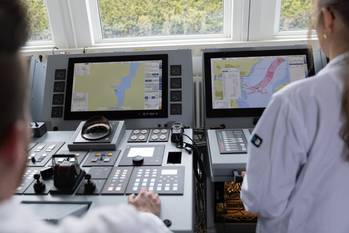
Autonomous Cargo Ships and New Collision Regulations
The possibility now exists for ships to navigate the globe with no one at the helm. This capability has been demonstrated in the United States, Europe and Japan by autonomous workboats, survey vessels, and coastwise voyages by autonomous cargo vessels and ferries with the development of larger vessels capable of making trans-oceanic voyages coming soon. Despite this new reality, aside from a patchwork of voluntary best practices, there are no international standards for the safe design…
SAFETY: Distractions Can Sink Careers

Familiarity can and does breed contempt. You don’t need anything else added to that heavy burden.We live and work in a frenetic environment replete with a wide range of both human and technological distractions. When those two elements came together on the bridge of a towboat traveling downriver to pick up a load of empty barges, the result was career-changing for the vessel’s first mate, who was on the wheel. It was yet another costly reminder of the need for professional mariners…
AIS Data: History & Future
The Automatic Identification System (AIS) was developed with the sole goal of improving maritime safety by allowing ships in proximity to one another to automatically exchange information regarding their name, course, speed, type, cargo, etc. The exchange of this information would allow conning officers on each ship to make better decisions regarding the possibility of close encounters and the need to change course and/or speed. It would also make it easier for one ship to contact the other by radio-telephone to hopefully remove any doubt. To that extent, AIS has largely worked as intended, although collisions continue to occur.It did not take long, though, for governments to get involved.
Lines in the Water
There are a variety of jurisdictional lines in the water. The first line to be considered is the national boundary between two adjacent or nearby countries. Adjacent countries tend to draw agreed boundaries extending their shoreside boundaries, with accommodations for headlands, capes, etc. Most national boundaries have been agreed upon long ago. A few, though, are not officially resolved. Somewhat surprisingly, of the four marine boundaries between Canada and the U.S., three are still in dispute.
This Day In Naval History: May 6
1860 - The sloop-of-war Portsmouth, commanded by John Calhoun, captures the slaver brig Falmouth off Porto Praya. 1908 - The Great White Fleet anchors in San Francisco Bay, Calif. The fleet is delayed from its round-the-world cruise after both Rear Adm. Robley D. Evans and Rear Adm. Charles M. Thomas fall ill. On May 15, Rear Adm. Charles S. Sperry assumed command and completes the cruise ending Feb. 22, 1909. 1916 - The first ship-to-shore radio telephone voice conversation was held on board USS New Hampshire (BB 25) off the Virginia Capes.
Night Moves on America's Waterways
Overnight operations are certainly not unusual on America’s inland waterways, but that doesn’t make them any less hazardous. Onboard activities that seem so straightforward and customary in the light of day can take on a decidedly different feel after the sun sets and darkness envelopes the river and shrouds its banks. And, while navigational aids on the river and electronic equipment on board clearly assist nighttime vessel movements, many towboat and tug operators will tell you that fatigue, boredom and endless repetition in the sensory-deprived environment of darkness present very formidable challenges to even the most experienced rivermen.
Slew of New SOLAS Amendments Come into Force
IMO informs that new requirements under the International Convention for the Safety of Life at Sea (SOLAS) to require all ships to have plans and procedures to recover persons from the water are among a set of SOLAS amendments that came into force on 1 July 2014. The SOLAS amendments, adopted in 2012, were developed as part of the International Maritime Organization (IMO)’s work on large passenger ship safety and are aimed at ensuring all ships have the capability to effectively serve as a rescue asset and have the right equipment to be able to rescue persons from the water and from survival craft, in the event of an incident. This new requirement is intended to enhance safety at sea and also to provide support to search and rescue coordinators in all types of rescue operations and…
New Requirements for Fire-Fighters’ Outfits

This applies to ship’s constructed (keel laid) on or after 1 July, 2014. Ships constructed (keel laid) before 1 July, 2014 must comply no later than 1 July, 2019. This applies to all ships on or after 1 July, 2014. New SOLAS regulation II-2/10.10.4 requires that: “For ships constructed on or after 1 July 2014, a minimum of two two-way portable radiotelephone apparatus for each fire party for fire-fighter's communication shall be carried on board. Those two-way portable radiotelephone apparatus shall be of an explosion-proof type or intrinsically safe.
Today in U.S. Naval History: May 5
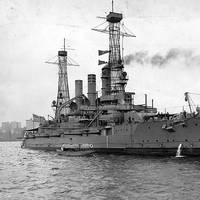
Today in U.S. Naval History - May 5 1909 - Great White Fleet anchors in San Francisco 1916 - First ship-to-shore radio telephone voice conversation from USS New Hampshire off Virginia Capes to SECNAV Josephus Daniels in Washington, D.C. 1942 - Capt. Milton Miles arrives in Chungking, China, to begin building an intelligence and guerilla training organization, Naval Group China 1945 - Naval landing force evacuates 500 Marshallese from Jaluit Atoll, Marshall Islands For more information about naval history, visit the Naval History and Heritage Command website at history.navy.mil.
Ocean Signal Presents Product Range at Workboat
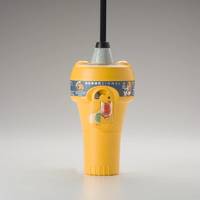
Marine communication and safety specialist Ocean Signal presents its SafeSea range of products plus the world’s smallest personal locator beacon at this year’s International Workboat Show, through U.S. and Canada distributor Datrex Inc. The SafeSea products provide all essential handheld communication devices required in an emergency situation, while Ocean Signal’s rescueME PLB1 is ideal for the commercial market as it can be carried easily and unobtrusively by workers on tug boats, patrol vessels and other workboats.
Today in U.S. Naval History: May 6
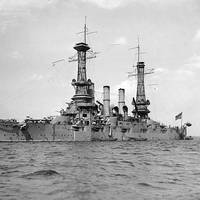
Today in U.S. naval history - May 6. 1909 - Great White Fleet anchors in San Francisco 1916 - First ship-to-shore radio telephone voice conversation from USS New Hampshire off Virginia Capes to SECNAV Josephus Daniels in Washington, DC 1942 – Capt. Milton Miles arrives in Chungking, China, to begin building an intelligence and guerilla training organization, Naval Group China 1945 - Naval landing force evacuates 500 Marshallese from Jaluit Atoll, Marshall Islands For more information about U.S. naval history, visit the Naval Historical Center Web site at www.history.navy.mil .
IMO Safety Committee to Tackle Busy Agenda
IMO's Maritime Safety Committee (MSC) meets at the Organization's London HQ for its 91st session from 26 to 30 November 2012. The busy agenda includes discussions on passenger ship safety; the adoption of amendments to the International Convention for the Safety of Life at Sea (SOLAS); and consideration of matters related to piracy and armed robbery against ships and other items submitted by the IMO Sub-Committees. The MSC is expected to establish a working group on passenger ship safety to consider relevant issues, including the action plan drawn up at the last session following the Costa Concordia incident in January. Draft amendments to SOLAS regulation III/17-1 to require ships to have plans and procedures to recover persons from the water.
Improving Vessel Safety Around The Solomon Islands
The Asian Development Bank recently commissioned GMDSS specialists Dunstan and Associates and their local partner company Cruz Communications to supply and install a new GMDSS marine radio station for the Solomon Islands Maritime Safety Authority. The station is located at the Rescue Coordination Centre in Honiara and provides communication for vessels operating in the Solomon Islands region. The station uses Barrett Communication 2050 MF/HF radio communications systems and the TransOceana Digital Selective Calling (DSC) system. As part of the installation, five operators attended a training course on the principles of GMDSS and operation of the new system. The Barrett 2050 is designed for ease of use to enable operators to easily transition to the new radio system with minimal training.
Datrex Distributing for Ocean Signal
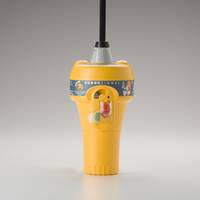
Datrex Inc. appointed for North American distribution. Ocean Signal, the specialist communications and safety at sea manufacturer, has appointed Datrex Inc. as its distributor for USA and Canada. Datrex Inc. has been a supplier of high quality lifesaving technologies to the marine industry for over 40 years and since early 2011 has worked with Ocean Signal to successfully establish the Ocean Signal SafeSea® range of EPIRB’s, SART’s and hand held VHF’s in USA. Ocean Signal products…
This Day in U.S. Naval History - May 6
1909 - Great White Fleet anchors in San Francisco 1916 - First ship-to-shore radio telephone voice conversation from USS New Hampshire off Virginia Capes to SECNAV Josephus Daniels in Washington, DC 1942 - CAPT Milton Miles arrives in Chungking, China, to begin building an intelligence and guerilla training organization, Naval Group China 1945 - Naval landing force evacuates 500 Marshallese from Jaluit Atoll, Marshall Islands (Source: Navy News Service)
This Day in Naval History – May 6
1909 - Great White Fleet anchors in San Francisco 1916 - First ship-to-shore radio telephone voice conversation from USS New Hampshire off Virginia Capes to SECNAV Josephus Daniels in Washington, DC 1942 - CAPT Milton Miles arrives in Chungking, China, to begin building an intelligence and guerilla training organization, Naval Group China 1945 - Naval landing force evacuates 500 Marshallese from Jaluit Atoll, Marshall Islands (Source: Navy News Service)
Pan United Tugboat Goes Missing
According to an April 21 report from ChannelNewsAsia.com, Pan United tugboat, P-U 2007, went missing in waters off Kuantan in Malaysia the night of April 19. Nine crew members were on board the tugboat, which belongs to Pan United's wholly-owned subsidiary, P.U. Vision. The tugboat which was towing a barge, also owned by P.U. Vision, was en route to Thailand. According to the ReCAAP Information Sharing Centre Incident Alert and Bryant’s Maritime News, the tug has possibly been hijacked. The vessel’s SSAS has been activated and radiotelephone contact has been lost. The tug appears to be heading easterly in the general direction of the Philippines. The barge has been sighted by an airplane, but there have been no visual contacts of the tug.
This Day in Naval History – May 6
1909 - Great White Fleet anchors in San Francisco 1916 - First ship-to-shore radio telephone voice conversation from USS New Hampshire off Virginia Capes to SECNAV Josephus Daniels in Washington, DC 1942 - CAPT Milton Miles arrives in Chungking, China, to begin building an intelligence and guerilla training organization, Naval Group China 1945 - Naval landing force evacuates 500 Marshallese from Jaluit Atoll, Marshall Islands (Source: Navy News Service)
Globe Wireless Acquires Atlantic Assets
Globe Wireless announced on Feb. 13 that it has entered into a Letter of Intent to acquire the assets of Atlantic RadioTelephone / SatPhoneStore (ART). The acquisition is expected to close within 30 days. Globe Wireless recently introduced the GlobeSwift product line, which was specifically designed for the coastal and yacht market. Globe also recently opened a new sales and support office in Ft. Lauderdale, Florida. ART has been in business for over 35 years in the Miami area. The company operates a an on-line store (www.satphonestore.com), selling maritime and land-mobile satellite equipment and airtime, VSAT Internet and television systems, radars and a variety of marine electronics.
Bollinger Returns after Gustav
Bollinger Shipyards returns 95 percent of its 14 locations back to work following Hurricane Gustav's plowing through the heart of the based shipyard community. According to Bollinger’s website, all but two locations are back up and running, with several locations on generators with supervisory staff only. The corporate office, located in , is on generators and is coordinating the efforts of the 3000 member workforce. Bollinger is working with the local and state authorities to insure the safe return of their employees and shipyard services to the Oil and Gas community, said Robert Socha, Executive Vice President Sales and Marketing. We are communicating with our employees over the web, via local radio, telephone and community interaction.
This Day in Naval History - May 06
By the Navy News Service 1909 - Great White Fleet anchors in . 1916 - First ship-to-shore radio telephone voice conversation from USS New Hampshire off to SECNAV Josephus Daniels in . 1942 - CAPT Milton Miles arrives in , to begin building an intelligence and guerilla training organization, Naval Group China. 1945 - Naval landing force evacuates 500 Marshallese from .
Raymarine Reports Strong Market Position in 2002
A $2 million marketing campaign, a $2 million investment in manufacturing and technological capabilities and a new suite of innovative products are at the heart of Raymarine's push into the 2002 season. The company, which completed its $108 million buyout from Raytheon at the beginning of this year, believes it will maintain its lead in the marine electronics market. new branding. to coincide with the major international boat shows over the next six months. The company is also soon to launch the first of its new campaigns for 2002. attention on the scale and quality of the information boaters will access. business. capacity and technology developments. market conditions. information needs of the boater. VHF radiotelephone solutions.
MariTEL Names Fyock Vice President Sales
Telecommunications industry veteran Lawrence R. Fyock has been appointed vice president sales for MariTEL. Launched in June 2001, MariTEL’s new Marine Wireless VHF Radiotelephone Network and Digital Selective Calling (DSC) currently covers the Gulf of Mexico and lower Mississippi River. Fyock’s will be responsible for MariTEL’s sales activity as the Network expands nationwide over the next few years. Fyock has over 19 years experience in telecommunications. He was most recently vice president ofsales and marketing for Digital Access, Inc. a facilities-based voice, video and data provider. Fyock was also a district director and vice president of sales and marketing for Sprint PCS, where he developed sales and marketing programs for the nationwide wireless provider.