Floating Data Centers: Maritime Frontier for a Data-Hungry World


As global demand for data storage and processing accelerates — driven by cloud computing, streaming media, and the explosive growth of artificial intelligence — the physical footprint of data centers has become a growing challenge. Land-based facilities face mounting constraints: limited space, water scarcity, grid congestion, long permitting timelines and rising community opposition. Against that backdrop, a once-niche concept is moving rapidly into the mainstream conversation: floating data centers.
For maritime designers, shipyards, and offshore infrastructure specialists, floating data centers represent a convergence of digital demand and marine engineering, one that could evolve into a significant new market segment over the coming decade.
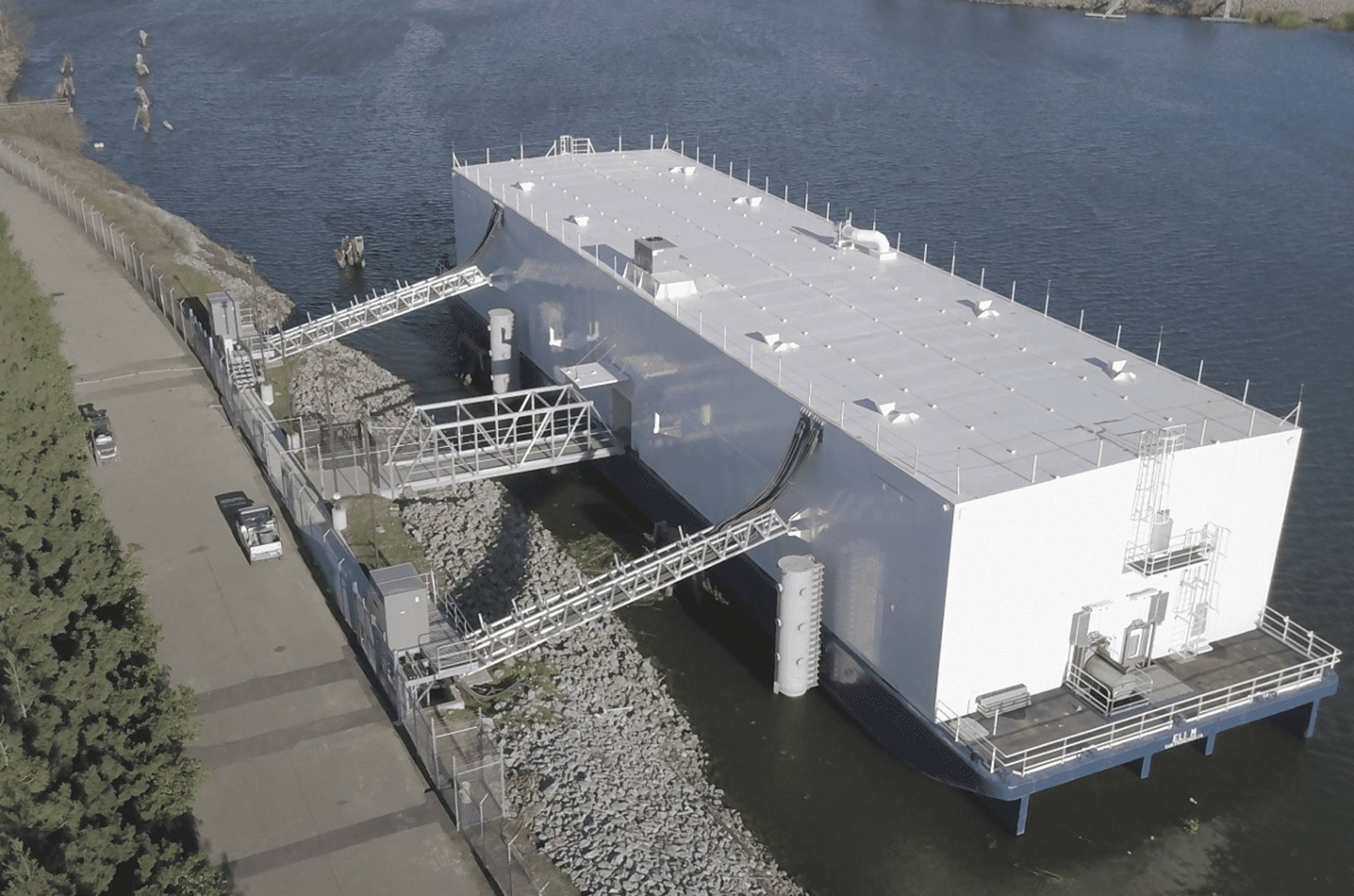
Few firms have deeper firsthand experience in this emerging space than Elliott Bay Design Group (EBDG). The Seattle-based naval architecture and marine engineering firm helped design and support construction of what is widely regarded as the world’s first operational floating data center, an installation in Stockton, California that has been operating successfully for several years.
“That first project gave us real insight into what works, what doesn’t, and where the market could go,” said Mike Complita, Principal in Charge and Vice President of Strategic Expansion at EBDG. “At the time, it was a bit ahead of the market. Now, with AI and data growth, the interest has come back in a big way.”
By the Numbers: Elliott Bay Design Group
Today, EBDG offers the industry its expertise from an internal crew of 70+, a number that has grown steadily in recent years alongside a strong market for specialized marine design services. Historically, about half of the firm’s work has been focused on passenger and vehicle ferries, with the remaining half spread across a diverse mix of projects.
“It’s that other 50% where we get to work on some really wild and interesting things,” Complita said. “Floating data centers definitely fall into that category.”
The Case for Floating Data Centers
At the core of the floating data center concept is one primary advantage: access to cooling water. Traditional land-based data centers consume enormous volumes of freshwater for cooling, often drawn from rivers, aquifers, or municipal systems, and substantially lost to evaporation. In contrast, floating data centers use surrounding water bodies as a closed-loop cooling medium.
“You’ve got an essentially unlimited source of cooling water that you’re not consuming,” Complita explained. “That’s a huge advantage in a world where freshwater is becoming increasingly precious.”
Environmental concerns around thermal discharge are often raised, but real-world data from the Stockton installation suggests those fears may be overstated. Studies conducted prior to deployment—and validated during operation—found that temperature changes in the surrounding water were negligible within just a short distance of the hull.
Beyond cooling, floating platforms offer additional benefits:
- Rapid deployment: Floating data centers can be designed, built, and deployed in roughly two to three years, compared with five to eight years for large land-based facilities.
- Mobility and flexibility: Built on barge platforms, they can be relocated, expanded, or redeployed as demand shifts.
- Reduced land use: No need to clear forests, rezone land, or build massive new concrete structures.
- Repurposing existing assets: The Stockton project reused a 1970s-era barge hull, minimizing new environmental impact.
“That reuse aspect was intentional,” Complita said. “Instead of creating a new footprint, we were able to repurpose something that already existed.”
 At the core of the floating data center concept is one primary advantage: access to cooling water. “You’ve got an essentially unlimited source of cooling water that you’re not consuming. That’s a huge advantage in a world where freshwater is becoming increasingly precious.”
-Mike Complita, Principal in Charge and Vice President of Strategic Expansion at EBDG.
Image courtesy EBDGThe Biggest ChallengeWhile cooling is a natural advantage offshore, power generation remains the most significant technical and economic hurdle.
Modern data centers are extraordinarily power-hungry. Even relatively small installations require 10–12MW, while current market inquiries are clustering around 30–80MW, with AI-focused facilities pushing into the 100–300MW range.
“To put that in perspective, that’s far more power than most ships use just to operate,” Complita said. “The amount of onboard generation, fuel storage, and redundancy required is enormous.”
For fully autonomous floating data centers — those not tied into shore power — the space required for generators, fuel, exhaust systems, and redundancy can exceed the footprint of the data center itself. Fuel logistics also become a major operational consideration, particularly when continuous uptime is non-negotiable. “These facilities can’t just shut down and go to a shipyard for maintenance,” Complita noted. “Everything has to be designed with redundancy so operations continue uninterrupted.”
In the U.S., floating data centers tethered to shore and carrying no passengers are not Coast Guard-inspected vessels. However, most owners are choosing to pursue voluntary class certification through organizations such as ABS or DNV.
“Class societies are starting to develop rule sets specifically for floating data centers,” Complita said. “That’s important for insurance, financing, and long-term asset management.”
While classification requirements differ from those of traditional ships, owners should still expect periodic inspection, maintenance planning, and lifecycle management considerations more akin to offshore infrastructure than conventional barges.
Designing for Data, Not Cargo
From a naval architecture perspective, floating data centers may resemble barges, but their design priorities are fundamentally different. The cooling system is the most critical and complex element, operating at a scale far beyond typical marine applications. Intake systems must minimize environmental impact, avoid harming marine life, and prevent debris accumulation, all while handling massive water flows.
EBDG’s Stockton design incorporated low-flow intake velocities and sophisticated, proprietary screening systems to ensure fish and marine organisms could safely swim away from intakes.
Another emerging concern is motion sensitivity. While protected harbors pose little risk, offshore deployments introduce vessel motions that can affect servers, cooling systems, and power generation equipment.
“As we look at more exposed or offshore applications, motion control becomes a serious design consideration,” Complita said.
From Prototype to Scale
The Stockton floating data center, operating in the 10–12MW range, served as a functional prototype. Today’s market interest is dramatically larger.
“We’re seeing baseline requests at 30 megawatts, most in the 50 to 80 range,” Complita said. “Once AI comes into play, that jumps even higher.”
At those scales, floating data centers are no longer single platforms but modular fleets — multiple barges operating together, offering scalability unmatched by land-based construction.
“That scalability is another big advantage,” Complita said. “You don’t have to build everything at once. You can grow as demand grows.”
While floating data centers remain a small slice of the global data infrastructure today, momentum is clearly building. What was once an experimental concept is now drawing serious interest from major players in both the technology and maritime sectors.
“For a long time, this was a curiosity,” Complita said. “Now it’s something companies are looking at strategically to get ahead of their competitors.”
For shipyards, designers, and marine equipment suppliers, floating data centers could represent an interesting opportunity: a high-value, technology-driven market that leverages core maritime expertise while opening the door to a rapidly expanding digital economy.
As data demand continues to surge, the question may no longer be whether floating data centers make sense, but how quickly the maritime industry is ready to deliver them.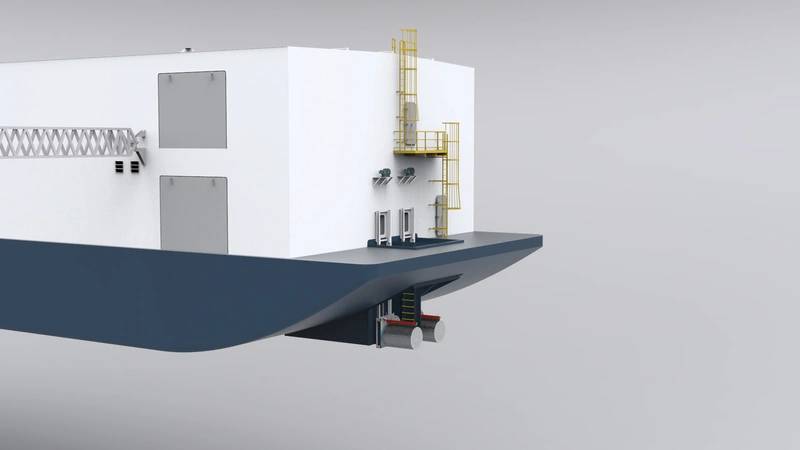 Image courtesy EBDG