

Ship Recycling Market “Woefully Slow”
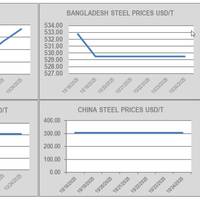
Global markets seemed to take a breather this week as things turned slow across the board once again, not only on the shipping side but even the ship recycling side of things, reports cash buyer GMS.Currencies fluctuated in moderate tandem, local steel plate prices made surprisingly marginal moves, all while the Baltic Exchange Dry Index (BDI) slipped and oil steadied itself. The BDI reported a declining week that shaved off about 3.2% last week, dropping to its lowest levels since early October as the Cape index took the lead shaving off over 6% of its value…
As China's Economy Slows, So Too Does Dry Bulk Shipping
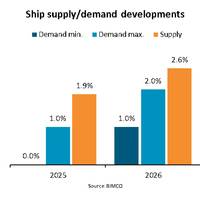
“We estimate the dry bulk supply/demand balance to weaken in both 2025 and 2026, compared to 2024. Demand growth is expected to slow, impacted by a weaker economic outlook for China and the world and a shift in US trade policy,” says Filipe Gouveia, Shipping Analysis Manager at BIMCO.The rise in tariffs and the start of trade negotiations by the US have introduced additional uncertainty and are directly impacting 4% of global dry bulk tonne mile demand. In China, this is expected to slow economic growth starting in the second half of 2025…
Landmark Week Ahead for Ship Recyclers
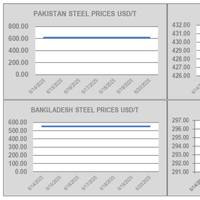
The tension surrounding the US attack on Iran saw the Baltic Exchange Dry Index (BDI) fall a massive 3.5% down to its lowest level seen over the last two weeks, erasing most recent gains as Friday closed, reports cash buyer GMS. Leading the race was the Capesize index that fell nearly 6.5% across the week while the Panamax index fell 0.2% during the same time.“The price of oil, which will also be a key item to keep an eye out for next week especially as the Iranian government votes to shut down the Gulf of Hormuz effectively terminating Iranian oil exports…
Dry Bulk Ship Breaking Skids to 17-year Low
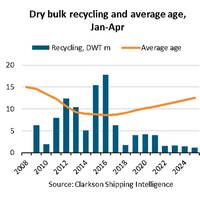
“Between January and April 2025, dry bulk ship recycling has fallen 24% y/y, reaching a 17-year low despite a 35% y/y drop in the Baltic Dry Index (BDI). While weaker freight rates typically encourage the recycling of older and less profitable ships, high uncertainty over the demand outlook could be delaying recycling decisions,” says Filipe Gouveia, Shipping Analysis Manager at BIMCO.Dry bulk ship recycling has been slow since the first quarter of 2021 when freight rates significantly strengthened due to a pickup in demand and congestion.
BDI Hits One-Week High as Commodity Markets Firm
The Baltic Exchange’s main sea freight index rose to its highest level in a week on Monday, supported by gains across all vessel segments amid strengthening demand and firmer commodity markets.The overall Baltic Dry Index (BDI), which tracks rates for ships carrying dry bulk commodities such as coal, iron ore, and grains, climbed 9 points, or 0.6%, to 1,652. This marks the index's highest level since March 17.Leading the upward momentum was the capesize segment, with its index rising 14 points, or 0.5%, to 2,690.
Iron Ore Shipments Fall 7%
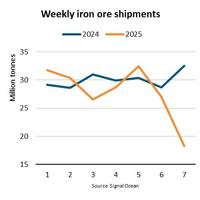
Global iron ore shipments have fallen 7% y/y, during the first seven weeks of 2025, amid supply disruptions and weak Chinese import demand. Australian cargoes have fared the worst, down 10% y/y while shipments from Brazil have weakened by 5% y/y.“The comparatively stronger Brazilian shipments are boosting average sailing distances, but tonne mile demand is nonetheless estimated to have taken a 6% fall y/y,” says Filipe Gouveia, Shipping Analysis Manager at BIMCO.The weakness of iron ore shipments this year has intensified this past week in particular.
BIMCO's Shipping Number of the Week
Dry bulk contracting falls 70% below average amid low rates.“Over the past three months, dry bulk newbuilding contracting has been 70% below the yearly average. Declining freight rates in recent months, a cloudy outlook and high newbuilding prices contributed to the slowdown, and contracting in 2024 will likely fall short of 2023 levels,” says Filipe Gouveia, Shipping Analyst at BIMCO.Driven by healthy demand, the dry bulk market was strong throughout most of the first three quarters of 2024. However, in recent months, weaker Chinese import demand paired with a recovery in Panama Canal transits has impacted freight rates negatively.
Key Bulk Vessels Index Down 10% Despite Freight Rate Rebound
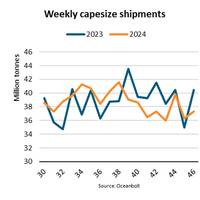
“The Baltic Dry Index (BDI) has recovered since the start of November due to stronger capesize freight rates, but the index is still down 10% y/y. The capesize market has benefited from a 1% increase in shipments so far in November compared to October 2024 and November 2023. However, the increase has not been enough to recover to the highs seen during the first three quarters of 2024,” says Filipe Gouveia, Shipping Analyst at BIMCO.On November 19, 2024, the BDI reached 1,627 points, up from 1,374 on 4 November.
Red Sea Shipping Attacks Pressure China's Exporters

For Chinese businessman Han Changming, disruptions to Red Sea freight are threatening the survival of his trading company in the eastern province of Fujian.Han, who exports Chinese-made cars to Africa and imports off-road vehicles from Europe, told Reuters the cost of shipping a container to Europe had surged to roughly $7,000 from $3,000 in December, when Yemen's Iran-aligned Houthi movement escalated attacks on shipping."The disruptions have wiped out our already thin profits…
Iron Ore Shipments Drop 13.1% to Start 2023
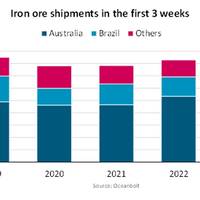
2023 has so far been a disappointment for the dry bulk shipping sector, despite hopes that a quick economic recovery in China would boost iron ore demand,. During the first three weeks of the year, iron ore shipments fell 13.1% year on year, the lowest volume since at least 2019, worsening conditions for capesizes. In this period, the Baltic Dry Index (BDI) declined by almost 500 points to 763 on 20 January, its lowest point since June 2020.It is not unusual for the bulk market to cool during the first quarter when demand weakens during the Lunar New Year celebrations.
RIX Industries Forms Sales Partnership with Blue Deep International

RIX Industries, a developer of gas generation systems and energy technologies, announced Blue Deep International (BDI) as a new sales partner for the commercial marine and international naval defense markets. U.K.-based BDI is a representative agency servicing countries and regions across the globe including Western Europe, North America, and Australia.Effective May 1, 2022, BDI represents RIX exclusively in the United Kingdom, Germany, Italy, The Netherlands, Norway, Denmark, Sweden, and Finland acting as a sales partner.
Concern Over Trade Wars Impacts Shipping Confidence

Confidence in the shipping industry has fallen marginally over the past three months, largely as a result of ongoing concern over trade wars and increased regulation, according to the latest Shipping Confidence Survey from leading shipping adviser and accountant BDO.The average confidence level in the three months to May 2019 was 6.1 out of a possible maximum of 10.0. This is slightly down on the figure of 6.2 recorded in February 2019.Confidence was up in Asia, from 5.8 to 6.0, and in North America, from 5.6 to 6.4.
Four New Dual-fuel Bulkers to Support U-Ming Charter Deal
U-Ming Marine Transport Corporation, Taiwan’s largest publicly listed bulk carrier company, secured a 10-year liquefied natural gas (LNG) dual-fuel dry bulk charter contract with global mining company Anglo American.A fleet of four LNG dual-fuel Tier III 190,000 DWT bulk carriers measuring 299 by 47.5 meters each will be built by Shanghai Waigaoqiao Shipbuilding (SWS) to support the charter. The new ships are expected to be delivered through 2023.The ships will be fitted with MAN Energy Solutions’ high-pressure ME-GI engines.
Three of Five Converted VLOCs Are No Longer Operating -BIMCO

Converted very large ore carriers (VLOC) are increasingly becoming a thing of the past with the long-term freight contracts coming to an end as newer and more reliable ships replace them in the market. Since June 2017, 43% of the VLOC fleet have been sent to the scrapyards, while 18% of the fleet is idled or damaged.“The tragic Stellar Daisy accident brought the safety aspect of VLOCs into question. Now, three years on, three out of five VLOCs are no longer in operation as their long-term charters have now expired.
Capesize Index Turns Negative for the First Time Ever

Capesize index plummets to -133, the first time ever in negative territory – is it all up from here?The Baltic Exchange Capesize Index (BCI) dropped to -133 index points on February 4, 2020, turning negative for the first time ever on January 31, 2020. The composite BDI index (BDI), which has excluded the more stable handysize segment since March 2018, also dropped on February 4, 2020 to settle at 453 index points.The BCI has been on a freefall through the entirety of December, but the descent started to pick up more steam during the past couple of weeks.
Ship Blocking Suez Canal Could Be Stuck for Weeks

A containership blocking the Suez Canal like a "beached whale" may take weeks to free, the salvage company said, as officials stopped all ships entering the channel on Thursday in a new setback for global trade.The 400-meter Ever Given, almost as long as the Empire State Building is high, is blocking transit in both directions through one of the world's busiest shipping channels for oil and grain and other trade linking Asia and Europe.The Suez Canal Authority (SCA) said eight tugs were working to move the vessel…
Shipping Industry Confidence Holds Firm: Moore Stephens
Shipping confidence held steady in the three months to end-May 2018 according to the latest Confidence Survey from international accountant and shipping adviser Moore Stephens. The average confidence level expressed by respondents was unchanged at the four-year high of 6.4 out of 10.0 recorded in February 2018. Confidence on the part of owners was also sustained at a four-year high, of 6.6, while managers’ confidence was up from 6.4 to 6.7. The rating for charterers was up to 6.7 from 5.0 and confidence in the broking sector was up from 6.1 to 6.3. The survey was launched in May 2008 with an overall rating for all respondents of 6.8.
Baltic Dry Index Rises as Smaller Vessels Lend Support

The Baltic Exchange's dry bulk sea freight index rose on Thursday, buoyed by gains for panamax and supramax vessels that countered a dip in rates for the larger capesize segment.The overall index, which factors in rates for capesize, panamax and supramax vessels, gained 24 points, or 1%, to 2,678 points.The capesize index shed 46 points, or 1.2%, to 3,776.Average daily earnings for capesizes, which transport 150,000-tonne cargoes such as iron ore and coal, fell $390 to $24,355.Despite a decrease in Brazil-China iron ore trade volumes…
Demolition Activity Weakens as BDI Moves Higher
After the Baltic Dry Index (BDI) had its seasonal weakness around the Chinese New Year in early February, stronger-than-expected demand came from across the board and lifted freight rates, says BIMCO market analysis of Dry Cargo. This brought earnings into profitable levels for a couple of days, as the BDI passed 1,282 on 27 March 2017. If earnings are at profitable levels now, how come BIMCO’s Road to Recovery keeps mentioning 2018 and 2019? That’s because it focuses on full year profits for all dry bulk segments. That would require a full year where the average BDI is above 1,280. Last time we had that was in 2011. Note that the BDI average for Q1-2017 was 945.
Crude Oil Tanker Demolition Bucking the Trend -BIMCO

Four very large crude carriers (VLCC) have been sold for demolition since October 2016, matching the number of VLCCs sold for demolition in the preceding two years, according to BIMCO. Most recently the 1999-built double-hull VLCC with the framing name Good News returned $15.5 million to the ship owner, as demolition prices have reached levels not seen since first half of 2015 ($400 per ltd). “January struck an upbeat tone for demolition in all sectors, but the overall pace of fleet renewal, via demolition, has slowed down since then,” said BIMCO’s Chief Shipping Analyst Peter Sand.
Shipping Confidence Climbs to Three-year High

Shipping confidence reached its equal highest rating in the past three years, according to the latest Shipping Confidence Survey for the three months to end-May 2017 from international accountant and shipping adviser Moore Stephens. The average confidence level expressed by respondents to the survey was up to 6.1 out of 10 from the 5.6 recorded in the previous survey in February 2017. Increased confidence was recorded by all main categories of respondent to the survey, which launched in May 2008 with an overall confidence rating of 6.8.
DVB Bank Losses on Shipping
DVB, the specialist in international shipping finance, reported a consolidated net loss before taxes of EUR 506.3 million in the first six months of 2017 (previous year: net income of EUR 14.1 million). Given persistent oil price uncertainty, oil and gas companies have continued to reduce their exploration and production spending, which has further curtailed demand for offshore vessels and equipment. Shipowners remain under pressure from low charter rates and competition for employment. Against this background, owners of vessels and drilling rigs adjusted their capacities, through lay-ups, restructuring or consolidation. Excess capacity remained a major challenge on shipping markets throughout the first half of 2017.
Baltic Exchange Main Index to Drop Handysize T/C Average
The Baltic Exchange says from March 1, 2018, the Baltic Dry Index, its main sea freight index, which typically factors in rates for capesize, panamax, supramax and handysize shipping vessels, will no longer include the handysize time charter average. The Exchange furthmore said the index will be re-weighted to the following ratios of timecharter assessments: 40 percent capesize, 30 percent panamax and 30 percent supramax. The contribution of the various dry bulk vessel types to the dry bulk market was 40 percent capesize, 25 percent panamax, 25 percent supramax and 10 percent handysize, as per external research. "The decision to not include Handysize contributions makes no statistical difference to the calculation of the BDI…