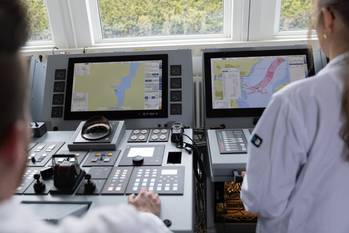

Addressing the New IMO Guidelines for Second Generation Intact Stability
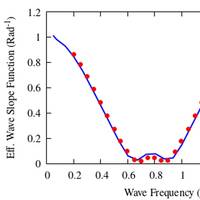
The common perception of intact stability has remained largely unchanged over the last few decades, where a vessel’s stability is evaluated using classical and static means: limits on righting arms, residual areas, and determining maximal VCG (or minimal GM) composite curves. These methods are familiar to most naval architects and are taught at a fundamental level in most naval architecture engineering programs.But repeated incidents of dynamic failure in recent decades brings question to the adequacy of classical static stability criteria to provide a complete understanding of…
Tech Talk: GHS Adds 'Seakeeping'
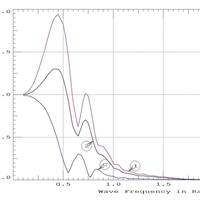
General HydroStatics is no longer just about hydrostatics, and will soon offer capabilities in the world of hydrodynamics with the introduction of a long awaited addition to the GHS product family: an optional seakeeping module. Adding a seakeeping module means run files may now include seakeeping capabilities by adding a couple new commands and existing geometry files (.GF) can be used for the seakeeping analysis with little or no modification. Integration with GHS also reduces required user input, getting answers faster while increasing user control.
SNAME Announces Pre-Meeting Training Courses
The Society of Naval Architects and Engineers (SNAME) has scheduled six pre-meeting training courses to run in the days immediately prior to the SNAME 2013 Annual Meeting and Expo, November 6-8 at the Hyatt Regency Bellevue in Bellevue, Washington. Early registration discounts of up to $200 are available until October 14. This opportunity is offered to companies who regularly provide training courses to Naval Architects, Marine and Ocean Engineers. Don't miss this one-day training course for active users of NavCad, HydroComp’s software for ship resistance and propulsion. The focus of the course will be to introduce and review "best practices" for experienced and novice users of NavCad. For more information, contact HydroComp, Inc.
Creative Systems Offers GHS Training
Creative Systems, Inc., developers of GHS, has several training classes scheduled for the remainder of 2011. This training provides the naval architect the knowledge and confidence to make use of the flexibility of power that are available in this software package. The Canadian Coast Guard will be hosting general GHS class, including model building and stability calculations. London Offshore Consultants will be hosting intermediate GHS class, dealing with salvage operations. Nick Danese Applied Research will be hosting an advanced GHS class in Probabilistic Damage. Class sizes are limited, so please contact Creative Systems directly for a seat in any of these classes. Additional future classes can be arranged at your location or at the offices of Creative Systems in Port Townsend, WA, USA.
Fleet Operators Choose GLM
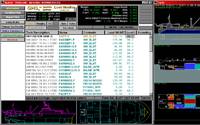
General HydroStatics (GHS) and its derivative, GHS Load Monitor (GLM), are both used by fleet operators. These software programs are designed to be configured by users to match their own reporting requirements while meeting the everyday needs of each vessel with minimal ongoing effort. Trident Seafoods uses GLM to manage its fleet and to aid the deck and engineering officers in load monitoring to prevent overloading and meet regulatory requirements. With this vertical business from fishing to processing…
Christian Joins Creative Systems

John W. Christian started his maritime career at Kings Point, USMMA, in the 1970s performing classwork on facility-sized mainframes, while Creative Systems was developing stability software on similar machines in Seattle. Since then John has accumulated wide-ranging experience in marine and computer technology while Creative Systems has become a leading supplier of marine software. Christian combines experience in merchant, naval, and offshore activities, both international and domestic, with business, computer, and training backgrounds.
Modeling Cranes on Barges with GHS
A new addition to GHS software, the Crane Module, helps naval architects charged with calculating the complicated effects of a crane's performance on barges. Although the Crane Module is useful for modeling any crane, it is especially powerful in modeling large cranes with multiple hooks mounted on a barge or ship. "Crane manufacturers give a limit to the amount of machine list allowed as the boom lifts and/or rotates," explained Ed Glowacki, owner of Glowacki Engineering, an engineering consulting firm in Florida specializing in naval architecture, "and these cranes are designed to operate on virtually level ground." Glowacki's consulting firm is often called upon to create a modified crane chart for cranes installed on ships and barges – surfaces that are anything but level.
CAD/CAM
Autoship Systems Corporation (ASC) has developed a complete CAD/CAM suite to meet the CAD/CAM needs in marine vessel design and construction, including two key programs in the CAD/CAM suite: Autostructure 3.0 and Production Manager 3.0. Autostructure and Production Manager are key components in the Autoship CAD/CAM suite, offering shipyards complete solutions in structural design, pre-construction drawing preparation and part nesting. Autostructure is used to create a 3D model of a vessel structure and to output the parts of that model in CAD format. The CAD representation can be used either to prepare construction drawings or for input to NC cutting processors.
Ship Stability Software Upgraded
Creative Systems, Inc., makers of GHS (General HydroStatics) ship stability software, has released version 8.0, a major update that incorporates many improvements, including a new on-sreen report preview. Shipments of the update to existing users with maintenance subscriptions are now complete. Others wishing to take advantage of these improvements, please contact Creative Systems directly. The company's onbard software, GHS Load Monitor (GLM) version 8.0, also has several new features which may be viewed at www.ghsport.com/glm.htm. Existing GLM installations wishing to update to the new version should contact their naval architects or Creative Systems. For more information e-mail [email protected] or visit www.ghsport.com/home.htm
Creative Systems Releases GHSCOM
from within common application programs such as Microsoft Office and AutoCAD. very little effort have a spreadsheet where cell values are calculated by GHS. COM technologies. programs. convention can link to GHS through the GHSCOM module. bodies or vessels containing liquids are dealt with in the application. and multiple-body interactions.
Creative Systems Upgrades GHS Software
General HydroStatics (GHS) software produced by Creative Systems is now available with an added feature - the ability to handle multiple floating bodies with points of contact between them. With ground contact handled simultaneously, applications include detailed simulation of loading and unloading of floating objects by partially submerging the carrier; complex salvage procedure modeling; ice breaker simulation and dry docking. Available through an optional software module labeled Multi-Body or MB, this capability is specifically integrated with GHS so that the regular features of the program can be used together.