Breakthrough Technology Unveiled at Oceanology International

Major industry announcements and new product launches continued to drive significant visitor numbers and plentiful business activity as Oceanology International 2026 (Oi26) surpassed expectations on the second day at Excel London.Among the companies taking center stage, expanding platform OceanSight used Oi to unveil its new collection of ocean technology brands built to advance marine sensing and subsea intelligence, celebrating an exciting new chapter focused on accelerating innovation and strategic growth.OceanSight…
Lockheed Martin Invests $50M in Saildrone to Advance USV Capabilities for US Navy

Saildrone Founder and CEO Richard Jenkins shares news on Lockheed Martin's recent investment in Saildrone:Today, I am delighted to announce a $50 million investment from Lockheed Martin in Saildrone, Inc. This commercial relationship marries the world’s most sophisticated and trusted defense technology with the world’s most capable and operationally proven USV technology. Together, we will rapidly equip Saildrone USVs with all-domain defense technology for lethal military applications.
Zeabuz Launches Dual-Use Autonomy Platform
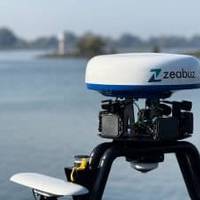
Zeabuz announced the launch of its defense and security autonomy platform, unveiled together with Damen Shipyards Group during the Damen Maritime Festival.As part of this launch, Zeabuz has integrated its autonomy system on the ZeaFalcon, a 7-meter Damen HDPE Uncrewed Surface Vessel optimized for defense and security applications. The system comprises a full suite of operational capabilities including autonomous navigation, collision avoidance, remote command and control, autodocking, and connectivity-denied operations.
NOC and Royal Navy Renew MOU on Underwater Systems

The UK's National Oceanography Centre (NOC) has renewed a memorandum of understanding (MOU) with the Royal Navy, reinforcing a long-standing partnership in marine science and technology. The MOU, which includes collaboration with the Defense Science and Technology Laboratory (Dstl), the Ministry of Defense (MOD)’s science and technology organization, underscores a shared commitment to fostering innovation and advances in autonomous and robotic underwater systems.With expertise from NOC Innovations…
First Marine Vehicle Classed Using ABS Autonomous Guide
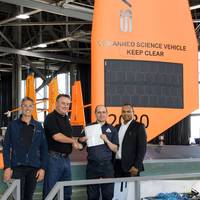
The Saildrone Voyager, a 10-meter commercial uncrewed surface vehicle (USV), is the first autonomous asset built to ABS Class using the ABS Requirements for Autonomous and Remote Control Functions. ABS presented the Class certificate to Saildrone at its headquarters in Alameda, Calif.The Voyager is a marine vehicle developed by Saildrone, a provider of ocean data for climate, mapping and maritime security applications using uncrewed autonomous assets. ABS issued approval in principle (AIP) to the Voyager earlier this year…
Wrangling Big Data Into Actionable Intel
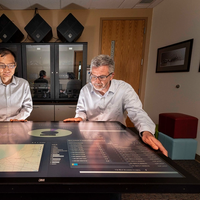
Social media, cameras, sensors and more generate huge amounts of data that can overwhelm analysts sifting through it all for meaningful, actionable information to provide decision-makers such as political leaders and field commanders responding to security threats.Sandia National Laboratories researchers are working to lessen that burden by developing the science to gather insights from data in nearly real time.“The amount of data produced by sensors and social media is booming — every day there’s about 2.5 quintillion (or 2.5 billion billion) bytes of data generated…
HENSOLDT Acquires Kelvin Hughes
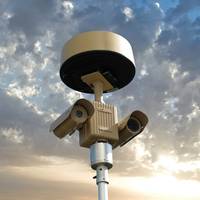
Kelvin Hughes has been acquired by HENSOLDT (formerly Airbus Defense Electronics) as a result of an agreement by its owners ECI Partners to sell its investment in the company. “Following the buyout from Smiths Group, ECI has been a consistent and supportive partner as we have consolidated our position as a global leader in surveillance and security radar solutions,” said Kelvin Hughes CEO, Russell Gould. Completion of the transaction remains subject to regulatory clearances. HENSOLDT, an independent sensor house, is a provider of radar and IFF systems on airborne, naval and land platforms.
70th Anniversary of First Type-approved Maritime Radar

Kelvin Hughes is celebrating 70 years of radar in 2017. In 1947 the first Type 1 radar was produced and installed on a new fishing trawler, the Type 1 then went on to be the first type approved radar, gaining its type approval certificate on August 11, 1948, the first radar to do so. Kelvin Hughes, a maritime navigation and security surveillance radar, has a history stretching back over 250 years. Over the course of that period, the company has been responsible for a number of significant technology ‘firsts’, including the first navigation radar for commercial ships to be type-approved.
Workboat Communications Evolve to Meet Myriad Missions
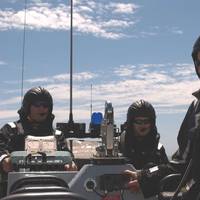
Choosing next generation communication systems for professional marine operations can be a daunting task. Not to worry: John Haynes provides a primer. Over the past decade we have come to expect fast, seamless global communications from a single device that fits in our pocket. The age of the smart phone and tablet enables multiple voices talking in a conference call and real time transfer of data, ranging from documents to photos and videos. In the modern bridge, most crew members have a GPS in their pocket which can identify where that person is on the planet.
Fast Craft and Innovative COTS Solutions
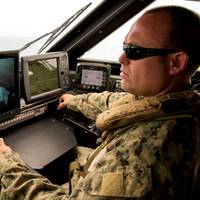
Many variables drive the design decisions for High Speed Craft and RHIBS. Commercial off the Shelf Solutions often tie all of these together. The world is changing fast and nowhere is this truer than in the fast boat sector. When selecting a new boat, the questions used to be relatively simple: how long, how many engines, what fuel type and how fast? Military and professional maritime organizations have been driving the evolution of extreme fast craft for over 30 years. Naval architects…
Satellite Radar

With the ocean moving more than 90% of world commerce, keeping it secure is of vital importance – yet our ability to monitor activity at sea is somewhat more challenging than on land given the vastness of the oceans. Also many maritime monitoring systems rely on ships to ‘opt-in’, that can leave potentially risky blind spots in our picture of maritime traffic. This article, derived from a presentation that David Beard of the Defence Science and Technology Laboratory gave at the recent DMC and NovaSAR International Conference…
Crowley Adds Vastly to its Fleet Cargo-Handling Equipment

Crowley Maritime Corporation’s liner services group is adding more than 3,000 pieces of cargo handling equipment to its diverse fleet. The additional resources will allow the company to better meet increasing customer demand throughout Puerto Rico, the Caribbean and Latin America service areas. The equipment includes 200 53-foot (102-inch wide) dry containers, 200 45-foot (102-inch wide) dry containers, 500 20-foot dry containers, 1,000 40-foot dry high-cube containers, 337 40-foot refrigerated high-cube containers…
TerraMar Networks Partners with Orbcomm
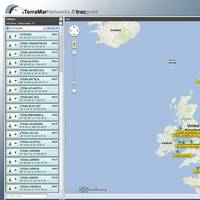
TerraMar Networks Limited has entered into an agreement with Orbcomm Inc. (Nasdaq: ORBC), a global satellite data communications company, to create one of the broadest and most complete maritime asset tracking offerings on the market. Orbcomm’s satellite AIS service receives a ship’s identification, position and other critical data. This data can be used to assist in vessel tracking, maritime navigation and safety. Its integration with TerraMar Networks’ proprietary fleet management portal…
Crowley Acquires 500 New 40' Containers
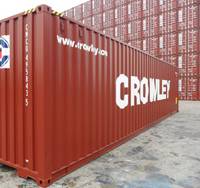
Brings Company Investment in New Equipment for 2011 to more than $23 Million. Crowley Maritime Corporation's liner services group is continuing to grow and update its equipment fleet to better serve customers with the addition of 500 new 40-foot, high-cube containers. The acquisition adds to the company's already robust equipment fleet of more than 45,000 units, as well as phases out some older containers. The new containers, which have a capacity of 2,700 cubic feet, will be used in all liner service operations in Latin America, the Caribbean and Puerto Rico.
Crowley Acquires 400 Additional 53' Containers

Increases Company Equipment Fleet to More than 45,000 Units. To better serve customers shipping cargo between the U.S. mainland and Puerto Rico, Crowley Maritime Corporation has acquired 400 53-foot (102' wide) dry high-cube containers and 375 53-foot chassis, adding to the company's already robust equipment fleet of more than 45,000 modern units. The containers, which have a capacity of 3,931 cubic feet and 42,660 pounds, were delivered in Jacksonville last week. "This significant acquisition is part of our continued commitment to the U.S.
Crowley Equipment Fleet Expansion to Add 500 New Containers in 2011

(JACKSONVILLE, Fla.; April 18, 2011) - Crowley Maritime Corporation's liner services group is adding 500 new containers to its already robust equipment fleet in order to better serve the growing needs of its customers in Puerto Rico, the Caribbean and throughout Central America. Once received, the company's equipment fleet will include over 46,000 pieces. This recent acquisition represents growth of nearly 4 percent in the company's fleet of 45-foot (102" wide) containers and nearly 5 percent of the 40-foot high-cube container fleet.
PortVision: A Helping Hand in the Deepwater Horizon Response
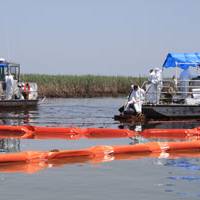
MarineNews spoke with Dean Rosenberg, CEO of PortVision, about the company’s role in the coordination of the Deepwater Horizon spill response in the Gulf of Mexico. PortVision is a web-based service that uses data from the Automated Identification System (AIS), mandated by the IMO and the U.S. Coast Guard, to provide shore-side users with real-time vessel tracking as well as historical reporting. “The main purpose for AIS, why it was mandated, is for collision avoidance,” Rosenberg said.
Paradox Marine Distributes Inferno Intenso
Boat security systems supplier Paradox Marine now offers acoustic technology to protect yachts, boats and marinas from intruders. Inferno Intenso Sound Barriers generate a patented, unbearable noise frequency pattern that immediately immobilizes onboard intruders between alarm activation and arrival of security or law enforcement. A single Inferno Intenso covers up to 750 square feet. Larger areas can be covered with several units. Inferno Intenso has passed the demanding testing procedures of the US Department of State for use in security applications. “Inferno Intenso will be available as a standalone deterrent or integrated into our comprehensive boat security…
OSI $1.3m Contract with Australian Navy
OSI Geospatial Inc. (TSX:OSI) announced that its International Systems Operations has signed a contract with the Australian Navy valued at approximately $1.3m. Under the terms of the contract, the company will provide a software upgrade and 12 months of software support. OSI Geospatial Inc. delivers advanced geospatial systems and software that enable shared real-time situational awareness for military and security applications. OSI products and services enable customers to integrate and visualize live data with any combination of sensor data, imagery, maps and charts. (www.osigeospatial.com)
Are you LRIT Compliant?
The International Maritime Organization (IMO) has adopted an amendment to Chapter V of the International Convention for the Safety of Life at Sea 1974 (SOLAS), which introduces new mandatory position reporting obligations for SOLAS ships. It's called Long Range Identification and Tracking (LRIT) and requires vessels to automatically transmit their identity, position with date/time at 6-hour intervals. • Mobile offshore drilling units. • Flag State: May track ships within its own fleet anywhere in the world. • Port State: May set its own requirements for ships that have indicated that they intend to call at its ports. • Coastal…
New Products: Marine Security Systems
The USCG's new Defender Class craft from Safe Boats will be powered exclusively by twin Honda BF225 4-stroke outboards. The Hondas can propel the new 25-ft. (7.6-m) Response Boat - Small, or RB-S as the Coast Guard refers to it through 30-mph winds and 6-ft. seas. The BF225s will provide a top speed of over 45 knots allowing the Safe Boat reaches plane in less than four seconds. Its marine-grade 5086 aluminum hull with integral, sealed air chamber and polyethylene, non-deflatable foam collar make the craft one of the safest boats on the water. The RB-S features an all-welded, self-bailing deck; insulated and heated full cabin; upper spotter windows; port and starboard sliding doors; marine electrical cable; stepped transom; and locking long gun storage.
WDT Awarded Contract for SCIB
Wave Dispersion Technologies (WDT) announced today it has received a contract from the United States Army Corps of Engineers (USACE) for the delivery of two WhisprWave® Small Craft Intrusion Barriers (SCIB) to be installed at Dams in separate Illinois’ lake locations. The SCIB is designed to demarcate the marine port and/or dam security zone and impede hostile small crafts from penetrating it. The SCIB's modular construction is engineered to allow its use as a platform to mount a multitude of security technologies including, warning signs, surface detection units, anti-intrusion instruments, fibre optic sensing systems, swimmer detection devices and capture nets both on the surface and underwater.
Security: Security of Ports and Vessels: A New Approach
Clearly, the maritime industry is one of the most powerful drivers of international commerce and economic vitality in the world. • The worldwide fleet of marine containers - a transportation cargo unit that can hold up to 500 computer monitors - is nearly 11 million. • The European Union, which is the main trading partner for two thirds of the world, in 2001 exported EUR 981 billion and imported EUR 1,027 billion. • The global ocean-liner shipping industry owns approximately $155 billion in vessels, containers, marine terminals and other direct operating assets now in service around the world. • Almost 16 million Americans work in port-related jobs, producing $210 billion in federal, state and local taxes annually.